















































































































































































































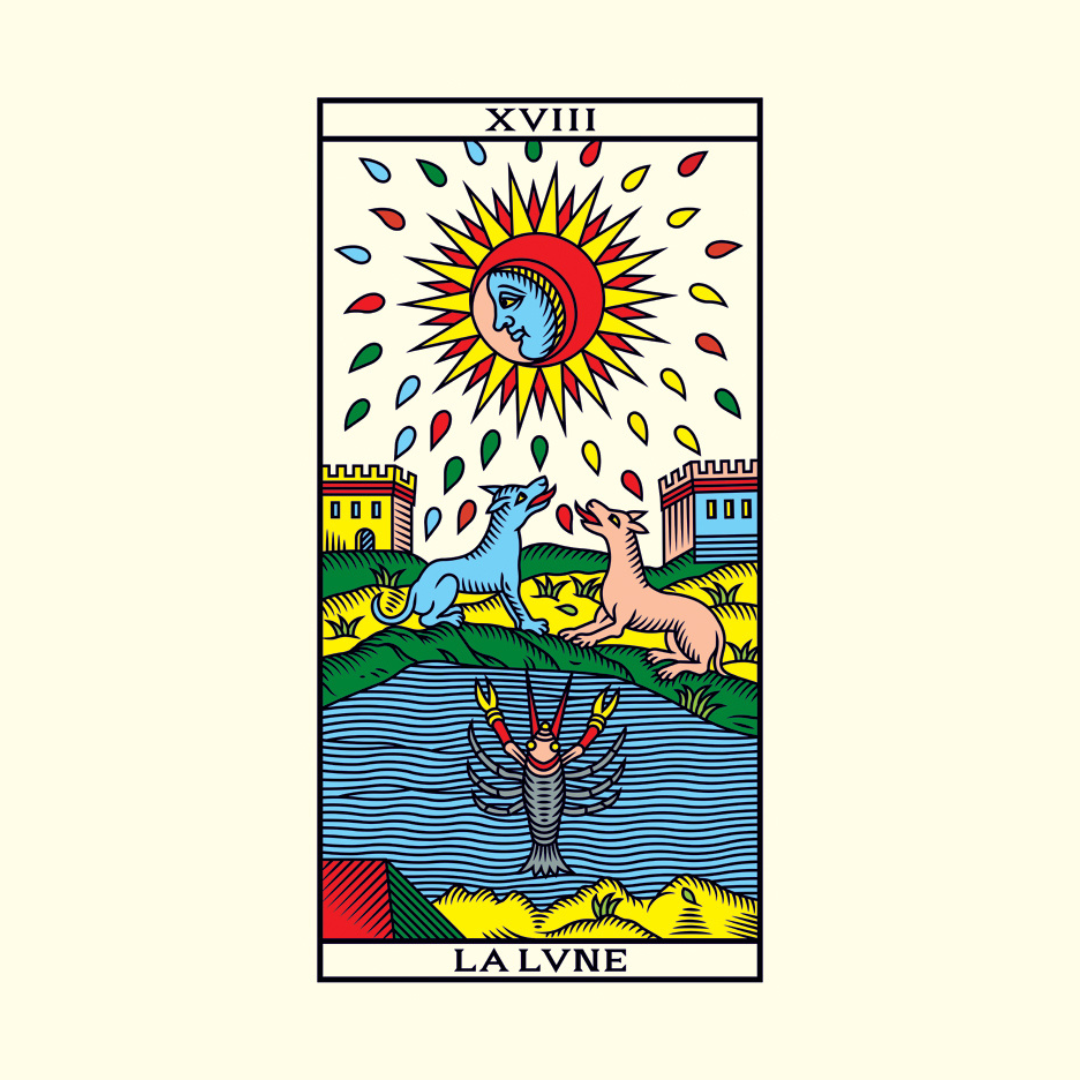

The Moon illuminates without providing the clarity of full daylight. Under its light, forms exist, but their outlines require confirmation. In a reading, the eighteenth card speaks of uncertainty, imagination, fear, detours, or incomplete information. It proves neither a lie nor a hidden threat: it asks us to distinguish between what is seen, what is assumed, and what remains to be verified.
This caution also stems from the history of the image. The Visconti-Sforza Moon shows a clothed woman holding a crescent moon. The Tarot de Marseille establishes a nocturnal landscape with two towers, two animals, and a crustacean emerging from the water. The Waite-Smith reproduces this composition, then extends it into a path toward the mountains. These cards bear the same number, but they do not depict exactly the same scene.
The Moon in Early Tarot Decks
In the 15th-century Visconti-Sforza card, a standing woman holds a crescent moon against a gold background. She is clothed, isolated, and not standing beside a pool. No dog, wolf, crustacean, path, or pair of towers appears. This image is enough to remind us that the now-familiar landscape does not belong to all the earliest Italian series. Reproduction of the Visconti-Sforza Moon.
The celestial cards of early tarot decks did not yet constitute a codified psychological method. They took their place among the game's moral, social, religious, and cosmic figures. The moon's borrowed light, the cycles of the sky, and the succession of night and day could be understood by players without a manual imposing a fixed divinatory meaning.
Iconographic reference. The two towers, the facing animals, and the crustacean belong to the French composition established later. They should not be retrospectively added to the crescent moon woman of the Visconti-Sforza.
From the Crescent Moon to the Night Landscape
In the Tarot de Marseille, a celestial body with a human face dominates the card. Colored drops seem to rise or fall depending on the design and its orientation. Two structures frame the distance. In the foreground, two animals raise their heads, while a crustacean emerges from a body of water. The scene brings several thresholds into relation: water and land, familiar animal and wild beast, enclosed space and horizon, visible light and obscure zone.
The Waite-Smith retains the towers, the dog, the wolf, and the creature emerging from the water. Pamela Colman Smith adds a winding path that crosses the landscape toward distant heights. Waite describes reflected light and a passage into the unknown. His commentary belongs to his 1911 system; it illuminates his own deck, not the certain intention of card makers from the 15th or 17th century.
The Golden Dawn connects the Moon with Qoph, Pisces, and Water. Papus and Wirth follow a different sequence and place the letter Tsade alongside trump XVIII. These two occult frameworks postdate the Tarot de Marseille. They can serve as interpretive frameworks if the school is stated, but they should not be combined as if they were original data.
What the ancient authors attributed to it
Mathers assigns the Moon twilight, deception, and error. Reversed, it indicates fluctuation, minor deceptions, or mistakes of limited consequence. Waite heightens the alarm with danger, slander, darkness, and hidden forces. His reversed card reduces the scale of the deception and adds instability, inconstancy, and silence.
These lists belong to cartomancy from the late 19th and early 20th centuries. In a current consultation, taking them literally would turn every hesitation into a hidden enemy. A responsible reading instead treats the Moon as a signal of reduced visibility: slow down, ask for evidence, name the fear, and avoid drawing conclusions before obtaining the missing information.
Meaning in a spread
In a favorable reading
The Moon favors patient observation, the work of the imagination, the creation of images, listening to a discomfort that is still difficult to articulate, and examining what escapes the first glance. It suits situations in which one moves forward with little light, marking out each step and accepting the need to revise one’s interpretation.
It can also describe a period of gestation, a story in the process of being written, or an emotion that needs language. The card does not permit confusing intuition with certainty. It invites you to note the impression, look for what supports it, then compare that impression with the facts and the words of the people concerned.
In an unfavorable reading
The card signals rumor, fear that grows in the shadows, distorted information, a burdensome secret, avoidance of a question, or inability to choose due to a lack of data. It can also show an imagination that creates a scenario and takes it for proof. The answer is then to reduce uncertainty through precise questions.
Love, work and finances
| Area | Favorable reading | Shadow aspect | Question to ask |
|---|---|---|---|
| Love | Sensitivity, desire to be named, relationship moving forward tactfully. | Unspoken issues, jealousy, projection, fear mistaken for proof. | What was said clearly, and what did I assume? |
| Work | Creation, investigation, discreet preparation, adaptation to a changing context. | Unclear instruction, rumor, misreading, withheld information. | What fact is missing before deciding? |
| Finances | Cautious review, examination of unclear line items, waiting before committing. | Hidden costs, opaque promise, fear of looking at the accounts. | Which figures and conditions can I control? |
| Project | Exploration phase, search for an atmosphere, scenario tested on a small scale. | Indistinct objective, undocumented changes, schedule drift. | What milestone will make the progress visible? |
How to read its combinations
The Moon reduces visibility and amplifies what has not yet been named. The neighboring card indicates whether the uncertainty comes from withheld knowledge, an emotional choice, fear, manipulation, or a stage preceding clarity.
| Combination | Possible dynamic | Point of vigilance |
|---|---|---|
| Moon + High Priestess | Information kept private, silent study, subtle perception of a context. | Ask when the knowledge can be shared. |
| Moon + Lovers | Ambivalent feelings, choice influenced by desire or fear. | Separate attraction from real commitments. |
| Moon + Justice | Document to be checked, account compared against a rule, clarification needed. | Rely on documents and dated facts. |
| Moon + Hermit | Slow search, a path traveled with few reference points. | Set a date to reassess the situation. |
| Moon + Devil | Exploited fear, hidden desire, dependency maintained through opacity. | Name the interests and power dynamics. |
| Moon + Star | Direction is present but the result is still distant, creation in the making. | Give hope observable milestones. |
| Moon + Sun | Passage from doubt to clarity, information made public. | Accept that the light corrects the first account. |
Correspondences according to the schools
| Reference point | Attribution | Historical scope |
|---|---|---|
| Family | Trump or major arcana XVIII | Second of the three great lights in the order Star, Moon, Sun. |
| Ancient figure | Clothed woman holding a crescent | Image from the 15th-century Visconti-Sforza. |
| Tarot de Marseille | Moon, drops, two towers, two animals, water, and crustacean | Landscape absent from the Visconti-Sforza card. |
| French occultism | Tsade; darkness, the trial of visibility | Attribution from the Papus-Wirth succession. |
| Golden Dawn | Qoph and Pisces | Distinct system from the French sequence Tsade-Moon. |
| Waite-Smith | Path between the towers toward the mountains | Development published in 1911. |
| Element | Water in the Golden Dawn framework | Occult attribution, not medieval. |
| Stone, plant, and season | No attribution shared by the older schools | Contemporary lists vary according to their authors. |
| Reading keywords | Uncertainty, imagination, detour, perception, waiting, verification | The card asks you to work with reduced visibility. |
| Shadow aspect | Rumor, fear, deception, confusion, projection, concealment | An impression does not become proof simply because it is strong. |
Choose a tarot deck for working with this card
To find this arcana in a complete deck, compare the Tarot de Marseille, the Rider-Waite-Smith, and all our divination tarot decks. If you are a beginner, also see How to choose your first tarot deck?.
Reference sources and texts
Wikimedia Commons, reproduction of The Moon from the Visconti-Sforza ; Accademia Carrara, Tarocchi. Le origini, le carte, la fortuna, 2026 ; The Metropolitan Museum of Art, Before Fortune-Telling: The History and Structure of Tarot Cards ; S. L. MacGregor Mathers, The Tarot, 1888 ; Papus, The Tarot of the Bohemians, 1889 ; Oswald Wirth, The Tarot of the Medieval Image-Makers, 1927 ; Arthur Edward Waite, The Pictorial Key to the Tarot, 1911, card XVIII ; Arthur Edward Waite, divinatory meanings of the major arcana.










