
The Devil shows what binds because it attracts, pays, excites, or grants power. Its presence proves neither a curse nor demonic intervention. It stages a bond whose price becomes visible: desire, dependence, an unfavorable contract, fascination, money, sexuality, or authority exercised without restraint.
The fifteenth card has not preserved an intact model from the earliest tarot decks. The Devil is missing from the Visconti-Sforza deck, now divided between New York and Bergamo. The Tarot de Marseille provides a later image: a hybrid, winged creature stands on a base, with two figures bound at its feet. The Waite-Smith further transforms this demon under the influence of the Baphomet figure drawn by Éliphas Lévi in the 19th century.
An image missing from the surviving Milanese tarots
The 15th-century Visconti-Sforza deck contains seventy-four surviving cards out of the seventy-eight expected. The four missing cards include the Devil and the Tower. This absence does not allow us to conclude that they never existed, but it does prevent a modern reconstruction from being presented as an original card. The Accademia Carrara and the Morgan Library currently document the surviving parts of the deck.
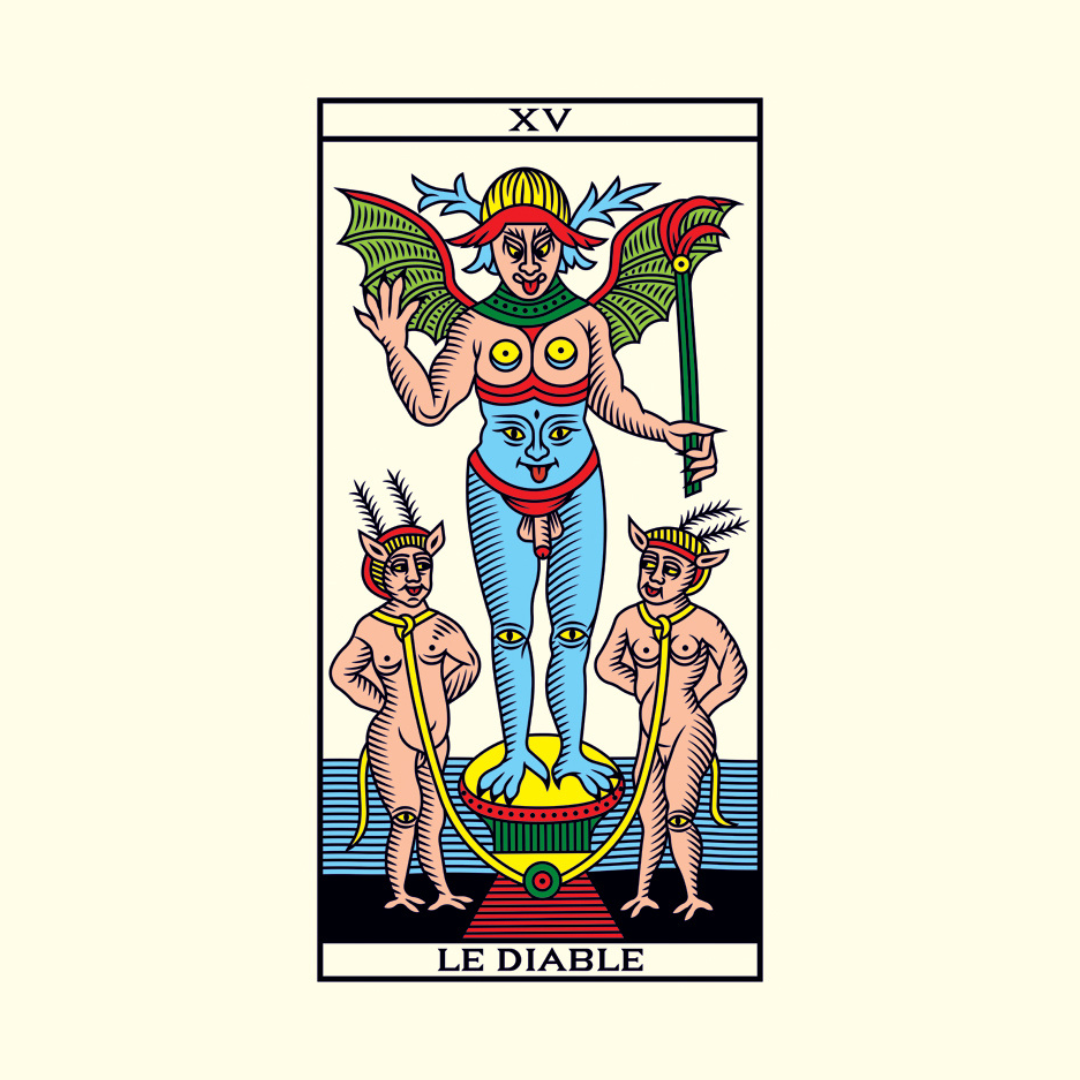
In the Tarot de Marseille, the Devil is a composite figure. Horns, wings, claws, and human features come together in a body that refuses a stable identity. Two smaller beings stand at its feet, connected to the base by ropes or collars. Their position reveals the card’s central theme: attachment to a power that fascinates as much as it constrains.
Iconographic reference. Details vary from one engraver to another: the character’s sex, additional faces, the shape of the limbs, and the emblem held in the hand. It is better to observe the card actually drawn than to impose a general anatomy on it.
From the Marseille demon to the occultist Baphomet
Mathers describes a horned, winged demon with claws, holding a flaming scepter. Two small demons remain attached to the altar. He associates the image with favorable or unfavorable fatality. Papus and Wirth place the fifteenth card under the letter Samekh in their French sequence.
After 1856, the figure drawn by Éliphas Lévi in Dogme et rituel de la haute magie permanently altered the iconography of the Devil. The Waite–Smith deck adopts a goat's head, bat wings, an inverted pentagram, a hand making the opposite gesture to the Hierophant's, and a torch pointed toward the ground. Two human figures, with tails, wear chains broad enough to suggest a captivity maintained as much as imposed.
This connection with Lévi's Baphomet therefore belongs to modern occultism. It proves no direct continuity with the Templars and does not turn the card into a portrait of a specific entity. In the Golden Dawn system, the Devil is assigned the letter Ayin and Capricorn, whereas the Papus–Wirth tradition retains Samekh.
What the early authors attributed to it
Mathers summarizes the card as favorable fatality, then as unfavorable fatality when reversed. This formula expresses a constraint whose value depends on the situation: a powerful commitment can support an ambition or trap a person in an outcome they no longer control.
Waite assigns the Devil ruin, violence, vehemence, excessive efforts, strength, and fatality. Reversed, his list speaks of weakness, blindness, and harmful fatality. Yet his visual commentary emphasizes the chain: domination remains bound to desire, ignorance of the way out, or the benefit each person still derives from the bond.
Meaning in a reading
In a favorable reading
The Devil can indicate strong ambition, an openly acknowledged desire, negotiating power, sexual attraction, or an ability to look at material interests without false modesty. It suits questions in which money, influence, pleasure, and competition must be named clearly.
Its power becomes fruitful when the querent understands the cost, the limit, and the possibility of escape. A profitable contract, a passionate relationship, or a demanding goal does not become condemnable merely because the card appears. The reading must show whether the commitment remains consensual and manageable.
In an unfavorable reading
The card indicates coercive control, manipulation, dependence, debt, blackmail, or desire that erases boundaries. It also shows the power a person refuses to acknowledge within themselves. The question is therefore not about fighting an invisible force, but about identifying the concrete mechanism: a benefit received, fear of loss, a contract, a habit, or a person who keeps the chain in place.
Love, work, and finances
| Area | Favorable reading | Shadow aspect | Question to ask |
|---|---|---|---|
| Love | Intense attraction, openly expressed desire, consensual sexuality between adults. | Jealousy, coercive control, blackmail, a relationship maintained by fear. | Does consent remain free, clear, and revocable? |
| Work | Ambition, firm negotiation, persuasive power, recognized material interest. | Harassment, manipulation, destructive competition, hierarchical dependence. | What advantage keeps this power dynamic in place? |
| Finances | Business acumen, ability to create value from a resource, pursuit of profit. | Debt, burdensome credit, speculation, compulsive spending. | What is the total cost, and how can you exit the commitment? |
| Project | Powerful motivation, commercial strategy, will to conquer. | An objective turned into an obsession, means contrary to the limits set. | Is the result still worth the price paid? |
How to read its associations
The Devil brings desire, attachment, material interest, and power. The neighboring card clarifies the object of fascination, the form of constraint, or the means of regaining some freedom of choice.
| Association | Possible dynamic | Point of vigilance |
|---|---|---|
| Devil + Magician | Charisma, cunning, a beginning motivated by gain or desire. | Verify the means used and the promises made. |
| Devil + Lovers | Powerful attraction, choice influenced by pleasure or dependence. | Do not confuse intensity with freedom. |
| Devil + Justice | Binding contract, debt, power dynamic governed by a rule. | Read the clauses and seek competent advice. |
| Devil + Strength | Controlled desire or a direct struggle for control. | Consent can never be inferred from silence. |
| Devil + Temperance | Negotiation, reduction of an excess, pursuit of controlled consumption. | A simple dosage is not enough in the face of severe addiction. |
| Devil + Tower | Broken coercive control, scandal, sudden loss of an advantage. | Prepare safety before confrontation. |
| Devil + Star | Desire brought to light, generosity mixed with self-interest, overt seduction. | Clarify what is given and what is expected. |
Correspondences according to the schools
| Reference point | Attribution | Historical scope |
|---|---|---|
| Family | Trump or Major Arcana XV | The card belongs to the tarot series, but the oldest Milanese specimens are lost. |
| Visconti-Sforza | Missing card | No modern reconstruction can be considered the original from the 15th century. |
| Tarot de Marseille | Hybrid figure on a pedestal and two bound beings | Image of attachment, power, and constraint. |
| French occultism | Samekh; fate and power | Attribution in the Papus-Wirth system. |
| Golden Dawn | Ayin and Capricorn | Distinct system from the French-suited Samekh–Devil. |
| Waite-Smith | Winged goat, inverted pentagram, torch, and two chained humans | Composition marked by Éliphas Lévi's Baphomet. |
| Element | Earth in the Golden Dawn grid | Indirect attribution through Capricorn. |
| Stone, plant, and season | No attribution shared by the ancient schools | Contemporary lists vary according to their authors. |
| Reading terms | Desire, power, attachment, money, fascination, constraint | The apparent benefit may reinforce the chain. |
| Shadow aspect | Coercive control, manipulation, debt, dependence, violence, blindness | Naming the concrete mechanism precedes any resumption of choice. |
Reference sources and texts
Accademia Carrara, Tarot Cards. The Origins, the Cards, Fortune, 2026 ; Morgan Library, Visconti-Sforza Tarot Cards ; The Metropolitan Museum of Art, Before Fortune-Telling: The History and Structure of Tarot Cards ; S. L. MacGregor Mathers, The Tarot, 1888 ; Papus, The Tarot of the Bohemians, 1889 ; Oswald Wirth, The Tarot of the Medieval Imagiers, 1927 ; Arthur Edward Waite, The Pictorial Key to the Tarot, 1911.