















































































































































































































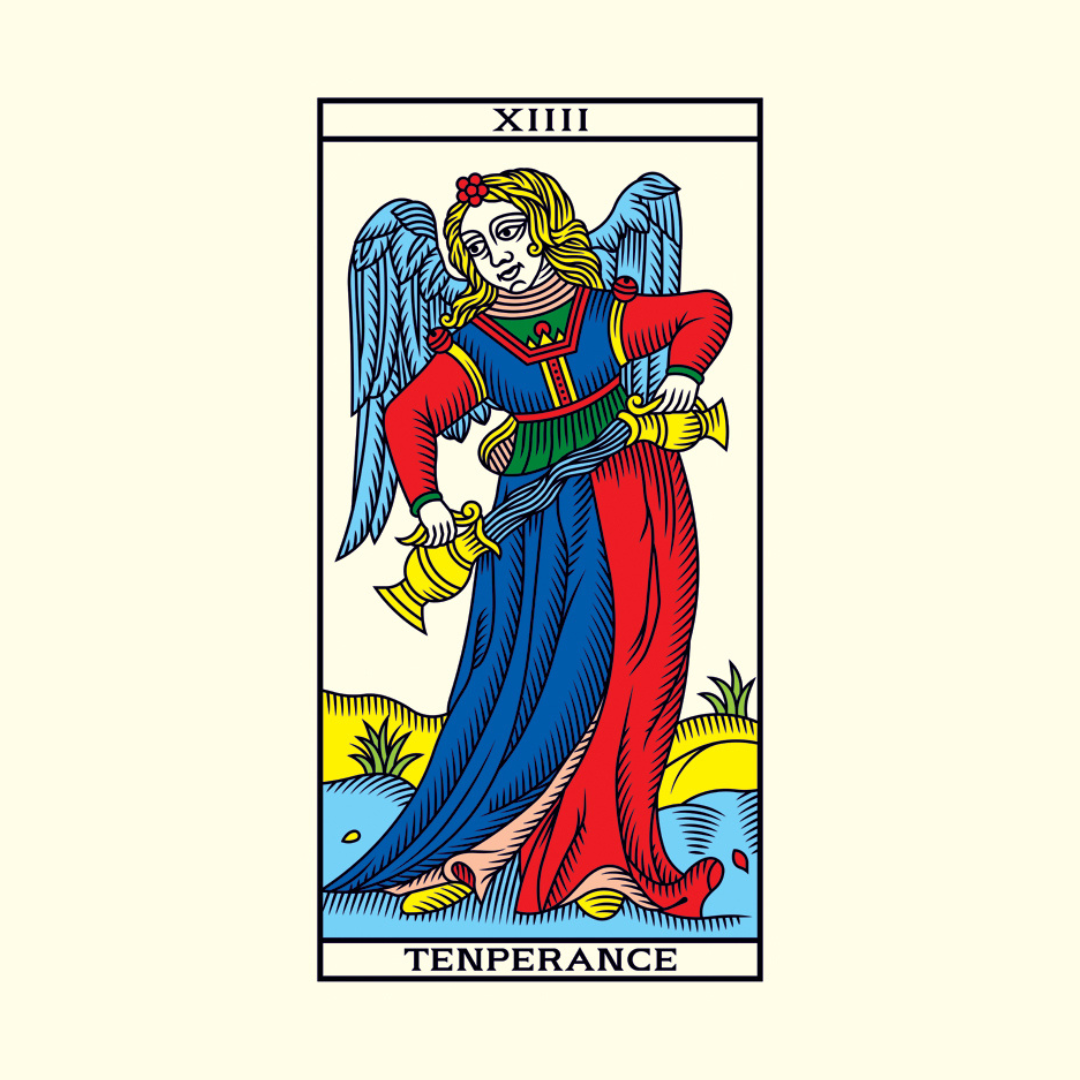

Temperance passes a liquid from one vessel to another without losing its thread. Her art consists neither in holding everything back nor in pouring everything out, but in finding the proportion that allows the two vessels to communicate. In a reading, the fourteenth card speaks of adjustment, circulation, measure, and harmony between elements that no longer worked together.
This image belongs first and foremost to the cycle of virtues. The Visconti-Sforza tarot shows a woman holding two jugs in a landscape. The Tarot de Marseille gives her wings and makes the stream between the vessels visible. The Waite-Smith adds one foot in the water, another on the earth, a path, a crowned light, and a geometric emblem on the chest. Each stage enriches the scene, but the astrological correspondence with Sagittarius belongs to the Golden Dawn system, not to the cards of the 15th century.
The virtue of Temperance in the earliest tarot decks
The Visconti-Sforza card held by the Morgan Library dates from the 15th century. A woman personifying Temperance holds a jug in each hand in the middle of a landscape. The gesture refers to the virtue of moderation: water and wine could be mixed to temper the drink. The image shows neither a zodiac sign nor an initiatory journey yet. Morgan Library, Visconti-Sforza Tarot, Temperance.
In the Tarot de Marseille, the figure becomes winged. She tilts two vessels connected by a clear stream. The fluid appears to flow in a position that gravity makes uncertain. This visual strangeness allows the card to be read as a continuous exchange: giving and receiving, correcting a proportion, bringing two rhythms closer, or passing information along without breaking the connection.
Iconographic marker. Temperance is not immobility. Her hands, her vessels, and the liquid are all in motion. The measure she teaches remains alive: it adjusts a situation instead of freezing it into a rule.
From measured mixing to Waite’s angel
Mathers describes an angel bearing a solar sign on the forehead and pouring a liquid from one vessel into another. He summarizes the card with the word combination. Papus and Wirth place the fourteenth card under the letter Nun in their French sequence. This classification belongs to their occultist constructions and is not a feature of the earliest Italian decks.
The Waite-Smith retains the angel and the two cups. The figure places one foot on the earth and the other in the water. A triangle inscribed in a square appears on her chest, while a path leads toward a light in which a crown takes shape. Waite presents the pouring as a harmonization of material and psychic natures.
The Golden Dawn nevertheless attributes the letter Samekh and Sagittarius to Temperance. The French sequence Nun–Temperance and the Golden Dawn sequence Samekh–Temperance therefore belong to two distinct systems. The reader may use either one, provided they name their system and do not present these correspondences as the origin of the image.
What the early authors attributed to it
Mathers associates Temperance with combination, conformity, and union. Reversed, it indicates a poorly conceived association, disunion, or a conflict of interests. His reading focuses less on abstinence than on the quality of the mixture: two elements may complement or neutralize each other.
Waite emphasizes economy, moderation, frugality, management, and accommodation. Reversed, his list evokes disunion, unfortunate combinations, and competing interests, to which he adds religious or ecclesiastical matters. These meanings show a card of practical adjustment: allocation of resources, negotiation, and the search for a viable balance.
Meaning in a reading
In a favorable reading
Temperance indicates an agreement in progress, gradual healing, mediation, a transition carried out without rupture, or a rhythm becoming sustainable again. It favors approaches requiring several attempts, a regular flow of information, and the coordination of people with different habits.
The card works through small adjustments. It does not promise that a conflict will disappear on its own. It advises changing the quantity, schedule, or method of transmission until a fairer way of working is achieved. Its success is recognized by the return of continuity, not by a spectacular effect.
In an unfavorable reading
The card may signal poor balance, dispersion, forced conciliation, or an adaptation that always requires the same person to make the sacrifice. It also shows interrupted flow: incomplete messages, poorly distributed resources, incompatible deadlines, or agreements whose terms were never clearly established.
Love, work, and finances
| Area | Favorable reading | Shadow side | Question to ask |
|---|---|---|---|
| Love | Dialogue resumed, mutual compromise, a relationship finding its rhythm. | One person effacing themselves, a superficial agreement, incompatible needs. | What does each person really give and receive? |
| Work | Cooperation, mediation, smoother division of tasks. | Contradictory instructions, slow coordination, unproductive compromise. | What precise adjustment would improve the way things work? |
| Finances | Balanced budget, spreading things out, regular management of inflows and outflows. | Small repeated leaks, mixed resources, poorly allocated effort. | What proportion needs to be corrected right now? |
| Project | Successful assembly, gradual transition, method improved through trial and error. | Incompatible components, an overly fragmented schedule. | Which elements can actually work together? |
How to read its combinations
Temperance brings moderation, exchange, adjustment, and transition. The neighboring card indicates what needs to be brought closer, the quality of the circulation, or the outcome of the compromise.
| Combination | Possible dynamic | Point of caution |
|---|---|---|
| Temperance + Lovers | Agreement built through dialogue, negotiated choice among several interests. | The compromise must not conceal the absence of a decision. |
| Temperance + Justice | Balanced arrangement, formalization, or supervised mediation. | Put commitments and deadlines in writing. |
| Temperance + Hermit | Slow repair, discreet exchange, deliberately reduced pace. | Do not let the delay become abandonment. |
| Temperance + Death | Transition after an ending, gradual reorganization of what follows. | Do not try to rebuild what has been severed. |
| Temperance + Devil | Negotiation with a powerful desire, difficult balancing of a pleasure or interest. | Identify dependency and the power dynamic. |
| Temperance + Tower | Repair after a rupture or adjustment made urgent by a crisis. | Secure things before seeking harmony. |
| Temperance + Star | Calm, restored trust, generous circulation of resources. | Maintain clear boundaries when giving. |
Correspondences according to the schools
| Reference point | Attribution | Historical significance |
|---|---|---|
| Family | Trump or Major Arcana XIV | Virtue present in 15th-century Italian tarot decks. |
| Ancient figure | Woman holding two pitchers | Personification of Temperance in the Visconti-Sforza. |
| Tarot of Marseille | Winged figure and current flowing between two vessels | Image of moderation, exchange, and circulation. |
| French occultism | Nun; combination and transformation | Attribution of the Papus-Wirth sequence. |
| Golden Dawn | Samekh and Sagittarius | Distinct system from the French-suited Nun–Temperance sequence. |
| Waite-Smith | Angel, two cups, earth, water, path, and crown | Composition developed within the Golden Dawn framework. |
| Element | Fire in the Golden Dawn system | Indirect attribution through Sagittarius. |
| Stone, plant, and season | No attribution shared by the ancient schools | Contemporary lists vary according to their authors. |
| Reading keywords | Moderation, exchange, agreement, circulation, balance, transition | Balance results from continuous adjustment. |
| Shadow side | Poor balance, scattering, forced compromise, broken exchange | An agreement ceases to be fair when the effort remains one-sided. |
Sources and reference texts
Morgan Library, Visconti-Sforza Tarot, Temperance ; The Metropolitan Museum of Art, Before Fortune-Telling: The History and Structure of Tarot Cards ; S. L. MacGregor Mathers, The Tarot, 1888 ; Papus, The Tarot of the Bohemians, 1889 ; Oswald Wirth, The Tarot of the Medieval Image Makers, 1927 ; Arthur Edward Waite, The Pictorial Key to the Tarot, 1911.










