





























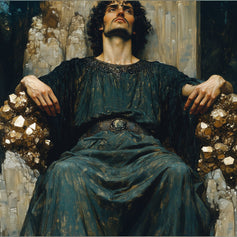





















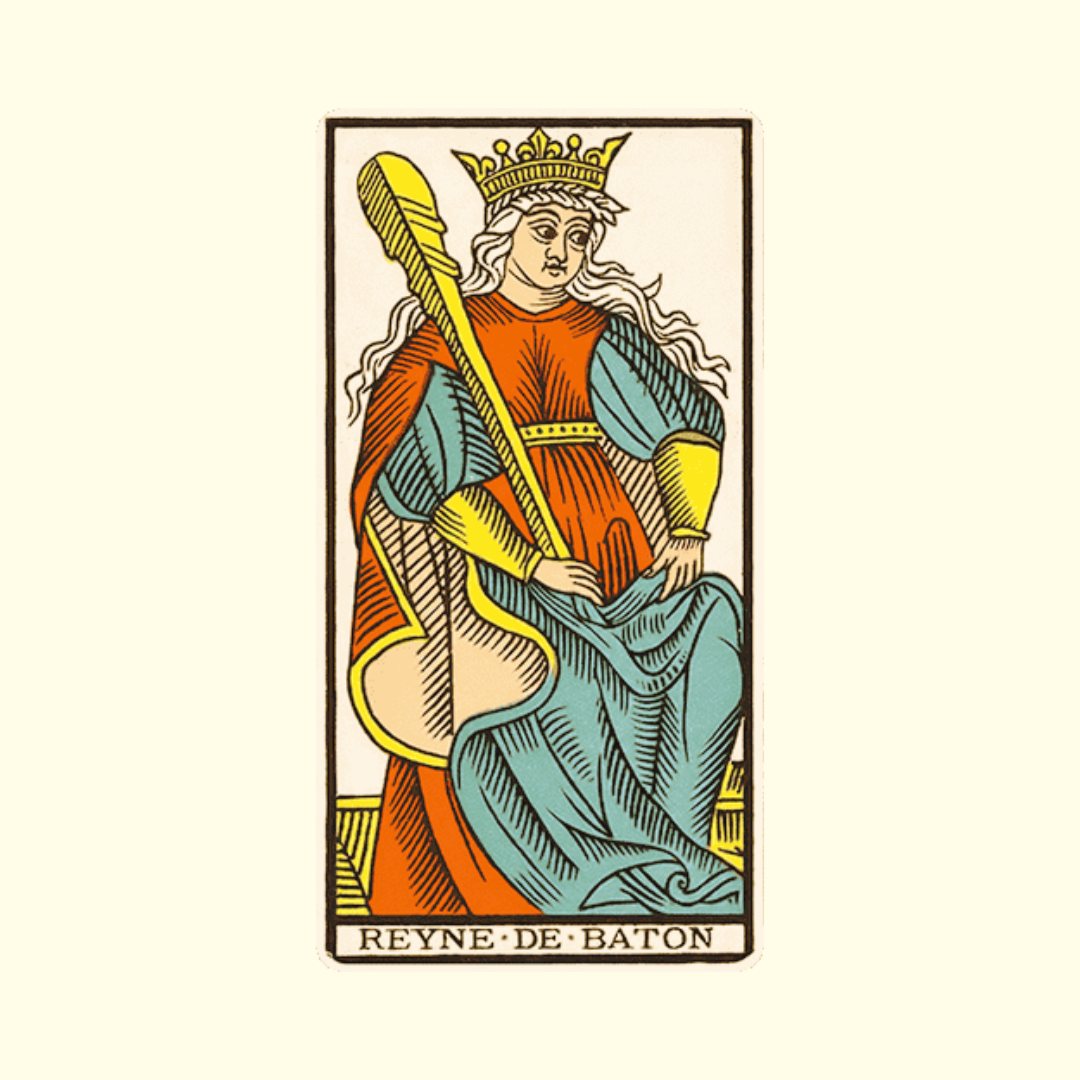

The Queen of Wands does not brandish Fire: she gives it a lasting form. In the Tarot de Marseille, she holds an imposing wand close to her crowned body. In the Waite-Smith, she sits with a flowering wand, a sunflower, and a black cat at her feet. The card speaks of living authority, attraction, confidence, and a talent for helping an enterprise grow - with the risk that relational strength may become control, jealousy, or domination.
The Queen may represent a person, a role, or a way of acting. She implies neither a particular gender nor age nor family situation. In a reading, she may designate the person who brings people together, leads without coldness, keeps energy flowing, and wins support through her presence as much as through her decisions.
The sources give her a very concrete dimension. Mathers speaks of a lady of the estate, money, thrift, and resistance. The Golden Dawn calls her the “Queen of the Thrones of Flame,” Water of Fire, and describes a stable force capable of commanding while remaining well-liked. Waite adds friendship, love, honor, and success in business. The Queen of Wands therefore rules over activity as much as over the bond that allows that activity to endure.
From the Marseille sovereign to the sunflower queen
In a Tarot de Marseille, the Queen is crowned and carries the wand of her suit. Depending on the workshop, it may appear heavy, almost architectural. The posture, clothing, and angle of the emblem vary, but no sunflower or black cat accompanies her. The card presents a court rank before it portrays a character.
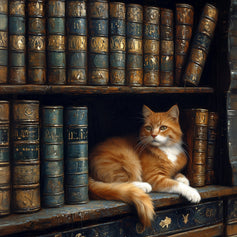
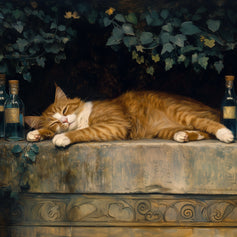
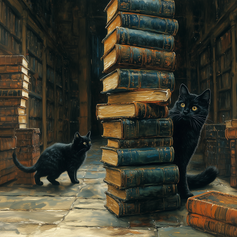
Smith places the Queen on a throne decorated with lions. She holds a leafy wand in one hand and a sunflower in the other. A black cat sits in front of her; hills appear in the distance. Waite emphasizes the life and animation of the color, whose wands remain leafy. He brings the Queen's personality close to that of the King, while describing her as more magnetic.
Iconographic reference. The sunflower, black cat, lions, and arid landscape belong to the Waite-Smith. The Marseille shows a sovereign and her emblem without these symbols. The cat can enrich a reading of the English deck; it does not prove an ancient association between all Queens of Wands and witchcraft.
Divinatory transmission
In The Tarot, published in 1888, Mathers attributes to the Queen of Wands the country woman, the lady of the estate, love of money, greed, and usury. Reversed, she becomes a good and virtuous woman, but strict and thrifty, then an obstacle, resistance, and opposition. The contrast does not simply separate a good Queen from a bad one: it places management, possession, and power struggles in tension.
Book T calls her the “Queen of the Thrones of Flame” and assigns her the Water of Fire. The text describes a crowned queen seated above regular flames and bearing leopard emblems. It attributes adaptability, steady strength applied to a purpose, power of attraction, and appreciated command to her. When she receives an unfavorable entourage, the same constancy becomes obstinacy, vengeance, domination, or tyranny.
Waite retains the country woman and her interest in money, then adds friendship, love, honor, and commercial success. For the reversed card, he cites economy, helpfulness, and a willingness to assist; only in certain positions does he mention opposition, jealousy, deceit, and infidelity. This reservation matters: the Queen should not automatically become a jealous rival.
Meaning in a spread
In a favorable reading
The Queen of Wands indicates a presence capable of mobilizing others without smothering them. Someone knows their worth, welcomes others, defends their project, and transforms enthusiasm into continuity. They can lead a team, develop an activity, welcome an audience, or run a household with a blend of warmth and authority.
The card also favors confident visibility. Speaking up, presenting a creation, setting a price, or taking a decision-making role does not require an apology. The Queen attracts because her energy has a center: she knows what she protects, what she offers, and what she refuses.
In a tension reading
The power of attraction becomes a means of control. The person expects loyalty and admiration, experiences any autonomy as opposition, or offers generosity on the condition of remaining at the center. The card may then show jealousy, rivalry, domination through charm, possessive management, or anger toward anyone who no longer follows.
The tension can also turn against the querent: fear of being visible, worth dependent on others' opinions, an activity kept under sole control, or difficulty accepting criticism. The useful question then becomes: does my influence leave others a genuine place, and can my project continue without depending entirely on my presence?
Love, work, and finances
The Queen connects influence, management, and continuity. The area being explored shows what she makes grow and how she exercises her authority.
| Area | Favorable interpretation | Tension aspect | Question to ask |
|---|---|---|---|
| Love | A warm relationship, openly expressed desire, a loyal partner who supports without fading into the background. | Jealousy, control through seduction, a need to be constantly chosen or admired. | Does each person's influence leave the other their freedom? |
| Work | Appreciated leadership, entrepreneurship, a strong network, a project confidently brought into the spotlight. | Centralization, rivalry, difficulty delegating, or authority based on personal affinities. | Can the team act without waiting for every decision from the same person? |
| Finances | Active management, commercial acumen, confident pricing, resources deployed for development. | Possessiveness, image-related spending, money used to maintain dependence. | Does the decision serve the project or the need to retain control? |
| Creation | Assertive style, work presented to the public, ability to nurture a coherent universe. | Search for attention, comparison, refusal to let the project evolve beyond oneself. | What part of the work should be protected and what part can be shared? |
| Collective life | Generous host, leader who brings people together, trusted person in a group. | Clan, favoritism, opposition treated as personal disloyalty. | Do the rules remain the same for everyone? |
Read the associations
The Queen brings attraction, maturity, and relational power. The neighboring card shows what she directs, who receives her support, and the limit of her influence.
| Association | Possible dynamic | Point of vigilance |
|---|---|---|
| Queen of Wands + King of Wands | Two authorities of the same suit build a shared direction or divide a domain between them. | Clarify roles to avoid competition at the top. |
| Queen of Wands + Three of Pentacles | Warm leadership supported by complementary skills. | Recognize everyone's work, not just the visible figure. |
| Queen of Wands + Empress | Fertile creation, activity gaining visibility, welcome, and materialization. | Growth requires resources, not just momentum. |
| Queen of Wands + Justice | Authority exercised within a clear framework, a firm but verifiable decision. | Personal ties must not replace the criteria. |
| Queen of Wands + Devil | Intense magnetism, ambition, desire, or considerable power of persuasion. | Control, jealousy, and dependence can hide behind attraction. |
| Queen of Wands + Star | Simple radiance, regained confidence, visibility that does not require domination. | Preserve sincerity as the audience grows. |
Correspondences according to the schools
The sovereign with the wand belongs to French tarot decks. The Water of Fire and the Thrones of Flame come from the Golden Dawn. The sunflower, black cat, and magnetic reading were developed by Smith and Waite.
| Reference | Attribution | Historical scope |
|---|---|---|
| Family | Minor Arcana, court figure of Wands | Queen's rank in 78-card tarot decks. |
| Tarot de Marseille | Crowned queen holding a large wand | Court figure without sunflower or cat. |
| Mathers, 1888 | Lady of the domain, relationship to money and management | Reversed: economy, obstacle, resistance, opposition. |
| Golden Dawn | Queen of the Thrones of Flame | Title of Book T. |
| Element | Water of Fire | Relational and stable force applied to the element of Wands. |
| Astrology | Last decan of Pisces at 20° of Aries | Celestial realm given to the Queen by the Golden Dawn. |
| Waite-Smith | Lions’ throne, flowering wand, sunflower, black cat | Composition published in 1909. |
| Age and gender | No required identity | The card may represent a person, a role, or a way of exercising authority. |
| Stone and plant | No common historical consensus | The sunflower belongs to Smith’s imagery; it does not form a shared framework common to all schools. |
| Reading keywords | Attraction, confidence, management, radiance, authority, continuity | Context distinguishes influence from control. |
Reading advice
Identify the Queen’s realm: team, business, home, creation, network, or relationship. Then ask how she gains support. Trust, competence, and generosity create lasting influence; fear of losing one’s position produces surveillance, favoritism, and dependence.
If the card represents the querent, look for what deserves to be shown without diminishing others. If it represents an outside person, observe their actions, the rules, and the room left for disagreement. A strong presence can support a project; it must not become the sole condition of its existence.
Choosing a tarot deck to work with this card
To find this arcana in a complete deck, compare the Tarot de Marseille, the Rider-Waite-Smith, and all of our divinatory tarot decks. If you are a beginner, also consult How to choose your first tarot deck?.
Sources and reference texts
For the history of decks and suits: Victoria and Albert Museum, A History of Tarot Cards; British Museum, reproduction of Nicolas Conver’s Tarot de Marseille.
For divinatory and occult texts: S. L. MacGregor Mathers, The Tarot, 1888, card meanings; Liber LXXVIII, “The Queen of the Thrones of Flame”, publication of material from Book T; Arthur Edward Waite and Pamela Colman Smith, The Pictorial Key to the Tarot, Queen of Wands, 1911.