















































































































































































































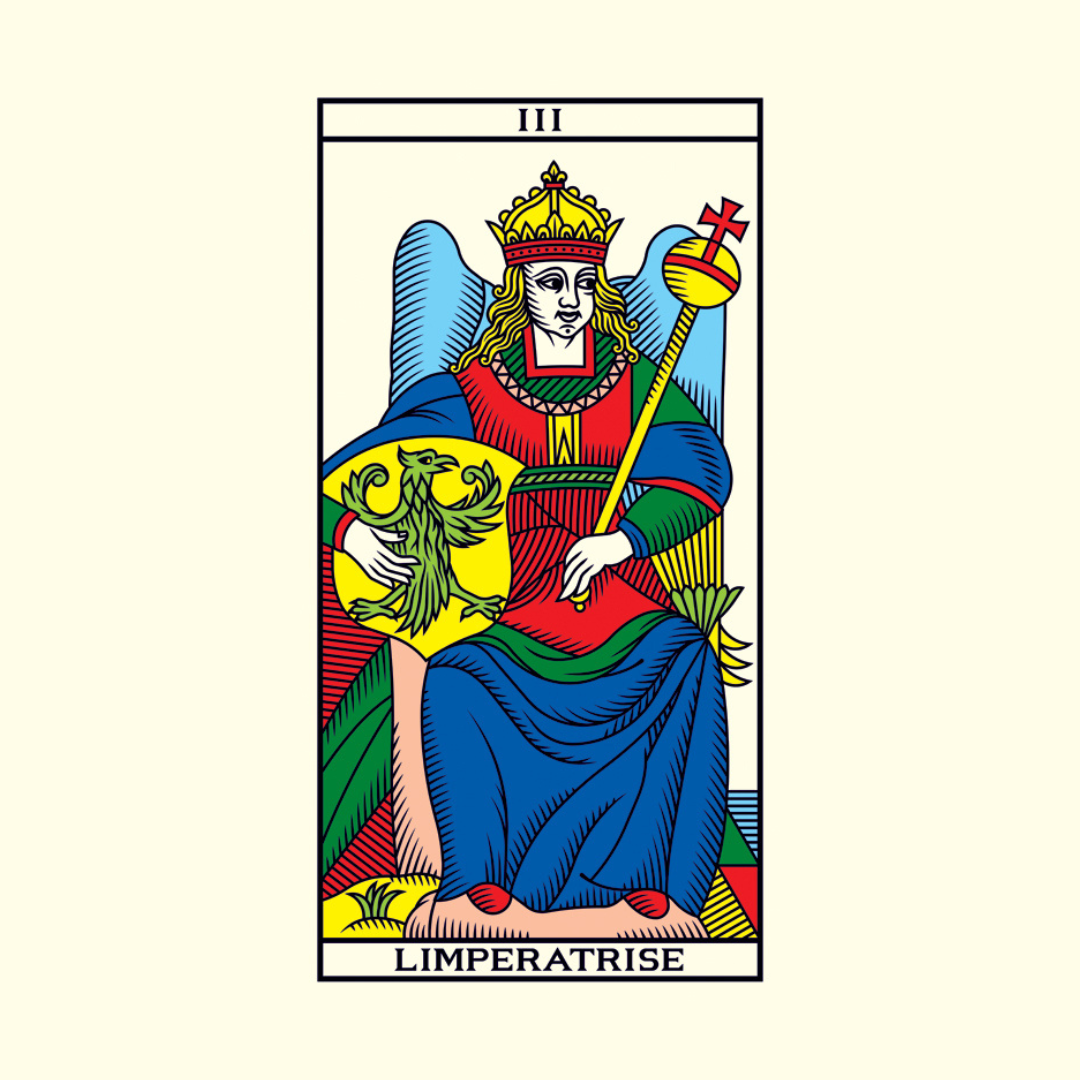

The Empress does not merely conceive: she gives visible form to what has been prepared. Crown, scepter, and shield place her among the sovereign powers of the early tarot. In divinatory readings, her domain is that of the idea that becomes speech, a project, a work, or a decision.
The sovereign of the Tarot de Marseille and the Empress of the Waite-Smith retain the number III, but their settings differ. In the early decks, the heraldic eagle and scepter assert imperial dignity. Pamela Colman Smith places her figure amid wheat, water, and trees, with the Venus symbol on a shield. Earthly fertility thus becomes the declared center of the image.
A Sovereign of the Early Tarot
The Empress belongs to the ancient series of dignities that organize the human world. In the Visconti-Sforza deck, dated to around 1450–1480, she is seated and veiled, holding a scepter and a shield bearing an eagle. The image first speaks of rank, legitimacy, and the exercise of power. Morgan Library, Visconti-Sforza Tarot, The Empress.
In the Tarot de Marseille, the Empress looks to the side and displays her shield. Her authority is expressed through the signs she bears and through her ability to represent an order. The number III places her after the Magician and the High Priestess: personal action encounters knowledge, then takes an intelligible and communicable form.
Iconographic reference. The eagle belongs to the European imperial vocabulary. It does not, by itself, constitute an astrological indication. The Venus symbol, wheat, and the garden appear explicitly in the Waite-Smith and should be read within that deck.
From the Imperial Shield to the Garden of Venus
Mathers describes the Empress as the result of the union between science and will. For him, she represents action. Papus and Wirth extend the French Kabbalistic sequence by assigning her Gimel. Their system does not correspond to that of the Golden Dawn.
In the Waite-Smith, the Empress is associated with Daleth and Venus. Her crown of twelve stars, the wheat field, the water, and the shield marked with the Venus symbol create a landscape of growth and fertility. Waite speaks of a fertile power and the visible world. This iconography reinforced interpretations related to creation, the body, pleasure, and motherhood, without reducing the card to pregnancy.
What ancient authors attribute to her
Mathers retains action, planning, enterprise, movement, and initiative. Reversed, the Empress becomes inaction, dissipation of power, lack of concentration, and hesitation. The card therefore does not represent abundance alone: it measures the ability to transform a conception into production.
Waite adds fertility, duration, and action, but his list also contains difficulty, doubt, and ignorance. This contrast recalls that growth involves an element of uncertainty. An idea that multiplies can enrich a project or make it uncontrollable.
Meaning in a spread
In a favorable reading
The Empress favors expression, production, and circulation. It may announce a convincing idea, a project taking shape, a negotiation conducted with ease, or a person capable of bringing together intelligence, charm, and authority. It encourages clearly naming what one wants to create and giving it a form that others can receive.
The card’s fertility may concern a work, a business, a relationship, a garden, or a child, depending on the question. It must never be turned into a pregnancy diagnosis. Its primary meaning remains the ability to make things grow and bring them into view.
In an unfavorable reading
The card may indicate proliferation without direction, brilliant words that produce nothing, a scattered project, or a desire for approval that weakens decision-making. It may also show overbearing protection, status rivalry, or production launched before its framework has been established.
Love, work, and finances
| Area | Favorable reading | Shadow aspect | Question to ask |
|---|---|---|---|
| Love | Lively exchange, expressed desire, relationship that develops and gains confidence. | Seduction focused on image, jealousy, intrusive presence. | Does the bond grow through genuine exchange? |
| Work | Successful presentation, creation, communication, project management. | Scattered efforts, rivalry, seductive promise without execution. | What concrete form will give the idea its value? |
| Finances | Developing resource, appreciation of an asset, income linked to a creation. | Showy spending, poorly controlled growth, diluted budget. | Does growth produce measurable value? |
| Project or creation | Writing, design, production, launch, or distribution. | Too many versions, seeking effect, inability to choose. | What result can now be shown? |
How to read its associations
The Empress brings form, speech, growth, and the ability to produce. The neighboring card indicates what will be conceived, disseminated, or developed.
| Association | Possible dynamic | Point of caution |
|---|---|---|
| Empress + Magician | An idea finds its tools and can be tested without delay. | Do not confuse speed with preparation. |
| Empress + High Priestess | Creation draws on study or returns to a maturation phase. | Balance expression and reserve. |
| Empress + Emperor | Conception receives structure, responsibility, and limits. | Avoid letting the framework stifle invention. |
| Empress + Lovers | A creation or relationship depends on a choice and an alliance. | Desire does not exempt one from making a decision. |
| Empress + Justice | A statement, contract, or work must be formalized accurately. | Review rights, duties, and responsibilities. |
| Empress + Devil | Charm, ambition, and the desire to produce become very powerful. | Watch for dependence on approval and power dynamics. |
| Empress + World | The work finds its audience, completion, or wider dissemination. | Preserve quality during expansion. |
Correspondences according to the schools
| Reference point | Attribution | Historical scope |
|---|---|---|
| Family | Trump or major arcana III | Third numbered trump in the French series. |
| Italian tarots | The Empress, scepter and eagle | A figure of imperial dignity attested in the 15th century. |
| Tarot de Marseille | Crown, scepter, and eagle shield | Sovereign iconography, without an inscribed planetary sign. |
| French occultism | Gimel; action and conception | Attribution found in Papus and Wirth. |
| Golden Dawn | Daleth and Venus | A distinct system from the French suit Gimel–Empress. |
| Waite-Smith | Venus, twelve stars, wheat, and water | Terrestrial fertility becomes explicit in the image. |
| Element | No universal element | Earth appears in recent frameworks without constituting a datum of the Tarot de Marseille. |
| Stone, plant, and season | No stable historical attribution | These additions vary according to contemporary works. |
| Reading keywords | Action, conception, speech, creation, growth, dissemination | The card gives visible form. |
| Shadow aspect | Dispersion, vanity, proliferation, hesitation | Creative power loses its direction. |
Sources and reference texts
Morgan Library, Visconti-Sforza Tarot, The Empress ; S. L. MacGregor Mathers, The Tarot, 1888 ; Papus, The Tarot of the Bohemians, 1889 ; Oswald Wirth, The Tarot of the Medieval Image-Makers, 1927 ; Arthur Edward Waite, The Pictorial Key to the Tarot, 1911.










