















































































































































































































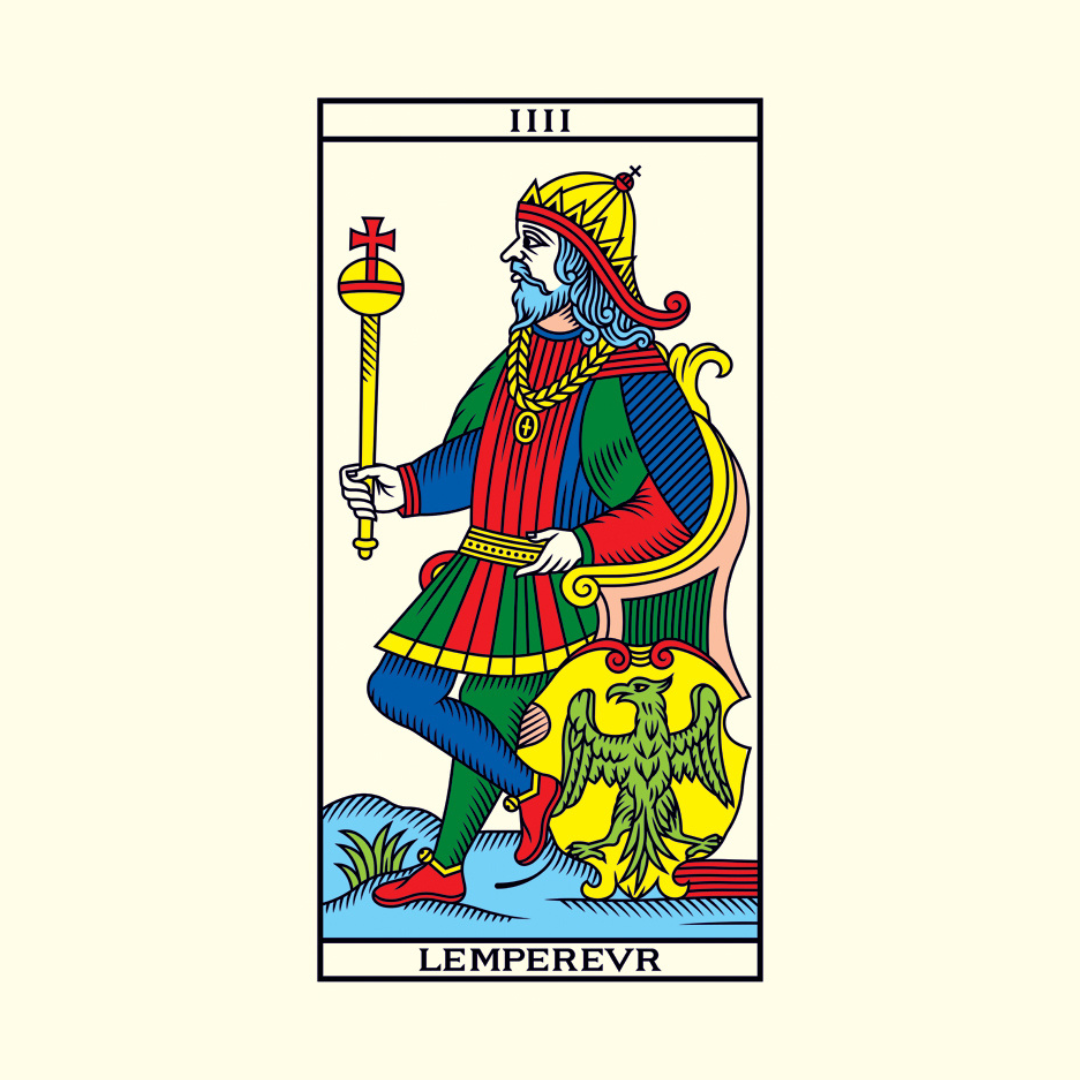

The Emperor gives a foundation to what the Empress conceived. His scepter, throne, and shield speak of territory, rule, and responsibility. The fourth trump does not promise power for its own sake: it questions the ability to build an authority that protects, organizes, and answers for its decisions.
In ancient tarot decks, as in the Tarot de Marseille, the Emperor belongs to the pair of temporal dignities. The Waite-Smith preserves this sovereignty, but adds the rams of Golden Dawn astrology and a rocky landscape. The card's core remains achievement; the association with He and Aries belongs to a specific system.
Temporal Authority in the Tarot
The Emperor is one of the oldest trumps. His presence alongside the Empress, the Papess, and the Pope places the tarot's first degrees within the political and religious order of 15th-century Europe. The crown, scepter, and eagle make him identifiable without recourse to a hidden doctrine.
In the Tarot de Marseille, his posture forms a four with his legs, while the eagle shield rests beside him. Occultists would make this geometry a symbolic argument. In the original image, it already supports a reading of stability, a maintained position, and power established over a territory.
Iconographic reference. The Emperor bears the signs of his office. A throne or a scepter does not guarantee that authority is just: the reading must show whether the rule protects, organizes, or merely serves to maintain domination.
From Sovereign to Master of Aries
Mathers sees achievement in the Emperor. Papus and Wirth place him under Daleth in their French succession. This letter should not be confused with the attribution given to the fourth trump by the Golden Dawn.
In the English system, the Emperor receives He and the sign of Aries. Pamela Colman Smith inscribes this correspondence in the throne adorned with ram's heads. The scepter takes the form of a crux ansata, the globe marks possession of the governed world, and the mountains give the landscape an austerity absent from many Tarot de Marseille decks. Waite describes him as executive power, achievement, and earthly authority.
What the Early Authors Attribute to Him
Mathers retains achievement, effect, and development. In an unfavorable position, he speaks of stoppage, obstacles, and immaturity. This last notion matters: the Emperor can show a power that has not yet learned to take responsibility for its actions.
Waite brings together stability, power, protection, achievement, assistance, reason, conviction, authority, and will. His unfavorable list also includes obstruction and immaturity. The card is therefore not limited to the leader. It may designate a structure, a rule, an owner, an administration, or anyone who has the power to authorize, protect, or prohibit.
Meaning in a spread
In a favorable reading
The Emperor announces consolidation. A project receives a framework, a schedule, a budget, clear responsibility, or the support of someone capable of making decisions. The card favors lasting commitments, defining a territory, and transforming an intention into a stable organization.
It may advise setting a rule, taking one’s place, or requesting an official decision. Its healthy authority is not based on fear: it makes boundaries clear and takes responsibility for the consequences of what it orders.
In an unfavorable reading
The Emperor may indicate rigidity, a hierarchy that refuses to listen, a blocked decision, or someone who confuses firmness with control. He may also point to a lack of structure: unclear responsibilities, contested authority, or a framework incapable of supporting the project.
Love, work, and finances
| Area | Favorable reading | Shadow aspect | Question to ask |
|---|---|---|---|
| Love | Stable commitment, protection, established boundaries, and a structured shared project. | Possessiveness, hierarchical relationship, refusal to show vulnerability. | Does stability leave equal room for both people? |
| Work | Responsibility, leadership, lasting contract, effective organization. | Authoritarian leader, blocking procedure, territorial struggle. | Who decides, and according to what rule? |
| Finances | Managed budget, assets, regulated investment, solid reserve. | Withholding, excessive control, immobilization, or imposed spending. | Does security rely on a viable structure? |
| Project | Plan, defined responsibilities, schedule, and stabilized resources. | An overly heavy framework, lack of delegation, refusal to adapt the plan. | What rule truly supports the objective? |
How to read its associations
The Emperor brings structure, limits, decisions, and authority. The neighboring card shows what he organizes, protects, or seeks to control.
| Association | Possible dynamic | Point of caution |
|---|---|---|
| Emperor + Magician | An authority provides the means to begin or demands a quick result. | Define the beginner’s margin of autonomy. |
| Emperor + High Priestess | The decision is based on a file, a rule, or expertise. | Do not conceal information behind status. |
| Emperor + Empress | An idea receives an organization capable of making it sustainable. | The framework must serve creation. |
| Emperor + Pope | Temporal power and moral authority come together in an institution. | Check the countervailing powers and legitimacy. |
| Emperor + Justice | Contract, official decision, arbitration, or legal responsibility. | The rule must be applied with moderation. |
| Emperor + The Devil | Authority, ambition, and material interests grow stronger. | Risk of domination, dependence, or abuse of position. |
| Emperor + The Tower | A structure is challenged, overturned, or forced to reorganize. | Identify what was solid and what held together only through coercion. |
Correspondences according to the schools
| Guide | Attribution | Historical scope |
|---|---|---|
| Family | Trump or major arcana IV | Fourth numbered trump in the French series. |
| Early Tarots | Emperor, crown, scepter, and eagle | Temporal authority figure attested as early as the 15th century. |
| Tarot de Marseille | Seated sovereign, shield with an eagle | No zodiac sign is shown in the image. |
| French occultism | Daleth; achievement and constructive power | Attribution found in Papus and Wirth. |
| Golden Dawn | He and Aries | Distinct system from the French Daleth-Emperor sequence. |
| Waite-Smith | Ram's heads, an ankh, globe, and mountains | The attribution to Aries becomes apparent. |
| Element | Fire in the zodiacal reading of Aries | Golden Dawn correspondence, not a universal Tarot de Marseille attribution. |
| Stone, plant, and season | No stable historical attribution | Recent lists vary according to the authors. |
| Reading keywords | Structure, authority, protection, rule, achievement | The card stabilizes and decides. |
| Shadow aspect | Rigidity, domination, obstruction, immaturity | Power no longer fulfills its function. |
Choose a Tarot deck to work with this card
To find this arcana in a complete deck, compare the Tarots of Marseille, the Rider-Waite-Smith, and all of our divination Tarots. If you are just starting out, also see How to choose your first Tarot deck?.
Sources and reference texts
Bibliothèque nationale de France, Tarot, Game and Magic ; S. L. MacGregor Mathers, The Tarot, 1888 ; Papus, The Tarot of the Bohemians, 1889 ; Oswald Wirth, The Tarot of the Medieval Image-Makers, 1927 ; Arthur Edward Waite, The Pictorial Key to the Tarot, 1911.










