















































































































































































































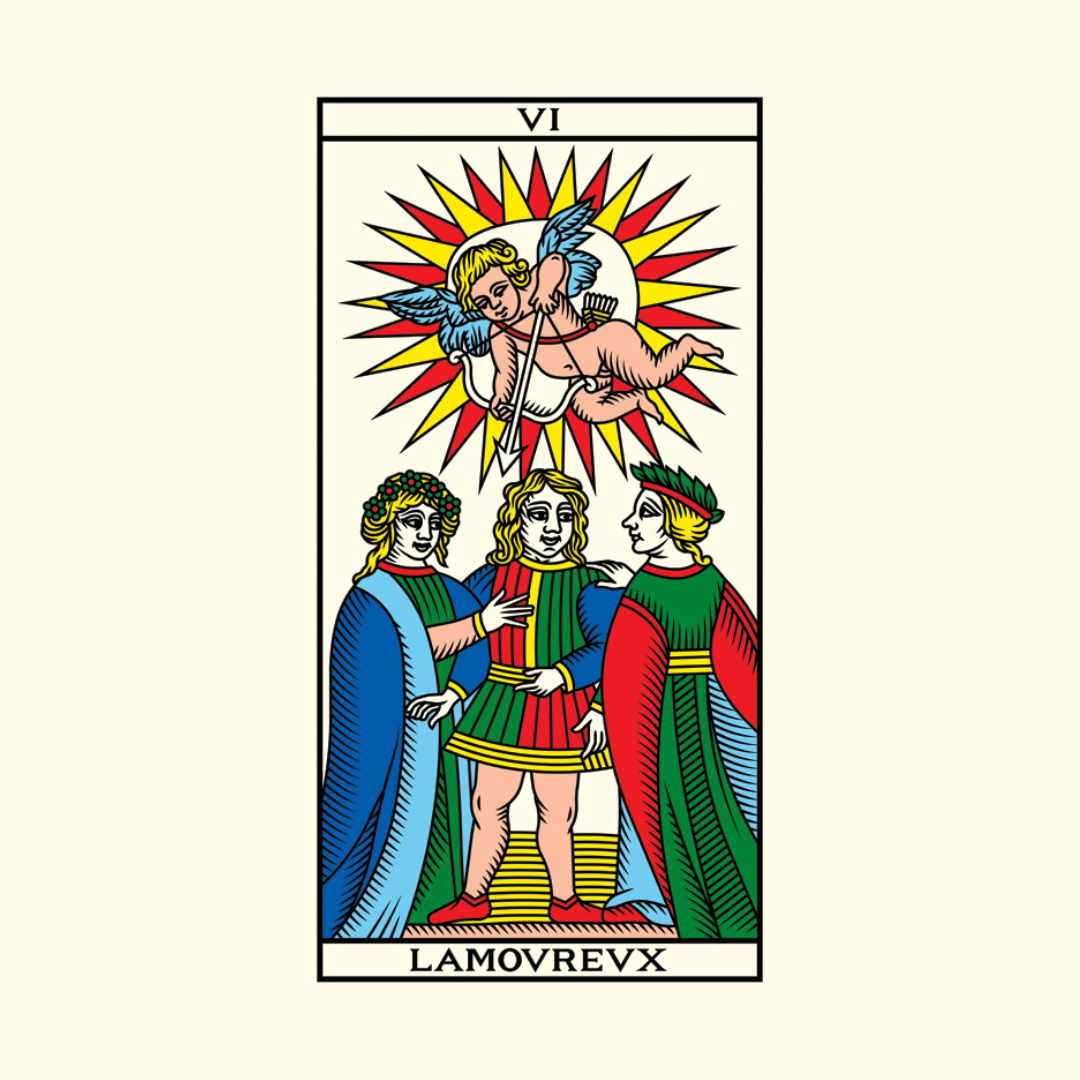

The Lovers places a relationship under the gaze of a power that transcends it. In the earliest Italian tarots, a man and a woman hold hands beneath a blindfolded Eros. In the Tarot de Marseille, a figure stands between two others while a winged archer aims at the scene. The card therefore speaks of a bond and the trial it imposes: choosing, consenting, reaching an accord, and taking responsibility for one’s decision.
The Marseille Lovers and the Waite-Smith Lovers do not show the same story. The French card preserves a scene with three figures whose gestures remain open to interpretation. Pamela Colman Smith depicts Adam and Eve, two trees, and an angel beneath a radiant sun. One emphasizes human deliberation; the other, union, knowledge, and a relationship placed under celestial authority.
Love in the earliest tarot decks
The card belongs to the earliest Italian sets of the 15th century. In the Visconti-Sforza deck held by the Morgan Library, a young man takes a woman’s hand beneath a winged, naked, blindfolded Eros. The archer holds his arrows above the couple. The card is then called Love and first evokes human union placed under the unpredictable power of desire. Morgan Library, Visconti-Sforza Tarot, Love.
In French decks, the composition changes. A central figure faces two figures, while the small archer occupies the sky. The hands cross between the chest, shoulder, waist, and arm. These gestures create a silent conversation: attraction, solicitation, family advice, promise, or hesitation. Reducing the scene to “a man between vice and virtue” imposes a later morality on a more ambiguous image.
Iconographic guide. The bow and arrow signify a relationship that reaches the central figure before everything has even been decided. The earthly figures then show the human aspect of the card: naming one’s desire, listening to the commitments of those present, and choosing without allowing oneself to be guided solely by pressure.
From human choice to the biblical couple
Nineteenth-century occultists make the sixth card a test of discernment. Mathers recalls the moral reading of the man placed between two paths, but prefers to see it as a wise disposition and a trial overcome. Papus and Wirth link The Lovers to the letter Vau in their French sequence. This construction belongs to their system and is not found in fifteenth-century cards.
The Waite-Smith changes the scene. Adam and Eve stand naked before the Tree of Life and the Tree of the knowledge of good and evil. An angel spreads its arms above them. Waite presents the card as one of human love, connection, and an alliance that engages one’s entire existence. The triangle of the French tarot disappears: reading this image as a simple hesitation between two partners would miss the deck’s own message.
What the old authors attribute to it
Mathers associates the card with the right disposition, the trial, and difficulties overcome. In its reversed aspect, it designates poorly conceived plans or failure when put to the test. The core of his interpretation therefore does not lie in feeling alone: an intention must withstand reality.
Waite emphasizes attraction, love, beauty, and trials overcome. Reversed, the card becomes failure, an ill-considered plan, frustration, or a union project prevented. These old lists do not necessarily announce a marriage. They connect emotional agreement with a concrete decision and the consequences that follow.
Meaning in a reading
In a favorable reading
The Lovers indicate an agreement based on a clear choice. They favor alliance, mutual attraction, reconciliation, and a decision made with the consent of the people concerned. They may represent a couple, but also a contract, collaboration, vocation, or commitment that requires actions to align with words.
The card asks you to identify what is truly attractive and what that attraction demands. It does not guarantee that the most enticing path is the best one. It shows that a relationship or decision becomes fruitful when desire, words, and responsibility move forward together.
In an unfavorable reading
The Lovers may indicate prolonged hesitation, uncertain consent, a contradictory promise, or someone who wants to keep two incompatible paths open. The difficulty does not come solely from the choice: it also arises from an agreement made to please someone, avoid conflict, or yield to outside pressure.
Love, work and finances
| Area | Favorable reading | Shadow aspect | Question to ask |
|---|---|---|---|
| Love | Mutual attraction, word given, choice of the couple, sincere rapprochement. | Love triangle, unclear commitment, pressure or desire without agreement. | Do both people want the same relationship? |
| Work | Association, chosen recruitment, team agreement, work aligned with values. | Fragile alliance, decision dictated by approval, incompatible interests. | What commitment accompanies this proposal? |
| Finances | Joint decision, negotiated contract, genuinely chosen purchase. | Emotional expenditure, a clause accepted too quickly, costly hesitation. | Does the desire to obtain the object conceal an unfavorable condition? |
| Project | Choice of direction, complementary partner, agreement between intention and method. | Two competing goals, a promise that cannot be kept, dispersion. | Which path must be given up in order to move forward? |
How to read its associations
The Lovers bring relationship, consent, the test, and the decision. The neighboring card indicates what unites people, what influences the choice, or the form the commitment will take.
| Association | Possible dynamic | Point of caution |
|---|---|---|
| Lovers + Magician | An attraction or proposal opens a new path. | Make sure the enthusiasm is grounded in real resources. |
| Lovers + High Priestess | The choice requires information, reflection, or words that are still being held back. | An unspoken issue may prevent informed consent. |
| Lovers + Emperor | A relationship receives a framework, status, or firm commitment. | The framework must be accepted, not imposed. |
| Lovers + Chariot | The decision is made and leads to a departure, a conquest, or shared progress. | Do not confuse speed with lasting agreement. |
| Lovers + Justice | Contract, fair decision, formalization, or clarification of responsibilities. | Read all the conditions before committing. |
| Lovers + Devil | Powerful attraction, material interest, or dependence at the heart of the choice. | Spot the constraint, jealousy, and emotional bargaining. |
| Lovers + World | Fulfilled alliance, acknowledged choice, and a relationship integrated into a broader project. | Preserve everyone's place in the shared success. |
Correspondences according to the schools
| Reference | Attribution | Historical scope |
|---|---|---|
| Family | Trump or major arcana VI | Sixth numbered card in the French series. |
| Old Italian name | Amore | A couple appears beneath Eros in 15th-century Italian decks. |
| Tarot de Marseille | Figure between two figures, winged archer | Scene of relationship, deliberation and choice. |
| French occultism | Vau; trial and disposition | Attribution found in the systems of Papus and Wirth. |
| Golden Dawn | Zain and Gemini | Distinct system from the French sequence Vau–Amoureux. |
| Waite-Smith | Adam, Eve, angel, two trees | New composition published at the beginning of the 20th century. |
| Element | Air in the Golden Dawn framework | Attribution associated with Gemini, absent from the historical Tarot de Marseille. |
| Stone, plant and season | No attribution shared by the older schools | Contemporary depictions vary according to their authors. |
| Reading keywords | Choice, bond, attraction, consent, alliance, trial | The relationship becomes an acknowledged decision. |
| Shadow aspect | Indecision, pressure, disagreement, fragile agreement | Desire alone is not enough to establish a fair commitment. |
Choosing a tarot deck to work with this card
To find this arcana in a complete deck, compare the Tarot de Marseille, the Rider-Waite-Smith, and all of our Divination Tarots. If you are just starting out, also see How to choose your first tarot deck?.
Sources and reference texts
Morgan Library, Visconti-Sforza Tarot, Love ; The Metropolitan Museum of Art, Before Fortune-Telling: The History and Structure of Tarot Cards ; S. L. MacGregor Mathers, The Tarot, 1888 ; Papus, The Tarot of the Bohemians, 1889 ; Oswald Wirth, The Tarot of the Image-Makers of the Middle Ages, 1927 ; Arthur Edward Waite, The Pictorial Key to the Tarot, 1911.










