
The Chariot moves forward because a direction has been imposed on forces that are not quite looking the same way. The card celebrates victory, but it also shows what that victory requires: holding one's position, governing movement, and not allowing momentum to turn into haste.
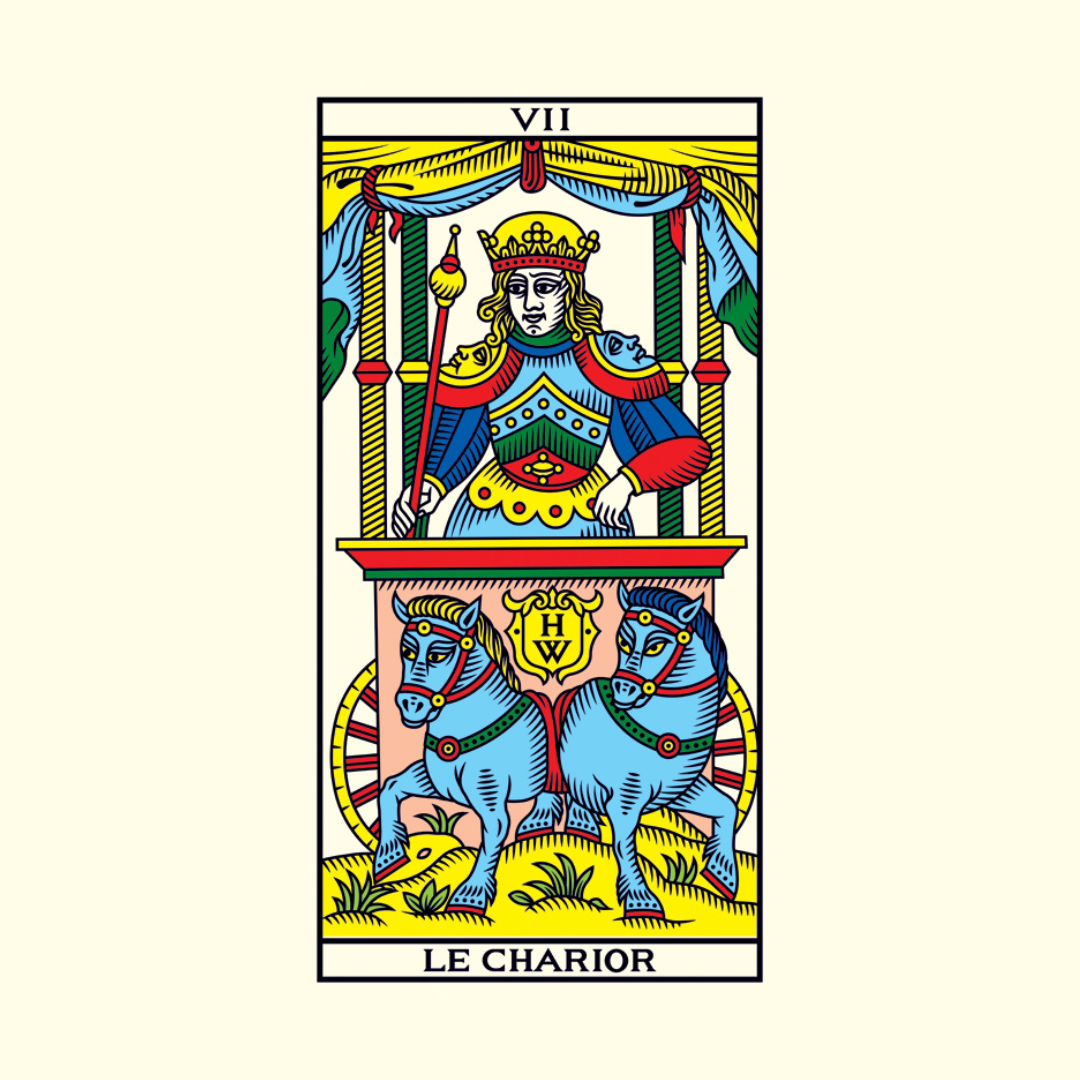
The Chariot of the Tarot de Marseille has neither the sphinxes nor the initiatory apparatus of the Waite-Smith. Its crowned driver stands in a vehicle pulled by two horses, beneath a canopy supported by four posts. In older cards, the triumphant figure may be a woman. The character's sex matters less than their function: they receive the signs of sovereignty and lead a public procession.
The triumphal chariot in the earliest tarot decks
The Chariot appears in 15th-century Italian tarot decks. The Visconti-Sforza card held by the Morgan Library shows a crowned woman seated beneath a Gothic arch. She holds a globe topped with a cross, and two winged horses pull her vehicle. This image of processional sovereignty predates the armored driver of French decks and the sphinxes of the Waite-Smith. Morgan Library, Visconti-Sforza Tarot, Chariot.
Triumph belonged to the visual vocabulary of Renaissance Europe: the victor's parade, solemn entry, allegorical chariot, and public assertion of rank. The Tarot de Marseille retains the crown, canopy, and vehicle. The horses head in slightly different directions, and no clear reins connect their mouths to the driver's hands. The mastery represented is therefore not simple physical traction: it comes from position, command, and the agreement given to the whole.
Iconographic marker. The two beasts do not automatically represent good and evil. They show two forces capable of carrying out the same plan if a direction brings them together. In a reading, they may indicate means, teams, desires, or obligations that must move forward at the same pace.
From horses to sphinxes
Mathers describes a crowned conqueror standing in a cubic chariot beneath a canopy. He attributes to it triumph as well as victory obtained through justice and judgment. Papus and Wirth place the card under the letter Zain in their French sequence. These interpretations make the driver a master of opposing forces, but they belong to 19th-century occultism.
In the Waite-Smith, two sphinxes replace the horses. The driver wears armor, symbols on his shoulders, and stands before a city. Waite emphasizes outward conquest and the triumph of the rational mind. He also specifies the limit of this success: the victor may solve the sphinx's riddle without gaining access to the book of the High Priestess. The card therefore celebrates effectiveness in the visible world, not total knowledge.
What the ancient authors attributed to it
Mathers sums up the card with triumph, victory, and obstacles overcome. Reversed, it designates a person defeated at the last moment by what they thought they had mastered. This nuance reminds us that success remains fragile until the destination is secured.
Waite adds help, protection, war, presumption, vengeance, and difficulties. His list brings glory and conflict together because a victorious chariot presupposes a confrontation. Reversed, the card becomes a quarrel, dispute, legal proceedings, or defeat. The Chariot is therefore not favorable by nature: its strength depends on the goal, the conduct, and the price of conquest.
Meaning in a reading
In a favorable reading
The Chariot indicates progress achieved through willpower, organization, and the ability to stay on course. It suits departures, travel, competitions, promotions, and projects entering an active phase. It can represent someone who takes charge of a situation and gathers resources that had previously been scattered.
The card advises establishing a precise destination before accelerating. The victory it announces does not fall from the sky: it is built through decision, discipline, and control of one's reactions. The driver wins because they remain standing in the midst of movement.
In an unfavorable reading
The Chariot can signal an ambition that tramples others, a hasty departure, sterile competition, or two forces pulling the project in incompatible directions. It can also show the winner's presumption, the conflict accompanying their advance, or public success masking a loss of control.
Love, work, and finances
| Area | Favorable reading | Shadow side | Question to ask |
|---|---|---|---|
| Love | Relationship moving forward, shared project, travel or decision taken with confidence. | Power struggle, reckless rush, partner who decides alone. | Are the two people moving toward the same destination? |
| Work | Promotion, project leadership, competition won, business travel. | Rivalry, overload, harsh authority, temporary victory. | What resources must remain coordinated until arrival? |
| Finances | Budget allocated to a specific objective, transport-related purchase, regaining control. | Hasty spending, prestige cost, risk taken through overconfidence. | Does the speed of decision-making still allow the figures to be checked? |
| Project | Launch, overcoming an obstacle, visibility, and firm leadership. | Conflicting objectives, unrealistic schedule, unstable direction. | Who is leading, and how will disagreements be settled? |
How to read its associations
The Chariot brings movement, conquest, leadership, and visible action. The neighboring card shows the destination, the driving force behind progress, or the obstacle that still requires mastery.
| Association | Possible dynamic | Point of caution |
|---|---|---|
| Chariot + Magician | A new project immediately receives resources and direction. | Do not launch before mastering the tools. |
| Chariot + Lovers | A choice triggers the departure or commits two people to a shared path. | Agreement must come before acceleration. |
| Chariot + Justice | Regulated victory, official decision, movement linked to a procedure. | The outcome depends on following the rules. |
| Chariot + Hermit | Progress slows to control the route, method, or destination. | Accept the pause that prevents a mistake. |
| Chariot + Wheel of Fortune | Rapid change, opportunity seized, movement that changes the situation. | Keep a margin for unforeseen events. |
| Chariot + Tower | Interrupted journey, shock, fall of a strategy, or victory that turns against you. | Slow down at the first signs of a breakdown. |
| Chariot + World | Journey completed, conquest recognized, project carried through to completion. | Prepare for what comes after victory and for its transmission. |
Correspondences according to the schools
| Reference | Attribution | Historical scope |
|---|---|---|
| Family | Trump or major arcana VII | Seventh numbered card in the French series. |
| Old Italian name | Carro | Triumphal chariot present in 15th-century Italian tarots. |
| Tarot of Marseille | Crowned driver, horses, vehicle, and canopy | Image of public victory and governed movement. |
| French occultism | Zain; victory and direction | Attribution found in the Papus and Wirth sequences. |
| Golden Dawn | Cheth and Cancer | Distinct system from the French Zain-Chariot sequence. |
| Waite-Smith | Armed driver, city, and two sphinxes | Occultist composition published at the beginning of the 20th century. |
| Element | Water in the Golden Dawn grid | Attribution linked to Cancer, absent from the historical Marseille Chariot. |
| Stone, plant, and season | No attribution shared by the older schools | Contemporary associations depend on each author. |
| Reading keywords | Progress, victory, direction, movement, mastery, ambition | Movement must remain governed. |
| Shadow side | Haste, presumption, conflict, dispersion, defeat | The conquest fails when the forces cease to cooperate. |
Choosing a tarot deck for working with this card
To find this arcana in a complete deck, compare the Tarots of Marseille, the Rider-Waite-Smith, and all of our Divination Tarots. If you are a beginner, also see How to choose your first tarot deck?.
Reference sources and texts
Morgan Library, Visconti-Sforza Tarot, Chariot ; The Metropolitan Museum of Art, Before Fortune-Telling: The History and Structure of Tarot Cards ; S. L. MacGregor Mathers, The Tarot, 1888 ; Papus, The Tarot of the Bohemians, 1889 ; Oswald Wirth, The Tarot of the Medieval Image Makers, 1927 ; Arthur Edward Waite, The Pictorial Key to the Tarot, 1911.