
The Wheel of Fortune never remains in the position in which it is found. What rises will reach the top, what reigns will begin to descend, and what lies at the bottom may resume its ascent. The tenth card therefore does not speak only of luck: it shows a place within a movement that exceeds individual will.
The wheel of the earliest tarot decks and that of the Waite-Smith do not tell exactly the same story. The former derives from the medieval allegory of Fortune, with its figures raised and then overturned. The latter receives a sphinx, a serpent, a jackal-headed figure, the four biblical Living Creatures, and letters inscribed on the wheel. The transition from one to the other transforms a lesson about the instability of status into a cosmological system.
Fortune in the earliest tarot decks
The Visconti-Sforza card held by the Morgan Library shows winged and blindfolded Fortune at the center of a wheel. Four figures occupy the stages of its movement. Their banners declare: “I will reign,” “I reign,” “I have reigned,” and “I have no kingdom.” The wheel therefore does not distribute permanent happiness: it recalls the fragility of power and the succession of states. Morgan Library, Visconti-Sforza Tarot, Wheel of Fortune.
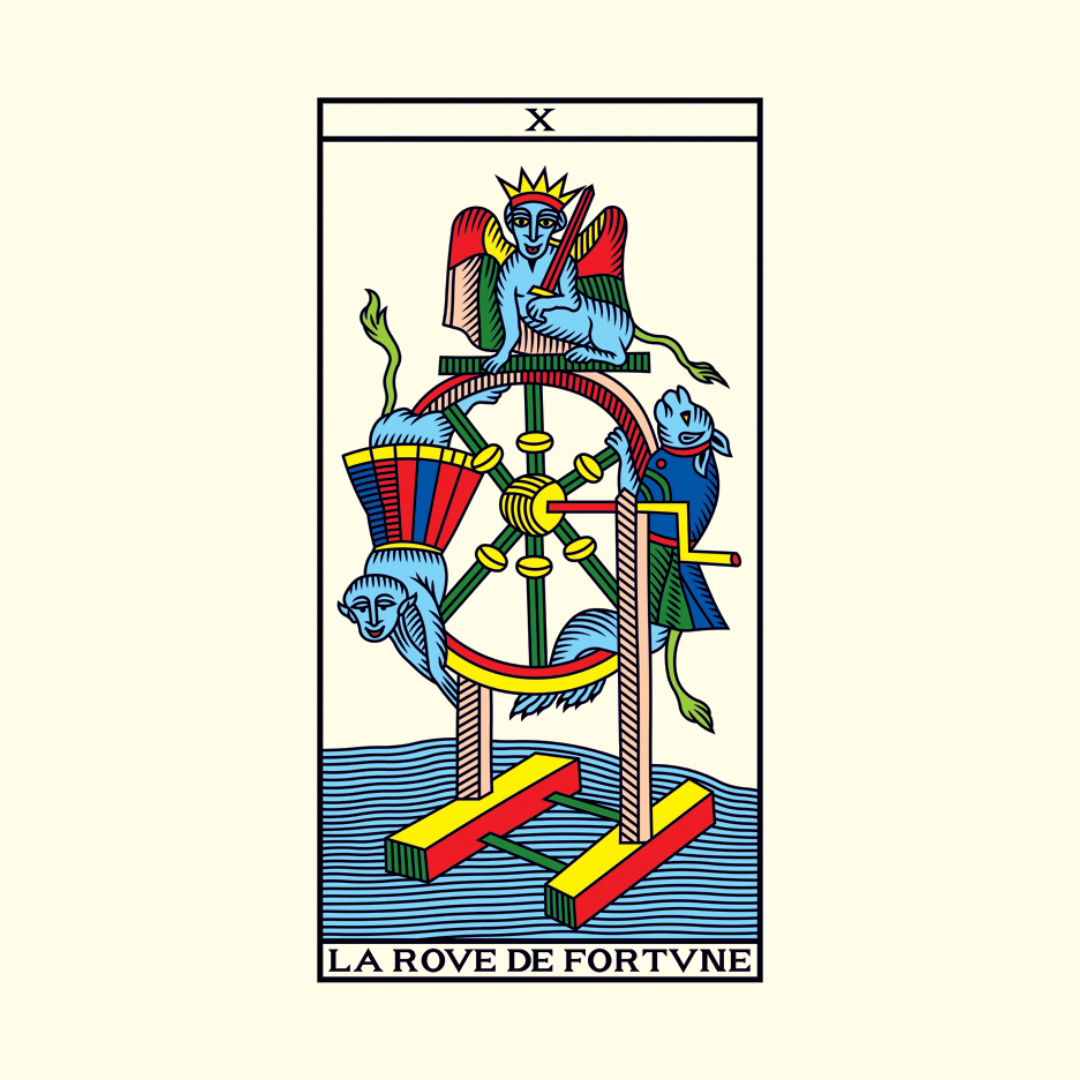
The Tarot de Marseille simplifies the scene. One creature rises, another descends, and a crowned being stands at the top. The crank visible in several decks suggests a mechanism, but no hand turns it in the card. The querent therefore faces a change already in motion, whose direction they can observe without claiming to control the entire cycle.
Iconographic note. The top of the wheel is not a final destination. It is the point where ascent becomes descent. In a favorable reading, the card invites you to seize the opportunity; in an unfavorable position, it advises against building complete security on a temporary advantage.
From medieval allegory to the occultist wheel
Mathers describes a wheel bearing two figures linked to its movement and an armed being at the top. He summarizes it as favorable or unfavorable fortune. Papus and Wirth place the tenth card under the letter Yod in their French sequence. Their interpretation retains the idea of a cycle while inserting it into a Kabbalistic structure absent from the earliest decks.
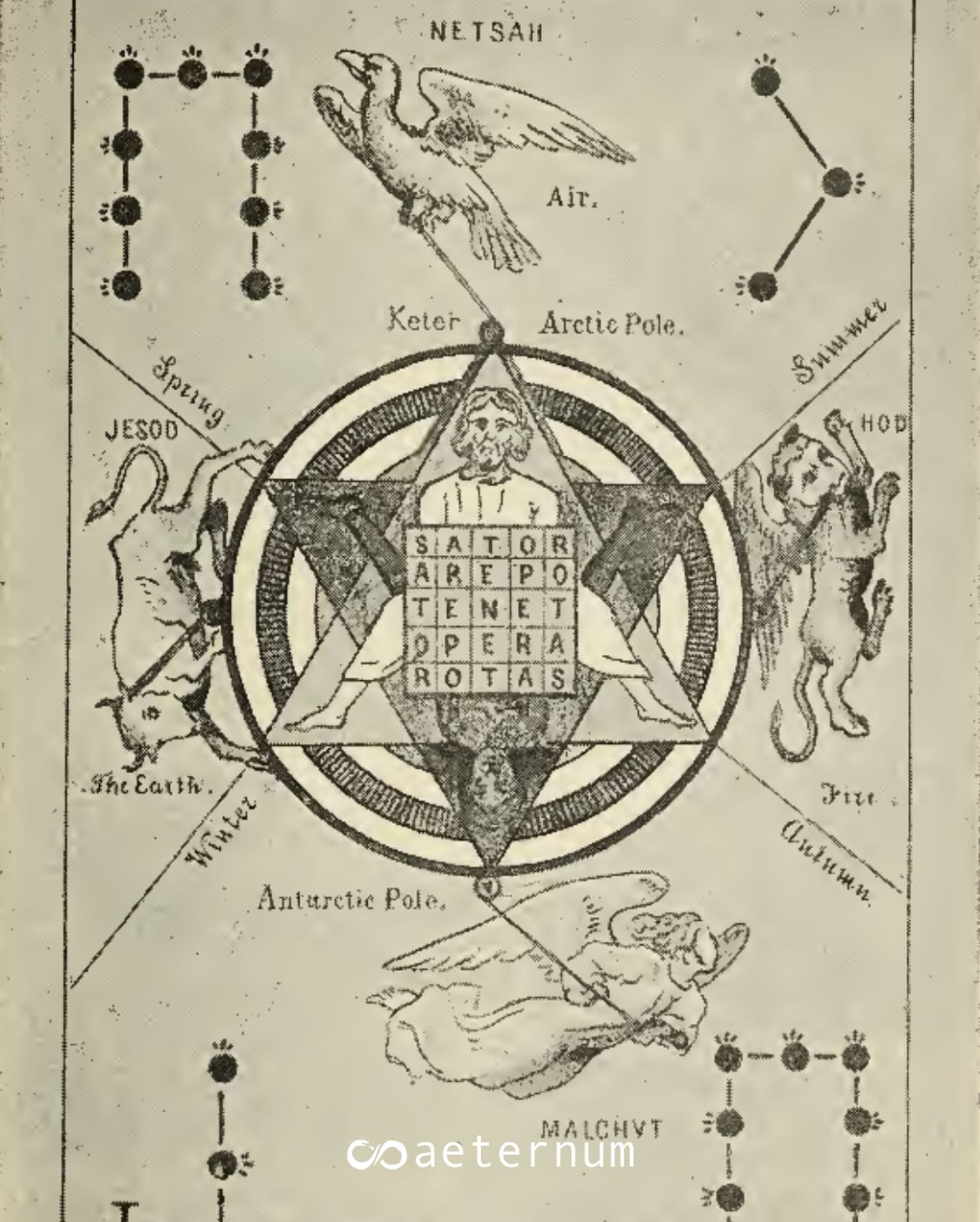
The Waite-Smith deck follows a reconstruction inspired by Éliphas Lévi. The wheel bears the letters TARO and ROTA, interwoven with the letters of the divine name. A sphinx remains balanced at the top, while a serpent descends and a figure rises. The four Living Creatures occupy the corners. Waite connects this image to the flow of life and to a providential purpose amid change.
What the early authors attribute to it
Mathers associates the card with good fortune, success, and unexpected opportunity. Reversed, it indicates failure or an unfavorable reversal. His reading follows the allegory’s movement directly: the position occupied on the wheel may improve or deteriorate.
Waite retains destiny, fortune, elevation, success, and happiness. His reversed list is surprising: it speaks of increase, abundance, and surplus. Reversal therefore does not always mean “bad luck” in his system. It may show a movement that has become excessive, growth that is difficult to control, or a situation that exceeds its proper measure.
Meaning in a spread
In a favorable reading
The Wheel of Fortune announces a change in position, an opportunity, a resumption of movement, or a combination of circumstances that opens a path. It suits periods of transition, results that depend on timing, and blocked situations that begin moving again. It may indicate a real stroke of luck, provided it is recognized and acted upon while it remains accessible.
The card does not remove all responsibility from the querent. It simply distinguishes what depends on them from what belongs to the circumstances. The proper reading is to prepare a flexible response: take advantage of the opening without confusing an opportunity with a guarantee.
In an unfavorable reading
The wheel can signal instability, repetition of the same scenario, dependence on chance, or a reversal the person was unwilling to consider. It also shows overconfidence at the peak, passive waiting at the bottom of the cycle, and difficulty understanding that a phase has already ended.
Love, work, and finances
| Area | Favorable reading | Shadow aspect | Question to ask |
|---|---|---|---|
| Love | Unexpected meeting, evolution of the relationship, emergence from a stagnant period. | Cyclical relationship, instability, return of an unresolved problem. | What is really changing this time? |
| Work | Opportunity, mobility, change of position, circumstances becoming favorable again. | Forced reorganization, precarious status, dependence on an external decision. | What preparation will make it possible to seize the opportunity? |
| Finances | Short-term improvement, unexpected income, restored circulation. | Fluctuations, temporary gain, gambling or risk-taking without control. | Can the budget withstand a coming reversal? |
| Project | Restart, favorable timing, arrival of a factor that unlocks everything. | Plan dependent on repeated luck, uncontrollable pace. | What needs to be stabilized while the window remains open? |
How to read its associations
The Wheel of Fortune brings change, opportunity, cycles, and instability. The neighboring card indicates what is turning, the direction of movement, or how to respond to change.
| Association | Possible dynamic | Point of caution |
|---|---|---|
| Wheel + Magician | An opportunity initiates something or puts the tools back in your hands. | Act before the window closes. |
| Wheel + Chariot | Rapid change, travel, or success accelerated by circumstances. | Maintain direction amid acceleration. |
| Wheel + Justice | Decision that changes status, administrative result, or regularization. | The consequences of the judgment may last longer than the opportunity. |
| Wheel + Hermit | Slow cycle, useful waiting, or analysis of the right moment. | Caution must not cause you to miss the opening. |
| Wheel + Strength | Ability to maintain control during a shifting period. | Do not try to immobilize what must evolve. |
| Wheel + Hanged Man | Reversal that suspends action or an imposed change of perspective. | Identify what remains possible despite the standstill. |
| Wheel + World | Completed cycle, fulfilled change, successful transition to a new position. | Prepare for the next cycle without devaluing the achievement. |
Correspondences according to the schools
| Guide | Attribution | Historical scope |
|---|---|---|
| Category | Trump or Major Arcana X | Tenth numbered card in the French and Waite-Smith series. |
| Historical figure | Blindfolded Fortune and four states of power | Allegory present in the 15th-century Visconti-Sforza. |
| Tarot de Marseille | Wheel, ascending creature, descending creature, crowned figure | Image of change and reversal of positions. |
| French occultism | Yod; cycle and fortune | Attribution found in the systems of Papus and Wirth. |
| Golden Dawn | Kaph and Jupiter | Distinct system from the French Yod–Wheel sequence. |
| Waite-Smith | Sphinx, serpent, sacred letters, and four Living Creatures | Occultist composition derived from the works of Éliphas Lévi. |
| Element | No direct element in the Golden Dawn framework | The card is assigned to Jupiter rather than an element. |
| Stone, plant, and season | No attribution shared by the older schools | Contemporary correspondences vary according to their authors. |
| Reading keywords | Cycle, opportunity, change, elevation, reversal, adaptation | The present position remains fluid. |
| Shadow aspect | Instability, repetition, passivity, excess, loss of position | Chance becomes a trap when it replaces preparation. |
Sources and reference texts
Morgan Library, Visconti-Sforza Tarot, Wheel of Fortune ; The Metropolitan Museum of Art, Before Fortune-Telling: The History and Structure of Tarot Cards ; S. L. MacGregor Mathers, The Tarot, 1888 ; Papus, The Tarot of the Bohemians, 1889 ; Oswald Wirth, The Tarot of the Medieval Image-Makers, 1927 ; Arthur Edward Waite, The Pictorial Key to the Tarot, 1911.