















































































































































































































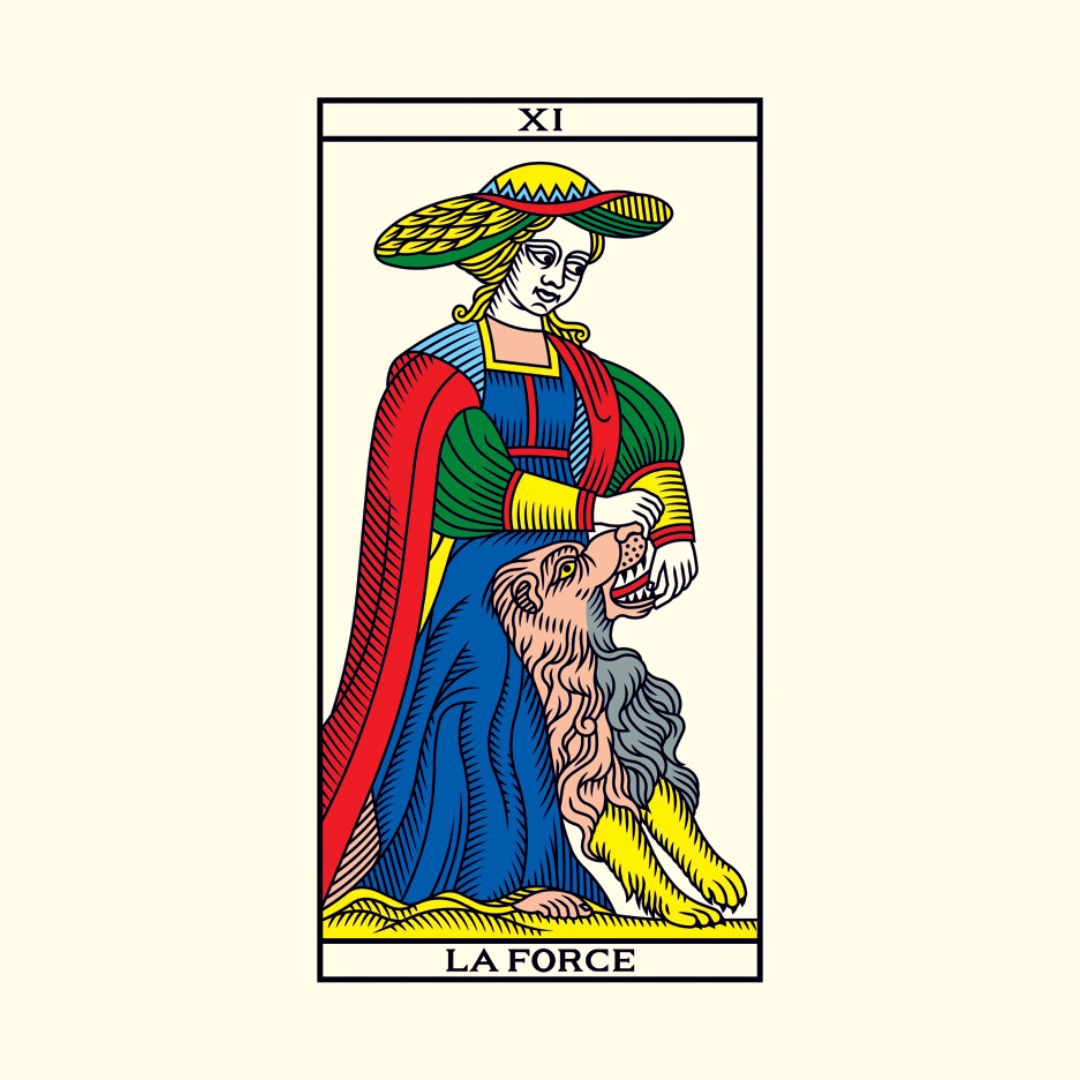

Strength does not celebrate brutality. It shows power restrained, directed, and made just through self-mastery. In the Tarot de Marseille, a crowned woman places her hands on a lion’s jaws. The gesture does not make it possible to determine with certainty whether she is opening or closing them: the entire card lies in this relationship between impulse and measure.
Yet the early decks do not all assign this role to a woman. In the Visconti-Sforza tarot, the virtue of Strength takes the form of a man raising a club above a lion. The shift from this armed struggle to the female figure of the Marseille, then to the flower-adorned woman of the Waite-Smith, changes the card’s language: physical domination becomes the guidance of instinct.
The virtue of Strength in the earliest tarots
In the 15th-century Visconti-Sforza, preserved by the Morgan Library, Strength is a male figure. He raises a club above a lion. This image belongs to the language of the virtues: it is not a psychological portrait, but a moral quality capable of confronting what threatens order. Morgan Library, Visconti-Sforza Tarot, Fortitude.
The Tarot de Marseille replaces this combat with a woman wearing a hat or crown, standing before a lion whose jaws she grasps. Her hands do not strike. The lion remains alive, visible, and active. The card therefore does not ask you to eliminate desire, anger, or ambition: it asks you to give them a form that devours neither the querent nor those around them.
Iconographic note. Saying that the woman “closes” the lion’s jaws is an interpretation. Several drawings can also be seen as depicting an opening. The card speaks less of a precise anatomical gesture than of the conscious relationship between a person and an animal power.
From Marseille to Waite-Smith
In the Marseille order, Strength bears the number XI and Justice the number VIII. Mathers still retains this order at the end of the 19th century. Papus and Wirth link the eleventh card to Kaph in their sequence of Hebrew letters. These attributions belong to French occultism: they appear neither on 15th-century Italian cards nor in the deck’s original structure.
Waite-Smith reverses the positions: Strength becomes VIII and Justice XI. Waite himself explains this exchange. Pamela Colman Smith draws a woman dressed in white, connected to the lion by a garland of flowers, with the infinity symbol above her head. The image no longer depicts a confrontation. The lion accompanies the woman and receives her gesture without apparent violence.
This change in number is not a printing error. It depends on the order adopted by the Golden Dawn, which associates Strength with the letter Teth and the sign of Leo. A serious reading therefore states which deck is being used before adding numbers or comparing cards VIII and XI.
What the ancient authors attributed to it
Mathers attributes power, strength, courage, and generosity to Strength. Reversed, it becomes abuse of power, weakness, or discord. His list contains both sides of the same faculty: the ability to act can protect and support, or turn into a constraint imposed on others.
Waite attributes strength, courage, and action to Strength, adding magnanimity and success. In his reversed interpretation, despotism, abuse of power, weakness, and discord appear. Yet his image emphasizes the gentleness of control more than his list does. The woman is not passive: she achieves her aim without striking.
Meaning in a reading
In a favorable interpretation
Strength indicates the ability to sustain an effort, contain an immediate reaction, and exercise authority with restraint. It suits periods that require consistency, calm courage, endurance, and negotiation. It can also show a powerful desire that finally finds a fruitful framework.
The card recommends neither perpetual silence nor accepting everything. Its mastery is active: setting a boundary, postponing a response, defending someone, or choosing the right moment to act. The lion is not humiliated; its power is placed in service of a direction.
In an unfavorable interpretation
Strength can signal domination, suppressed anger, exhaustion from trying to control everything, or loss of confidence in the face of a demanding situation. It can also show theatrical authority masking fear. In this case, the issue is not to tighten the reins further, but to identify what calls for a boundary, assistance, or a change of method.
Love, work, and finances
| Area | Favorable interpretation | Shadow aspect | Question to ask |
|---|---|---|---|
| Love | Acknowledged desire, patience, dialogue capable of weathering tension. | Power struggle, suppressed jealousy, desire to shape the other person. | Does the relationship allow each person to keep their voice? |
| Work | Calm authority, perseverance, leading a team under pressure. | Overwork, excessive control, power struggle. | What limit protects sustained effort? |
| Finances | Discipline, control of spending, gradual recovery. | Punitive restriction, contained then unleashed compulsive spending. | Is the budget based on a sustainable rule? |
| Project | Channeled momentum, endurance, ability to overcome resistance. | Obstinacy, constant tension, refusal to delegate. | Should you hold firm, negotiate, or change your grip? |
How to read its associations
Strength brings mastery, endurance, desire, and authority. The neighboring card shows what must be directed, how this power is exercised, or the risk that it may become domination.
| Association | Possible dynamic | Point of caution |
|---|---|---|
| Strength + Magician | New momentum supported by means already available. | Do not confuse confidence with haste. |
| Strength + Chariot | Willpower, mastery of direction, and capacity for conquest. | Ambition can drown out signs of fatigue. |
| Strength + Justice | Authority governed by a rule, firm and measured decision. | Firmness must remain proportionate. |
| Strength + Hermit | Silent endurance, slow effort, voluntary restraint. | Do not carry alone a burden that has become excessive. |
| Strength + Hanged Man | Impeded power or a conscious choice not to act yet. | Distinguish patience from imposed powerlessness. |
| Strength + Devil | Intense desire, control, fascination, or power struggle. | Consent and boundaries must be explicit. |
| Strength + World | Accomplished mastery, full possession of one's abilities. | Retain flexibility after success. |
Correspondences according to the schools
| Guide | Attribution | Historical scope |
|---|---|---|
| Family | Trump or major arcana | The virtue of Strength appears in the earliest Italian tarot decks. |
| Ancient figure | Man with a club before a lion | Image from the 15th-century Visconti-Sforza. |
| Tarot de Marseille | XI; crowned woman and lion | Strength comes after the Wheel and before the Hanged Man. |
| French occultism | XI and Kaph | Sequence adopted by Papus and Wirth. |
| Golden Dawn | VIII, Teth, and Leo | Distinct from the Marseille order; Justice is XI. |
| Waite-Smith | VIII; woman, flowers, lion, and infinity symbol | Composition derived from the Golden Dawn framework. |
| Element | Fire in the Golden Dawn system | Attribution linked to the sign of Leo, absent from the old cards. |
| Stone, plant, and season | No attribution shared by the old schools | Contemporary lists vary according to their authors. |
| Reading keywords | Mastery, courage, desire, endurance, authority, moderation | Power receives direction. |
| Shadow aspect | Domination, anger, exhaustion, weakness, abuse of power | Control loses its value when it denies boundaries or consent. |
Reference sources and texts
Morgan Library, Visconti-Sforza Tarot, Fortitude ; The Metropolitan Museum of Art, Before Fortune-Telling: The History and Structure of Tarot Cards ; S. L. MacGregor Mathers, The Tarot, 1888 ; Papus, The Tarot of the Bohemians, 1889 ; Oswald Wirth, The Tarot of the Medieval Magicians, 1927 ; Arthur Edward Waite, The Pictorial Key to the Tarot, 1911.










