















































































































































































































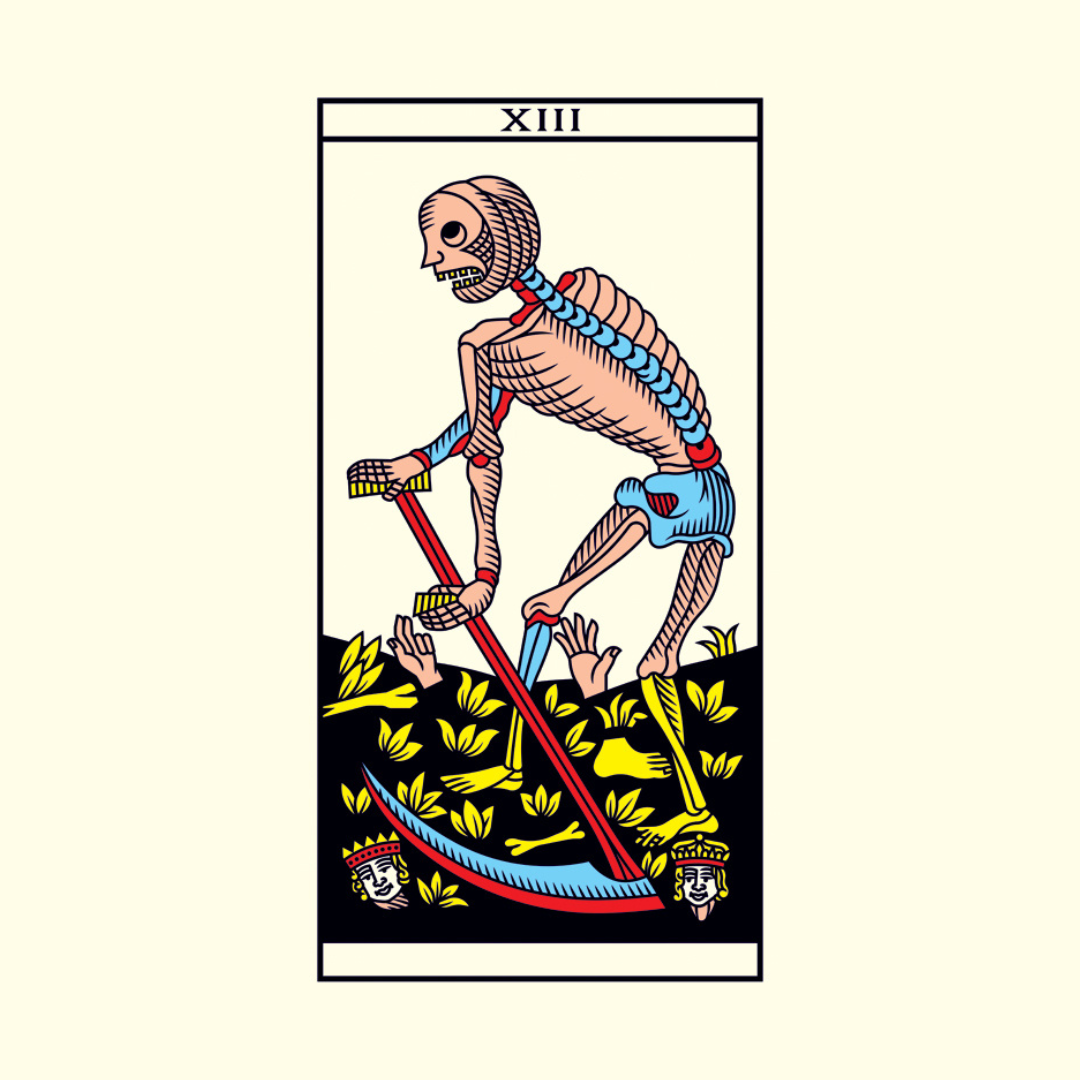

The thirteenth card cuts away what can no longer retain its form. In the Tarot de Marseille, a skeleton wields a scythe above black ground where heads, hands, and shoots appear. The card announces a real ending in the area under consideration: the end of a contract, a relationship, a role, or a way of life. It cannot be used to predict a person's physical death.
The title also calls for precision. Several Marseille editions print the number XIII without a name cartouche. The phrase “Arcanum without a name” is used today to designate this absence, but it was not the uniform title of the old decks. Other tarot decks clearly name the card “Death.” Using both names makes it possible to respect the card being examined without erasing its history.
Death in the earliest tarot decks
In the 15th-century Visconti-Sforza held by the Morgan Library, a skeleton holds a staff in each hand. A knotted cloth surrounds its forehead. The image has neither scythe nor rider, but it makes death recognizable through a body stripped of flesh. Morgan Library, Visconti-Sforza Tarot, Death.
The Tarot de Marseille gives the skeleton an agricultural tool. Its scythe cuts through human forms, while the black ground bears small colored shoots. The image associates destruction with the preparation of a plot of land. Nevertheless, it would be too quick to make it an automatic promise of rebirth: the cutting comes first, and the reading must show what can actually follow.
Iconographic reference. The absence of a title on certain XIII cards does not erase the skeleton or the scythe. Reading the card as a simple “positive transformation” weakens its imagery. It marks a loss of form, a separation, or a conclusion before any reconstruction.
From the reaping skeleton to Waite's rider
French occultists retain the number XIII and place the card under the letter Mem in their sequence. They develop the passage from death to renewal, but their correspondences belong to the 19th century. They should not be projected onto the Italian decks that predate these systems by several centuries.
The Golden Dawn chooses another letter: Nun, associated with Scorpio. In the Waite-Smith, death becomes an armored rider on a white horse. His black banner bears a white rose. A king lies on the ground; a child, a woman and a religious figure stand in the way. Between two towers, the sun rises or sets on the horizon.
Waite thus multiplies signs of continuity amid destruction. The rider turns aside for no rank. Yet the scene does not promise the return of what has disappeared. It shows that collective life continues after a conclusion that remains irreversible for the figures affected.
What the older authors attribute to it
Mathers assigns the card death, change and the alteration of a situation, favorable or unfavorable according to the neighboring cards. Reversed, it indicates a partial change. His list reminds us that nineteenth-century readers did not rule out the literal meaning, even though responsible practice does not turn a card into a diagnosis or an announcement of death.
Waite emphasizes the end, mortality, destruction and corruption. Reversed, the card takes on inertia, sleep, lethargy or destroyed hope. This last series shows a less spectacular aspect: the end has occurred, but the person remains motionless, unable to acknowledge the new situation.
Meaning in a spread
In a favorable reading
Death indicates a clear conclusion, a necessary separation, the abandonment of an exhausted structure, or a decision that makes going back impossible. It helps cut off dead commitments, finish what still occupies space without producing results, and make available ground that had previously been cluttered.
Its benefit does not lie in immediate joy. It lies in the clarity of the separation. A closed contract allows a new choice; an abandoned habit makes another rhythm possible; a position left behind ceases to define one’s entire identity. Reconstruction belongs to the cards that follow, particularly Temperance, the Star or the World.
In an unfavorable reading
The card may signal an unwanted breakup, a loss, destruction that was poorly prepared for, or a refusal to admit that a situation is over. It also shows a radical act carried out in anger, without protecting the resources needed for what follows. The first question therefore concerns the facts: what is truly over, what remains, and what transition needs to be arranged?
Love, work and finances
| Area | Favorable reading | Shadow aspect | Question to ask |
|---|---|---|---|
| Love | End of an old way of functioning, acknowledged break, bond completely redefined. | Forced separation, abrupt break, denial that a return is impossible. | What needs to be named as finished? |
| Work | Closure of a position, career change, abandonment of an exhausted method. | Dismissal, contract termination, loss of status. | Which rights, documents, and handoffs need to be secured? |
| Finances | Elimination of an expense, orderly liquidation, new budget after the break. | Net loss, exit costs, debt that survives the end of the project. | What remains to be paid after closure? |
| Project | Clear-sighted stoppage, sorting, complete replacement of an ineffective structure. | Premature destruction, resources discarded along with what fails. | What should be kept before closing? |
How to read its associations
Death brings an ending, severance, irreversibility, and stripping away. The neighboring card indicates what is ending, how the separation occurs, or what form the aftermath may take.
| Association | Possible dynamic | Point of caution |
|---|---|---|
| Death + Emperor | End of a structure, mandate, or established authority. | Organize the transfer of responsibilities. |
| Death + Lovers | A choice that ends a possibility or redefines a bond. | Accept that one choice closes off other paths. |
| Death + Justice | Official termination, judgment, contractual closure. | Check the legal and financial consequences. |
| Death + Hermit | Slow mourning for a position, withdrawal after a conclusion. | Do not confuse integration time with indefinite isolation. |
| Death + Wheel of Fortune | End of a cycle followed by a rapid change in circumstances. | The new movement does not restore the former state. |
| Death + Temperance | Gradual transition, reorganization after the break. | Allow time for practical adjustments. |
| Death + World | Complete conclusion, closed cycle, transition to another framework. | Recognize the achievement without holding on to what is ending. |
Correspondences according to the schools
| Indicator | Attribution | Historical scope |
|---|---|---|
| Family | Trump or major arcane XIII | Thirteenth card in the Marseille and Waite-Smith series. |
| Ancient figure | Skeleton carrying two staffs | Image from the 15th-century Visconti-Sforza. |
| Tarot de Marseille | XIII, skeleton, scythe, and black ground | The name is missing from several editions, but not all. |
| Modern designation | Nameless Arcane | Convenient designation for card XIII without a named cartouche; not a uniform title in old decks. |
| French occultism | Mem; death and renewal | Attribution found in the Papus-Wirth sequence. |
| Golden Dawn | Nun and Scorpio | Distinct system from the French suit Mem-Mort. |
| Waite-Smith | Rider, black banner, white rose, and sun | Occult composition that develops continuity after the end. |
| Element | Water in the Golden Dawn system | Indirect attribution through the sign of Scorpio. |
| Stone, plant, and season | No attribution shared by the old schools | Contemporary lists vary according to their authors. |
| Reading keywords | End, cutting, separation, closure, stripping away, transition | The card first names what is ending. |
| Shadow aspect | Loss, destruction, forced rupture, inertia, refusal of the end | Denial delays organizing what comes after. |
Choosing a tarot deck to work with this card
To find this arcane in a complete deck, compare the Tarot de Marseille decks, the Rider-Waite-Smith decks, and all of our divination tarot decks. If you are a beginner, also consult How to choose your first tarot deck?.
Reference sources and texts
Morgan Library, Visconti-Sforza Tarot, Death ; The Metropolitan Museum of Art, Before Fortune-Telling: The History and Structure of Tarot Cards ; S. L. MacGregor Mathers, The Tarot, 1888 ; Papus, The Tarot of the Bohemians, 1889 ; Oswald Wirth, The Tarot of the Medieval Imagery, 1927 ; Arthur Edward Waite, The Pictorial Key to the Tarot, 1911.










