















































































































































































































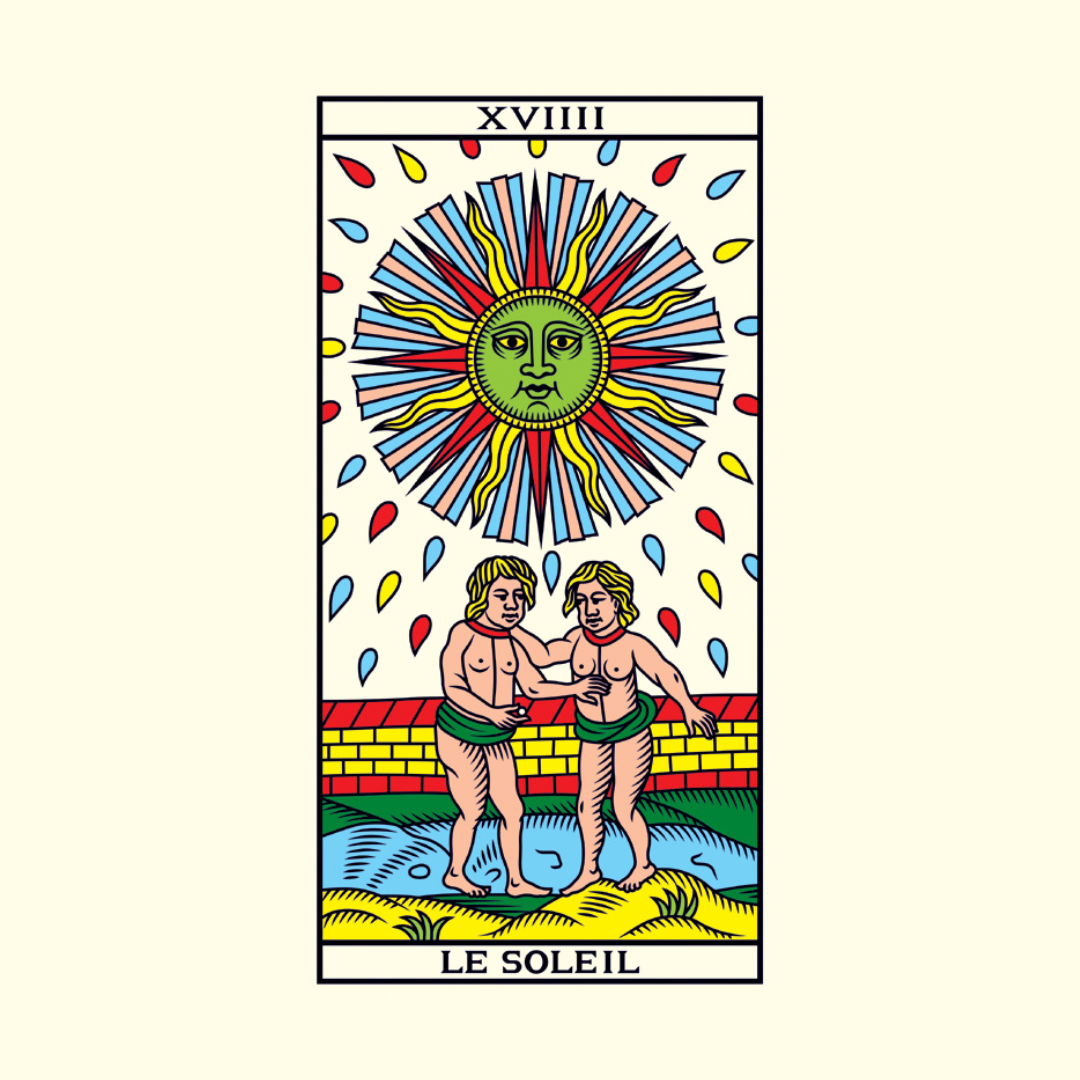

The Sun makes things visible. It illuminates an outcome, warms a bond, draws attention, and makes it possible to name what had remained uncertain. In a reading, the nineteenth card announces clarity, joy, harmony, recognition, or tangible success. Yet its light does not eliminate all restraint: exposure can be tiring, confidence can become pride, and success still needs to be maintained.
The card's history shifts the emphasis. The Visconti-Sforza Sun shows a winged figure presenting a radiant solar face. The Tarot of Marseille places two figures beneath the celestial body, behind a low wall. The Waite-Smith replaces this pair with a child riding a white horse. These differences allow each deck to be read in its own visual language.
The Sun in the earliest tarots
In the 15th-century Visconti-Sforza Tarot held at the Morgan Library, a young nude, winged figure stands on a cloud above a landscape. The figure holds a solar head surrounded by rays in both hands. This arrangement evokes less a scene of encounter than a presentation of the celestial body itself. Notice and reproduction of the Visconti-Sforza Sun, Morgan Library & Museum.
The earliest Italian tarots therefore do not all depict the two figures recognizable in Marseille decks. They bear witness to a phase in which celestial figures took changing forms. The presence of the sun is stable; the protagonists, their gestures, and the landscape are not. A historical reading begins with this distinction before interpreting each detail.
Iconographic reference. The couple or pair of children in the Tarot of Marseille does not appear in the Visconti-Sforza Tarot. The child on the white horse belongs to the deck by Pamela Colman Smith and Arthur Edward Waite.
From the winged figure to the child rider
In the Tarot of Marseille, a sun with a human face spreads its rays and colored drops. Two figures stand close to each other in front of a low wall. Their age, sex, and the exact nature of their relationship are not fixed by the image. It may suggest harmony, mutual recognition, sharing a protected space, or showing oneself openly, without turning these hypotheses into historical certainty.
Pamela Colman Smith radically changes the scene: a naked child, crowned with red feathers, rides a white horse and unfurls a red banner. Sunflowers rise behind a wall. Waite contrasts this direct light with the reflected light of the Moon and makes the child a figure of restored simplicity. This explanation describes the Waite-Smith deck published in 1911.
The Golden Dawn associates card XIX with Resh and the Sun as a planetary celestial body. Papus and Wirth follow a different sequence and place Qoph with the Sun. Unlike zodiac signs, a planetary attribution does not automatically lead to an element in this system. Adding Fire as an absolute equivalent is a modern simplification.
What the older authors attributed to it
Mathers summarizes the Sun as earthly happiness. In his divinatory list, the upright card brings happiness, contentment, and joy; reversed, it retains these qualities to a lesser degree. Waite assigns it material happiness, a happy marriage, and contentment. He too diminishes the effect when the card is reversed, without making it a disaster.
These meanings explain the card's favorable reputation. They do not promise that everything will be easy. The Sun shows what can be seen, celebrated, or shared. It can also expose an error, reveal a rivalry, and place someone under collective scrutiny. The light supports decision-making when it provides access to facts and genuine agreement.
Meaning in a reading
In a favorable reading
The Sun indicates a situation becoming clear, recognized success, an honest relationship, effective cooperation, or the pleasure of fully inhabiting what has been built. It favors announcements, public gatherings, sharing knowledge, visible creation, and results that several people can observe.
The card encourages saying things simply and sharing the credit. In a project-related question, it asks you to show the work, measure what is working, and bring people together around a common goal. Its warmth becomes fruitful when it circulates instead of serving a single image.
In an unfavorable reading
The card can signal pride, a need to be applauded, excessive exposure, exhaustion from constant activity, or confidence that refuses contradiction. It also shows a diminished or delayed success, or one that is less satisfying than expected. The answer is not to hide the result, but to examine its limits with the same frankness.
Love, work, and finances
| Area | Favorable reading | Shadow aspect | Question to ask |
|---|---|---|---|
| Love | Declared understanding, shared joy, shared project made visible. | Relationship put on display, competing egos, need for approval. | What are we building together away from the eyes of others? |
| Work | Recognition, cohesive team, public result, clear instructions. | Overload, rivalry over credit, excessive confidence. | What result can be demonstrated and shared? |
| Finances | Clear situation, identified gain, agreement under transparent conditions. | Showy spending, optimism without a safety margin, overestimated success. | What figure confirms the favorable impression? |
| Project | Visible launch, validation, effective communication, audience found. | Premature exposure, unsustainable pace, ignored criticism. | What limit protects continuity after the launch? |
How to read its associations
The Sun illuminates, brings together, and makes things public. The neighboring card specifies what receives this clarity: an initiative, an authority, a choice, a decision, confusion dispelled, an announcement, or the completion of a cycle.
| Association | Possible dynamic | Point of vigilance |
|---|---|---|
| Sun + Magician | Demonstrated talent, notable launch, first concrete success. | Do not confuse a favorable reception with finished work. |
| Sun + Emperor | Recognized authority, solid structure, consolidated result. | Make room for the team’s objections. |
| Sun + Lovers | Declared choice, emotional agreement, happy alliance. | Check that everyone gives the commitment the same meaning. |
| Sun + Justice | Clear decision, official recognition, situation regularized. | Distinguish satisfaction from genuine compliance. |
| Sun + Moon | Clarification, verified account, emergence from a confused period. | Accept the facts that correct the assumptions. |
| Sun + Judgement | Favorable announcement, public result, call heard. | Prepare for the consequences of this visibility. |
| Sun + World | Recognized achievement, shared success, broader visibility. | Close the cycle before opening the next one. |
Correspondences according to the schools
| Reference | Attribution | Historical scope |
|---|---|---|
| Family | Trump or Major Arcana XIX | Third great light after the Star and the Moon. |
| Early figure | Young winged figure bearing a solar head | Image from the 15th-century Visconti-Sforza. |
| Marseille Tarot | Sun, drops, two figures, and low wall | Distinct composition from the earliest Italian models. |
| French occultism | Qoph; light and earthly happiness | Attribution from the Papus-Wirth tradition. |
| Golden Dawn | Resh and Sun | Distinct system from the French sequence Qoph-Sun. |
| Waite-Smith | Child, white horse, red banner, and sunflowers | New composition published in 1911. |
| Element | No direct element in the Golden Dawn framework | The Sun is a planetary attribution here. |
| Stone, plant, and season | No attribution shared by the old schools | Contemporary lists vary according to their authors. |
| Reading keywords | Clarity, joy, harmony, recognition, success, visibility | Light makes it possible to observe and share. |
| Shadow aspect | Pride, overexposure, exhaustion, rivalry, blindness | Strong light can obscure nuances. |
Choosing a tarot deck to work with this card
To find this Major Arcana card in a complete deck, compare the Marseille Tarots, the Rider-Waite-Smith, and all our Divination Tarots. If you are just starting out, also see How to choose your first tarot deck?.
Reference sources and texts
Morgan Library & Museum, The Sun, Visconti-Sforza Tarot ; Accademia Carrara, Tarot Cards. Origins, Cards, Fortune, 2026 ; The Metropolitan Museum of Art, Before Fortune-Telling: The History and Structure of Tarot Cards ; S. L. MacGregor Mathers, The Tarot, 1888 ; Papus, The Tarot of the Bohemians, 1889 ; Oswald Wirth, The Tarot of the Magicians of the Middle Ages, 1927 ; Arthur Edward Waite, The Pictorial Key to the Tarot, 1911, card XIX ; Arthur Edward Waite, divinatory meanings of the Major Arcana.










