















































































































































































































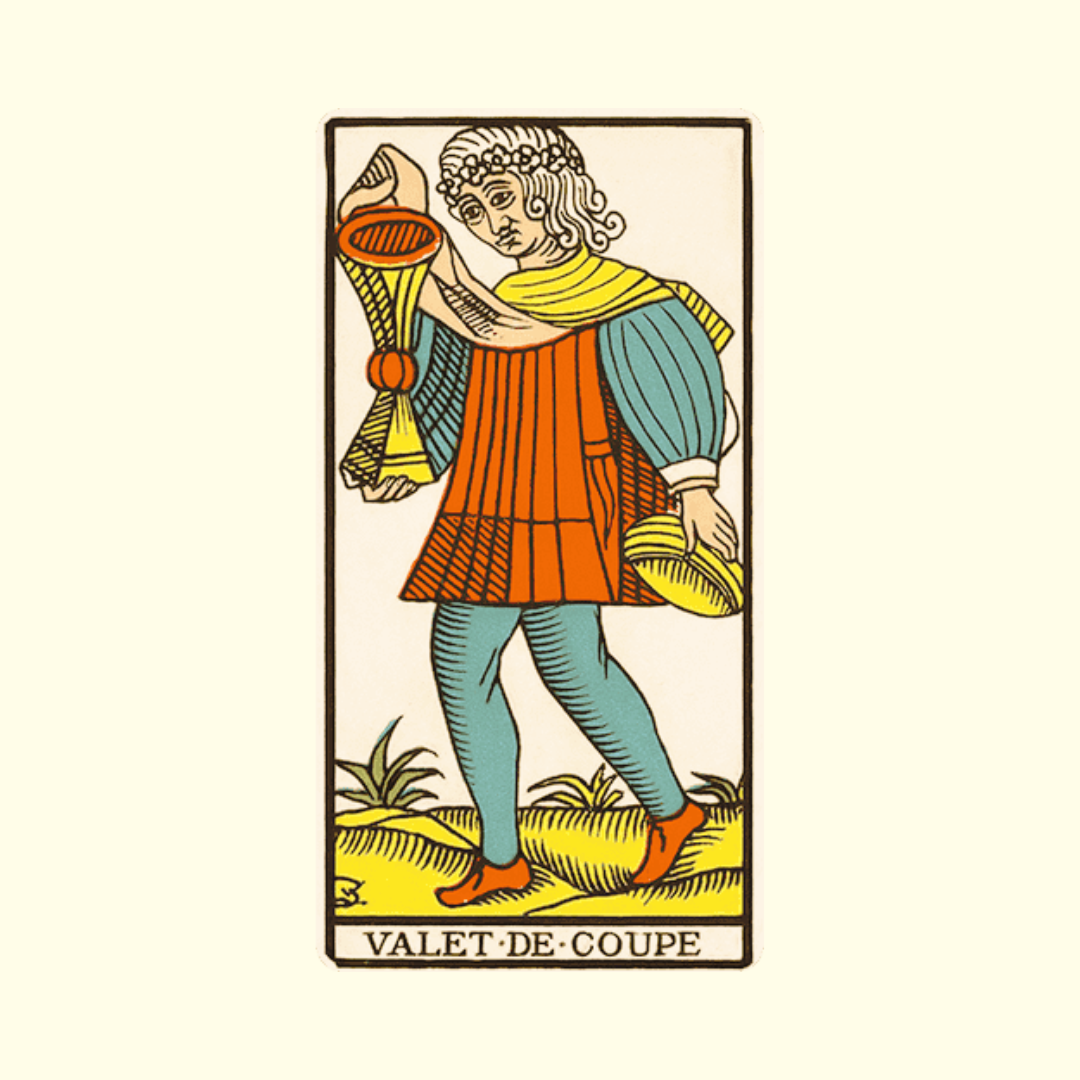

A young figure holds a cup attentively. In the Tarot de Marseille, the Page presents the emblem of his suit and holds its lid in his other hand. In the Waite-Smith, a fish emerges from the chalice and looks at the Page. The figure does not speak of defenseless naivety: it represents what is beginning to take shape in feeling, study, a message, or service, before it has acquired the mastery of the higher court figures.
The Page of Cups may represent a young person, a messenger, a student, a curious disposition, or the beginning of an emotional and creative apprenticeship. It brings news, a proposal, reflection, delicacy, and a willingness to serve. Its difficult side involves flattery, deceptive seduction, immaturity, or emotion used as a means of diverting a question.
Court cards require a more flexible method than numbered cards. They may designate a person, a role, a way of acting, or an event carried by someone. The age, gender, and appearance given in 19th-century catalogs reflect their era; they are not required for recognizing the Page's function in a current reading.
From the Page to the messenger of the cup
In a Tarot de Marseille, the Page stands holding a large cup and its lid. His gaze and stride are directed toward the emblem. The cup may be open or closed: the image gives the figure a concrete responsibility for what he carries. He receives, protects, presents, or hands over content that has not yet been consumed.
Smith dresses the Page in a tunic adorned with flowers and places him by the water's edge. He watches a fish emerge from the cup. Waite describes images of the spirit taking shape. The wonder comes from a precise and almost comical detail: the unexpected speaks from the vessel held by the figure. The card can therefore announce an idea, a message, or an emotion that surprises the person receiving it.
Iconographic reference. The fish emerging from the chalice belongs to the Waite-Smith. The Marseille Page holds a cup and its lid, with no animal or shoreline. In both decks, the figure remains standing and focused on the emblem they must understand, guard, or transmit.
Divinatory transmission
Mathers gives the Page of Cups a fair young man, confidence, probity, discretion, and integrity. Reversed, he becomes flattering, deceptive, or artificial. The text specifies that court cards may represent people; in that case, their abstract meaning should not be added mechanically. This rule protects the reading from overloaded portraits.
In Book T, the rank corresponding to the Page is called Knave or Princess. The “Princess of the Waters” carries a lotus and a cup from which a turtle emerges. She embodies gentleness, poetry, kindness, and imagination; in her degraded aspect, she becomes selfish and luxurious. The attribution “Earth of Water” describes the lower rank's ability to give concrete form to the matter of the suit. This nomenclature belongs to the Golden Dawn and should not be projected as an ancient code of the Marseille.
Waite describes a studious person, ready to be of service, then news, a message, application, reflection, and meditation, including in business matters. Reversed, it signifies taste, inclination, attachment, seduction, deception, and artifice. The Page therefore does not guarantee that a message will be sincere: the associated card shows its quality and effect.
Meaning in a spread
In a favorable reading
The Page of Cups shows an emotion that can be named without yet being mastered. A person expresses interest, apologizes, brings gentle news, or begins studying a symbolic, artistic, or relational language. The card favors listening, curiosity, and service rendered discreetly.
It can also describe the serious student. The talent exists in an emerging form and benefits from receiving a method, exercises, and someone capable of responding without humiliating them. The Page's astonishment then becomes a quality: they truly look at what appears.
In a tension reading
Sensitivity can serve as a mask for avoidance. The Page then indicates flattery, an enticing promise, an ambiguous message, an apology without making amends, changing attraction, or difficulty coping with a negative response. It may also represent a sincere person who is too inexperienced to keep the commitment announced.
The card does not confirm the truth of a message received. The sender, facts, date, and exact request must be verified. In an emotional question, the actions that follow matter more than the beauty of the declaration.
Love, work, and finances
The Page brings a message, a beginning, or learning. The area indicates what the Cup carries and the degree of maturity needed to give it a future.
| Area | Favorable reading | Tension aspect | Question to ask |
|---|---|---|---|
| Love | Tender message, measured declaration, sincere apologies, discovery of one's own feelings. | Flattery, seduction without follow-through, unstable emotion, expectation of an immediate response. | What concrete action accompanies the message received? |
| Work | Proposal, application, training, or trusted task assigned to a serious beginner. | Vague promise, hidden lack of experience, need for approval that prevents asking questions. | What framework and support will make learning safer? |
| Finances | Small offer, useful information, first budgeting lesson. | Emotion-driven purchase, overly enticing offer, mistake due to inexperience. | Are the conditions written down and understood? |
| Creativity | New idea, surprising motif, study, first project that needs form. | Daydreaming without work, attachment to the concept, giving up at the first criticism. | What exercise will turn the idea into reality? |
| Relationships | Sensitive listening, news, simple invitation, discreet help. | Indiscretion, distorted message, poorly handled intermediary role. | Can the message be conveyed without additions or pressure? |
Read the associations
The Page brings a message, a person who is learning, or a budding emotion. The associated card shows the nature of the news, its sincerity, and what may follow from it.
| Association | Possible dynamic | Point of caution |
|---|---|---|
| Page of Cups + Ace of Cups | A declaration, invitation, or emotional beginning presented sincerely. | The beginning still requires an answer and a framework. |
| Page of Cups + Eight of Pentacles | Applied study, or artistic or relational learning that progresses through work. | Sensitivity does not eliminate the need for repetition or method. |
| Page of Cups + Justice | Formal message, apology followed by reparation, proposal considered with moderation. | Check the terms before committing. |
| Page of Cups + Seven of Swords | Incomplete message, self-interested flattery, or someone avoiding saying everything they know. | Check the facts and retain useful exchanges. |
| Page of Cups + Moon | Rich imagination, dream, ambiguous news, or an emotion that is difficult to interpret. | Do not turn an impression into certainty. |
| Page of Cups + Knight of Cups | A message quickly receives a follow-up; an invitation becomes an initiative. | The progression may remain appealing without yet proving its stability. |
Correspondences according to the schools
The honest young man comes from Mathers; the Princess of the Waters and the Water of Earth from the Golden Dawn; the fish and mental imagery from Smith and Waite. The Marseille Knave retains his cup and its lid.
| Reference | Attribution | Historical scope |
|---|---|---|
| Suit | Minor arcana, Cups court card | Rank of the Knave or Page, depending on the edition. |
| Tarot de Marseille | Young figure standing with a cup and its lid | No fish emerges from the chalice. |
| Mathers, 1888 | Fair young man, confidence, honesty, discretion, integrity | Reversed: flattery, deception, and artifice. |
| Golden Dawn | Princess of the Waters, Lotus of the Palace of the Waves | The Knave or Princess corresponds to the lower court rank. |
| Rank element | Water of Earth | Attribution from Book T, not an inscription from the Marseille. |
| Astrology | No specific decan | The Princesses rule celestial quadrants in the Golden Dawn grid. |
| Waite-Smith | Page, cup, fish, shore, and floral tunic | Composition published in 1909. |
| Hebrew letter | No letter specific to this card | The letters are assigned to the trumps in this system. |
| Stone and plant | No historical agreement | Recent lists are not common to the cited sources. |
| Reading keywords | Message, study, service, sensitivity, flattery | Neighboring cards assess sincerity and maturity. |
Reading guidance
When the Jack represents a person, do not reduce the portrait to age or gender. Look for their function: are they receiving information, learning, serving as an intermediary, or presenting a cup? This approach makes it possible to recognize a child, a beginner adult, an employee entrusted with a message, or a part of the querent still in training.
With a Waite-Smith, ask what the fish is announcing and whether the Page can hear it. With a Marseille, look at the cup’s opening, the lid, and the direction of the step. The next card indicates what becomes of the contents after they are presented.
Choosing a tarot deck to work with this card
To find this arcana in a complete deck, compare the Tarot de Marseille, the Rider-Waite-Smith, and all our divinatory tarot decks. If you are just starting out, also see How to choose your first tarot deck?.
Reference sources and texts
For the history of decks and figures: Victoria and Albert Museum, A History of Tarot Cards; British Museum, reproduction of Nicolas Conver’s Tarot de Marseille.
For divinatory and occult texts: S. L. MacGregor Mathers, The Tarot, 1888, card meanings; Liber LXXVIII, “The Princess of the Waters,” publication of material from Book T; Arthur Edward Waite and Pamela Colman Smith, The Pictorial Key to the Tarot, Page of Cups, 1911.










