















































































































































































































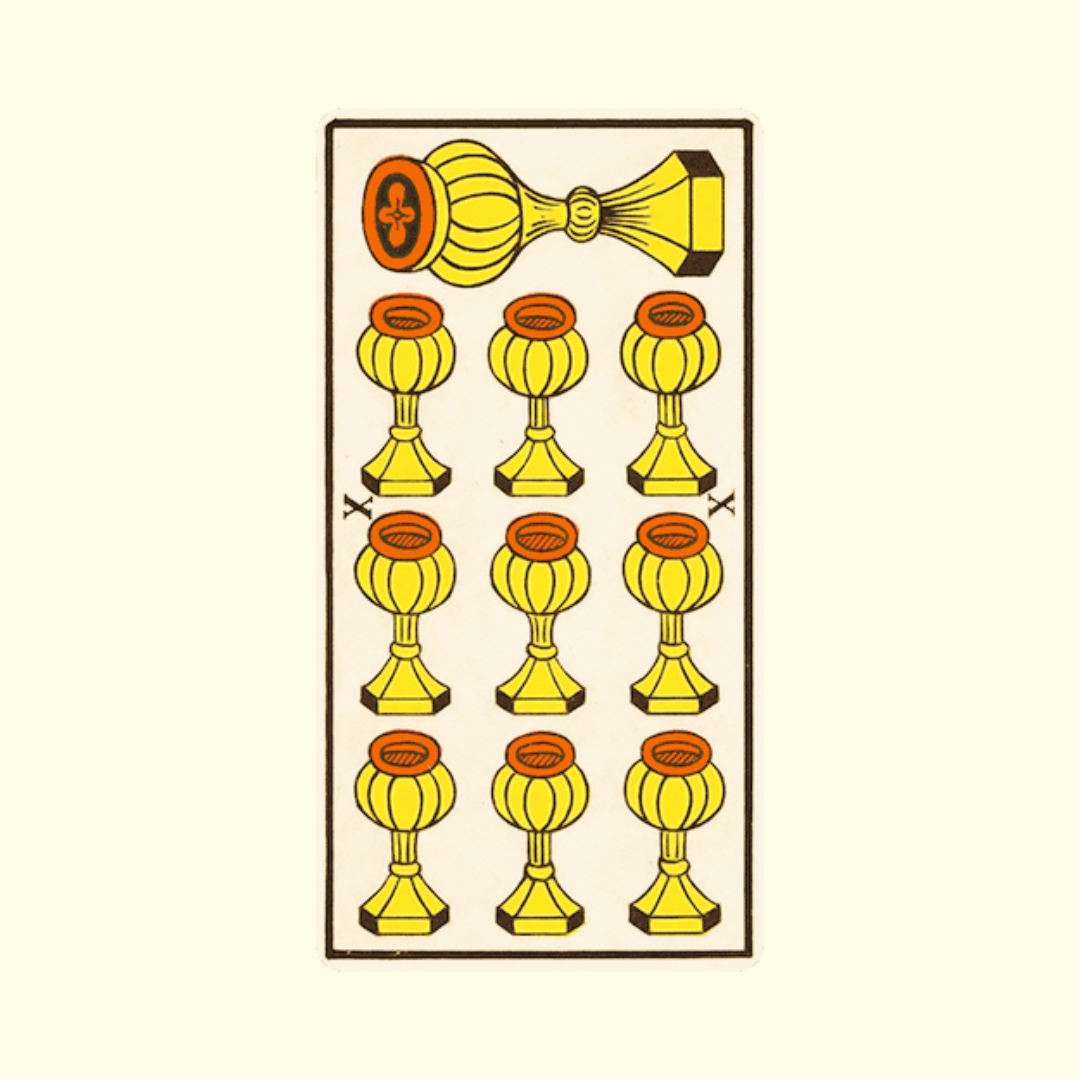

Ten cups complete the numbered series. In the Tarot de Marseille, they form a dense and symmetrical whole. In the Waite-Smith, they appear in a rainbow above a couple, two children, and a distant house. The card gives happiness a communal form: an inhabited place, recognized bonds, and a joy that extends beyond the satisfaction of a single person. This fullness remains alive only when everyone can occupy their true place within it.
The Ten of Cups speaks of shared contentment, human love, friendship, family harmony, a favorable reputation, and belonging to a place. It may mark the fulfillment of a relationship or collective project. It does not describe a perfect family: it shows an image of harmony whose foundations, duration, and truth the reading must verify.
Its story goes beyond the family scene. Mathers mentions the town where one resides, honor, esteem, and reputation. The Golden Dawn gives it the title “Accomplished Success” under Mars in Pisces, with a warning against excess and quarrels born of prolonged satiety. Waite brings together the heart, friendship, home, and the querent’s territory.
From the ten chalices to the happy home
In a Tarot de Marseille, ten chalices occupy the space in pairs and frame a central motif. No house or family appears. The number ten indicates the end of the series before the return to the court figures. A reading faithful to the image may speak of a complete whole, a framework that has reached maturity, or an organization that leaves little room for anything more to be added.
Smith places the ten cups within a radiant rainbow. A man and a woman contemplate them, one with an arm around the other, while two children dance. A house and a landscape lie beyond. Waite presents the whole as a domestic scene of contentment, love, and friendship. He adds the village, town, or country inhabited by the querent: happiness takes place somewhere, within a concrete community.
Iconographic reference. The rainbow, couple, children, and house belong to the Waite-Smith. In a Marseille deck, the Ten remains a suit card. Reading marriage, children, or a house into the latter deck requires clear support from the question or neighboring cards.
Divinatory transmission
Mathers associates the Ten of Cups with one's town of residence, honor, regard, esteem, virtue, glory, and reputation. Reversed, it indicates combat, opposition, differences, and dispute. This old list connects the card to the public square as much as to the family circle: the querent belongs to an environment that knows, judges, and recognizes them.
In Book T, the “Lord of Perfected Success” corresponds to Mars in Pisces. The ten cups overflow beneath the water of the lotuses. The text speaks of lasting happiness, a settled matter, kindness, generosity and calm. It also retains waste, dissipation, weariness and quarrels arising from excessive comfort. Fulfillment therefore does not eliminate the need to maintain harmony.
Waite emphasizes peace of the heart, the perfection of human love and friendship. With several court cards, he also sees a person who takes charge of the querent's interests. The reversed card can signal false contentment, indignation or violence. The happy home is therefore not a façade to protect: the favorable Ten rests on verifiable bonds, shared security and the possibility of discussing disagreements.
Meaning in a spread
In a favorable reading
The Ten of Cups shows a happiness that can be named in the plural. A relationship finds a framework, a family goes through a happy stage, a team shares a success, or a person discovers a place where they feel recognized. The card favors commitments that give affection a lasting form: living together, welcoming, celebrating, passing things on or building a shared life.
It can also confirm the value of an emotional support network. Security does not come from one person alone, but from a set of bonds, rules and places that make it possible to live with confidence.
In a tension reading
The happy image can become an obligation to smile, a reputation defended at the price of silence, or a family ideal that fails to respect the people present. The card then shows conflict beneath the façade, an imposed place, refusal to acknowledge a separation, or exhaustion caused by maintaining an artificial harmony.
The Ten can also signal that a collective cycle is full. A family, team or community must change its rules to accommodate a change. Without new space, fulfillment turns into saturation.
Love, work and finances
The Ten measures the quality of shared happiness. It asks who belongs to the circle, which rules support it, and which words remain difficult to hear.
| Area | Favorable interpretation | Tension aspect | Question to ask |
|---|---|---|---|
| Love | Lasting agreement, shared plans, relationship recognized by the close circle. | Ideal couple presented to others, disagreements left unspoken, family pressure regarding the form of the relationship. | Does living together meet the real needs of both partners? |
| Work | Supportive team, healthy culture, collective success, good reputation. | Conformity, conflict concealed by the group image, loyalty demanded at the expense of boundaries. | Does cohesion allow for disagreement and leaving? |
| Finances | Household security, a stable shared budget, a resource shared transparently. | Expense intended to maintain social standing, financial dependence on the circle. | Are rights, contributions, and responsibilities explicit? |
| Suit | Gathering, intergenerational support, welcoming home, peaceful transmission. | Imposed role, secret, family reputation protected from the truth. | Can everyone speak without losing their place? |
| Place of residence | Sense of belonging, supportive neighborhood, successful settlement. | Attachment to a place that no longer meets current needs. | Does the territory still support the life you want? |
Read the associations
The Ten brings shared fulfillment, home, and belonging. The associated card clarifies the framework's solidity, the event being celebrated, or the tension hidden behind the collective image.
| Association | Possible dynamic | Point of caution |
|---|---|---|
| Ten of Cups + Four of Wands | Party, home, union, or recognized collective milestone. | Celebration does not replace practical agreements. |
| Ten of Cups + Ten of Pentacles | Home, assets, and family continuity brought together in a single question. | Distinguish affection, property, and legal obligations. |
| Ten of Cups + Justice | Formalized commitment, family agreement, or decision that stabilizes the framework. | Tarot does not replace a contract or legal advice. |
| Ten of Cups + The Tower | Family or collective framework overturned, truth that breaks through a facade. | Rebuild after identifying what no longer held together. |
| Ten of Cups + Five of Cups | Shared joy achieved through loss, disappointment within the circle, or a difficult emotional inheritance. | Acknowledge the pain without erasing the bonds that remain. |
| Ten of Cups + Star | Peace, trust, and a sense of belonging after a difficult period. | Hope still requires a framework and reciprocal actions. |
Correspondences by school
The place of residence and reputation come from Mathers, Perfected Success and Mars in Pisces from the Golden Dawn, and the family beneath the rainbow from Smith. Marseilles preserves the ten chalices and their formal fullness.
| Reference | Attribution | Historical scope |
|---|---|---|
| Suit | Minor Arcana, Ten of Cups | Last pip card of the suit. |
| Tarot of Marseilles | Ten chalices arranged in a dense, symmetrical composition | Suitless, house-less pip card. |
| Mathers, 1888 | City of residence, honor, esteem, glory, reputation | Reversed: conflict, opposition, and dispute. |
| Golden Dawn | Lord of Perfected Success | Title from Book T. |
| Element | Water | Occult attribution of the color of the Cups. |
| Astrology | Mars in Pisces | Third decan of Pisces in the Golden Dawn grid. |
| Waite-Smith | Rainbow, ten cups, couple, two children, house | Scene published in 1909. |
| Hebrew letter | No letter specific to the card | The letters are assigned to the trumps in this system. |
| Stone and plant | No historical agreement | Contemporary lists do not constitute a common tradition. |
| Reading keywords | Shared happiness, home, belonging, reputation, fulfillment | The truth of the bond matters more than its appearance. |
Reading advice
In a family question, do not ask only whether happiness is present. Ask how it is built: who cares, who decides, who bears the cost, who can refuse, and who remains outside the picture. The Ten becomes reliable when agreement is visible in daily organization.
With a Waite-Smith, look at the distance between the family in the foreground and the house in the background. Is happiness being experienced now or projected into an idealized future? With a Marseille, observe the density of the ten chalices. The following cards indicate whether the cycle stabilizes, is passed on, or calls for a new form.
Choose a tarot deck for working with this card
To find this arcana in a complete deck, compare the Tarot de Marseille, the Rider-Waite-Smith, and all of our divinatory tarot decks. If you are just starting out, also see How to choose your first tarot deck?.
Sources and reference texts
For the history of decks and suits: Victoria and Albert Museum, A History of Tarot Cards; British Museum, reproduction of Nicolas Conver’s Tarot of Marseille.
For divinatory and occult texts: S. L. MacGregor Mathers, The Tarot, 1888, card meanings; Liber LXXVIII, “The Lord of Perfected Success,” publication of material from Book T; Arthur Edward Waite and Pamela Colman Smith, The Pictorial Key to the Tarot, Ten of Cups, 1911.










