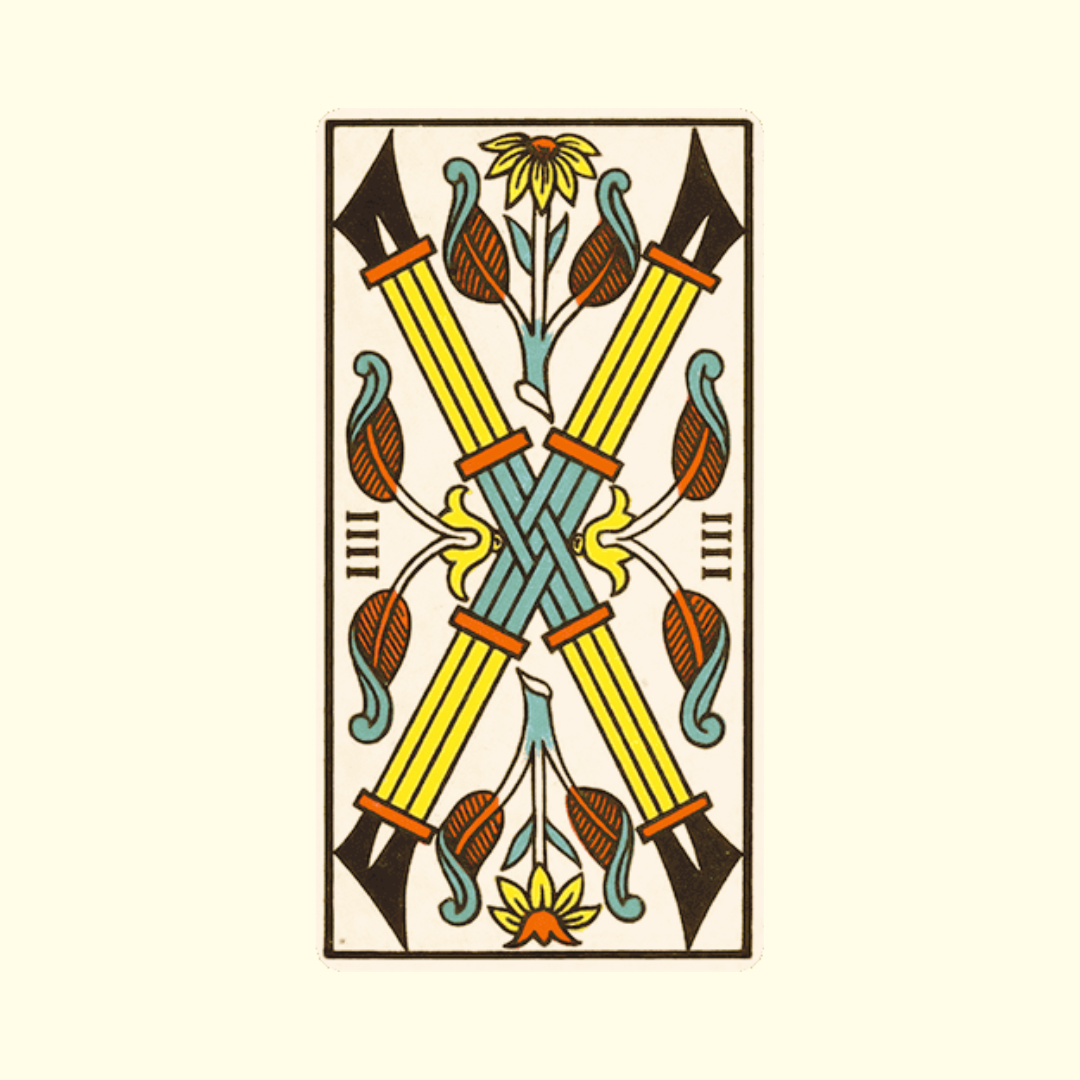

Four wands form a threshold. In the Tarot de Marseille, they create a regular framework amid leaves and flowers. In the Waite-Smith, a garland connects four poles in front of a residence, while two figures raise bouquets. The movement of the first cards finds here a place, an assembly, and a time of rest: something holds together well enough to be shared.
The Four of Wands speaks of shared structure, a completed stage, welcome, and concord. It may designate a home, a team, a ceremony, a meal, an association, or the framework that allows several people to acknowledge completed work. The card does not necessarily celebrate the end of the journey; it marks a stable plateau.
The early sources are remarkably favorable. Mathers cites society, union, association, and harmony, then gives prosperity and success to the reversal. Book T names it “Lord of Completed Work.” Waite maintains the meaning upright and reversed. The tense aspect must therefore be read in context: premature celebration, a closed group, superficial peace, or a setting that has become too comfortable.
From the framework of the wands to the house in celebration
In a Tarot de Marseille, four crossed wands construct a symmetrical trellis. The composition creates compartments occupied by plant motifs. No building or group appears on the card. The number four provides a visual foundation: the strength of the Wands no longer bursts forth alone; it is distributed through a form that can endure.
Smith transforms this framework into four vertical poles joined by a large garland. Two figures advance with bouquets; behind them, other figures gather near a bridge and a fortified residence. Waite evokes country life, refuge, harvest celebration, rest, concord, prosperity, and peace. The image thus connects work, place, and community.
Iconographic reference. The garland, bouquets, and house belong to the Waite-Smith. Marseille shows only a structure of wands and ornaments. The reading of stability can apply to both decks; the scene of a wedding, celebration, or return home depends on the English deck and the context.
Divinatory transmission
Mathers attributes society, union, association, concord, and harmony to the Four of Wands. Reversed, the card receives prosperity, success, happiness, and advantage. This catalogue makes the Four a place of collective agreement even before Smith depicted the house and the celebrating figures.
Book T gives it the title “Lord of Completed Work” and the correspondence Venus in Aries. Four wands or torches are held by two hands joined at the center. The text speaks of something completed after work, rest, beauty, joy, and success. It adds an unstable aspect linked to anxiety, haste, and lack of preparation.
Waite describes a refuge, a domestic celebration, harmony, prosperity, peace, and work brought to completion. He specifies that the reversal hardly changes the meaning: growth, happiness, and embellishment remain. This consistency rules out mechanically turning the reversed card into a rupture or an unhappy home.
Meaning in a reading
In a favorable reading
The Four of Wands shows that a framework can welcome joy. A team reaches a milestone, a home receives its guests, a contract finally makes it possible to work together, or a stage deserves recognition. Celebration is not a decorative extra: it confirms belonging, thanks the participants, and establishes a shared memory.
The card may announce a ceremony, family gathering, moving in, an opening ceremony, or a return to a safe place. It favors structures that are light but real: shared calendar, welcoming rules, distributed responsibilities, prepared space. Stability comes less from walls than from an agreement upheld.
In a tension reading
The celebration may come too early, the group may exclude those who contributed, or the peace may rest on an avoided issue. The framework then becomes a showcase, clan, or comfort that prevents what comes next. A welcoming home for some may remain closed to others; public success may conceal a fragile organization.
The tension does not come from the reversal alone, since Waite and Mathers retain favorable meanings in this position. It is read through the card’s placement and its neighbors. The useful question becomes: what have we actually completed, who can enter this framework, and what task resumes after the celebration?
Love, work, and finances
The Four indicates a shared framework and a milestone reached. The tableau conveys this stability without conflating welcome, marriage, property, and definitive success.
| Area | Favorable reading | Tension aspect | Question to ask |
|---|---|---|---|
| Love | Relationship finding a framework, welcoming home, celebrated commitment, family agreement. | Superficial peace, social pressure, couple defined more by the ceremony than by the relationship. | Does the chosen framework really suit both people? |
| Work | Completed stage, close-knit team, opening ceremony, shared rules that work. | Self-satisfaction, exclusion of a contributor, fragile process behind the celebration. | What work remains unfinished after this milestone? |
| Finances | Stabilized budget, spending related to a planned place or event, shared result. | Excessive reception expenses, an idealized property purchase, success displayed before the money is received. | Does the celebration respect the actual finances? |
| Home | Prepared home, welcome, moving in, sense of belonging. | Rigid family framework, space that does not protect everyone, conflict kept silent to preserve appearances. | Who truly feels safe here? |
| Collective life | Association, community, ceremony, or project gathered around a clear rule. | Closed clan, conformism, or unevenly distributed recognition. | Who built this result, and how will it be recognized? |
Reading associations
The Four provides a threshold, a place, or a shared stage. The neighboring card specifies what is being celebrated, what enters the house, and what still needs to be consolidated.
| Association | Possible dynamic | Point of vigilance |
|---|---|---|
| Four of Wands + Three of Cups | Collective celebration, reunion, shared event with a close circle. | Set limits on spending, time, and hosting. |
| Four of Wands + Ten of Pentacles | Durable home, family inheritance, property, or established activity. | The weight of family expectations may accompany security. |
| Four of Wands + Justice | Formalized union, contract, common rule, or structured ceremony. | Conformity does not guarantee emotional agreement. |
| Four of Wands + Tower | Upheaval of the setting, forced move, interrupted celebration, or structure revealed as fragile. | Rebuild after naming what was no longer holding together. |
| Four of Wands + World | Public accomplishment, completed cycle, welcome into a larger space. | Prepare the conclusion before opening a new cycle. |
| Four of Wands + Five of Wands | Stable group marked by competition or disagreement. | Prevent rivalry from turning the gathering into opposing camps. |
Correspondences according to the schools
The number four and the framework of wands are visible in French tarots. Venus in Aries and the Completed Work come from the Golden Dawn. The garland, bouquets, bridge, and house belong to Smith’s composition.
| Reference point | Attribution | Historical scope |
|---|---|---|
| Family | Minor Arcana, Four of Wands | Fourth numbered card of the suit. |
| Tarot de Marseille | Four crossed wands forming a framework with plant ornaments | Numbered-suit card without a building or depicted celebration. |
| Mathers, 1888 | Society, union, association, concord, harmony | Reversed: prosperity, success, happiness, advantage. |
| Golden Dawn | Lord of the Completed Work | Title of Book T. |
| Element | Fire | Occult attribution of the color of the Wands. |
| Astrology | Venus in Aries | Third decan of Aries in the Golden Dawn’s grid. |
| Waite-Smith | Four staffs, garland, bouquets, figures, bridge, and dwelling | Scene published in 1909. |
| Hebrew letter | No letter specific to the card | Numbered cards are not each assigned a letter in this system. |
| Stone and plant | No shared historical correspondence | Recent additions must not be presented as an old table. |
| Reading keywords | Framework, welcome, harmony, threshold, celebration, stability | Context distinguishes genuine fulfillment from superficial peace. |
Reading advice
First identify what forms the four pillars of the framework: people, rules, resources, place, or deadlines. Then ask what the garland celebrates. If the spread shows no concrete result, the card may speak of a need for structure rather than an achievement already secured.
In a love question, do not automatically conclude that marriage is indicated. In a real-estate question, promise neither a purchase nor a sale. Look for cards relating to contracts, material matters, and decisions. The Four of Wands describes a space where people can gather; the other cards reveal its duration and solidity.
Choosing a tarot deck to work with this card
To find this arcana in a complete deck, compare the Tarots de Marseille, the Rider-Waite-Smith, and all our divinatory tarot decks. If you are a beginner, also see How to choose your first tarot deck?.
Sources and reference texts
For the history of decks and suits: Victoria and Albert Museum, A History of Tarot Cards ; British Museum, reproduction of Nicolas Conver’s Tarot de Marseille.
For divinatory and occult texts: S. L. MacGregor Mathers, The Tarot, 1888, card meanings ; Liber LXXVIII, “The Lord of Perfected Work”, publication of the material from Book T ; Arthur Edward Waite and Pamela Colman Smith, The Pictorial Key to the Tarot, Four of Wands, 1911.