















































































































































































































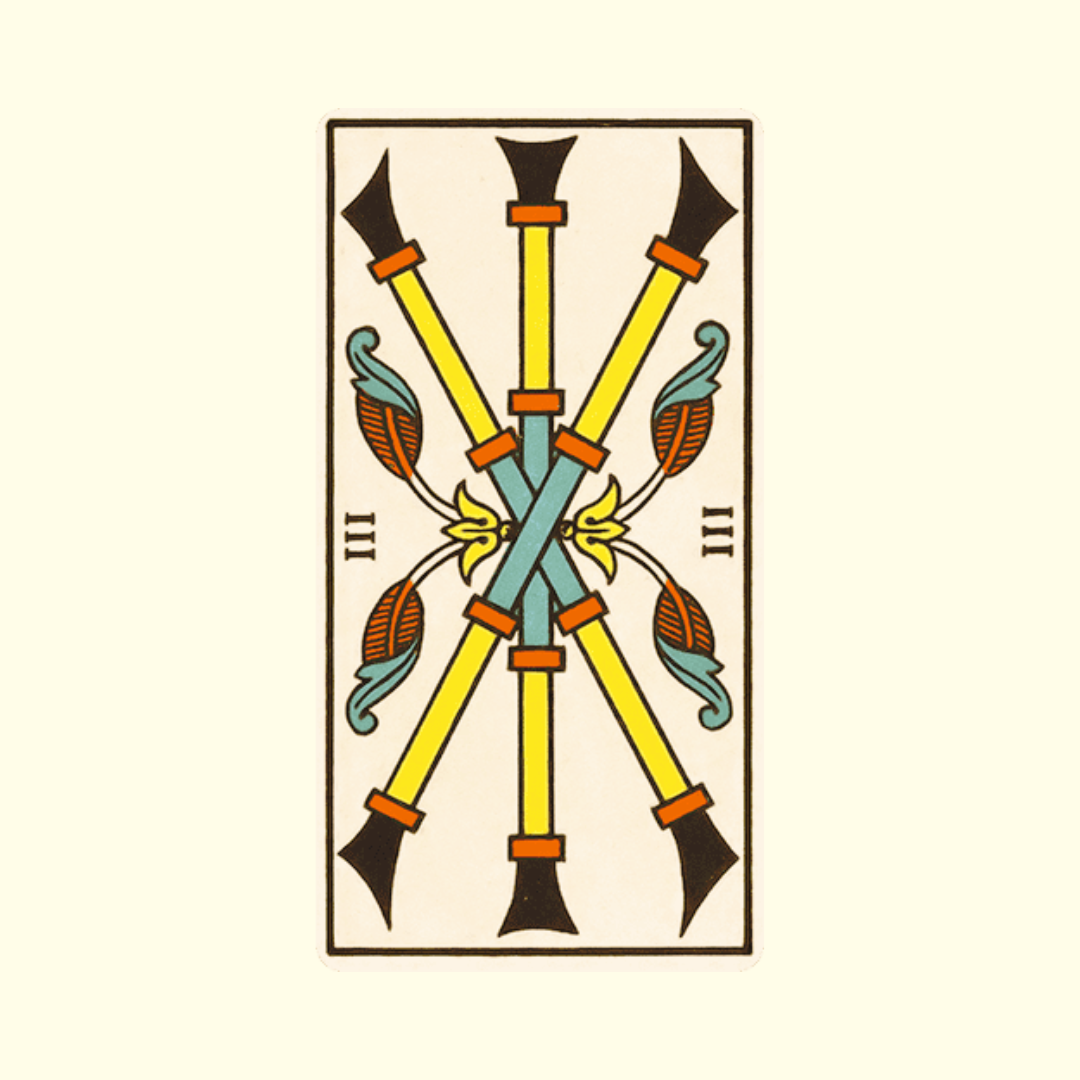

Three wands give the force a lasting foundation. In the Tarot de Marseille, they arrange the card around an axis and a vegetal network. In the Waite-Smith, a figure stands at the edge of a height and watches ships cross the sea. The project has left the realm of intention alone: it is circulating, meeting partners, and producing results that must now be monitored.
The Three of Wands belongs to an enterprise already under way. It speaks of commerce, expansion, cooperation, negotiation, and an expected return after an effort. Where the Two examines the territory, the Three sends something outward: merchandise, a work, a proposal, an application, or a message whose response also depends on others.
The sources converge on activity and established strength. Mathers cites enterprise, commerce, and negotiation. Book T gives the Sun in Aries and the title “Lord of Established Strength.” Waite describes a merchant whose ships carry his merchandise and adds the cooperation of a capable ally. The card therefore unites autonomy, networks, and active patience.
From the three wands to the awaited ships
In a Tarot de Marseille, three wands structure the space without creating a scene. The central wand asserts an axis, while the others establish a crossed framework. Leaves and flowers fill the open areas. The eye can follow the way the central unity holds the whole together: a direction becomes stable because it rests on several forces.
Smith places a figure with their back turned on a promontory. Three wands are planted in the ground; the figure leans on one of them and watches the ships. The boats are not clearly heading toward or away from the figure, keeping open the question of departure and return. Waite speaks of effort, commerce, discovery, and cooperation capable of supporting the enterprise.
Iconographic reference. The ships and the merchant come from the Waite-Smith. The Tarot de Marseille tells no story of maritime commerce. It does, however, provide the number three, the axis, and the balance of the wands, which make it possible to read a force that has left its initial state and is now organized.
Divinatory transmission
In his 1888 catalog, Mathers assigns the Three of Wands enterprise, business, commerce, exchange, and negotiation. Reversed, the card receives hope, desire, attempt, and wish. This difference may signal real action upright, followed by a project still suspended in expectation when the card loses its stability.
Book T calls it “Lord of Established Strength” and assigns it the Sun in Aries. Three wands held by a radiant hand produce flames at the center. The text cites established strength, fulfillment of hope, work completed, success after struggle, nobility, wealth and generosity. It also mentions pride, arrogance, stubbornness and excessive self-assertion.
Waite develops the commercial scene: the ships are carrying the character's merchandise. He adds discovery and the help of a capable partner. Reversed, the card may announce the end of difficulties or the cessation of adversity. This favorable reversal rules out a simplistic mechanism: the meaning depends on the position, the question and the cards that describe the ships' movement.
Meaning in a spread
In a favorable reading
The Three of Wands shows a project that exceeds its initiator. The first actions have been taken, contacts exist and a response may come from the market, an audience, an institution or a partner. The card supports openness, dissemination, export, useful travel and the ability to look beyond the usual framework.
It calls for active waiting. The querent should neither call every hour nor abandon what has been sent. They track deadlines, prepare the next step, check the intermediaries and remain available to adjust the offer. The strength is established, but the result is moving through a world that does not depend entirely on them.
In a tension reading
Expansion may exceed the company's real capacity. Too many territories are opened, the partners do not have the same interests, or the querent watches the results instead of dealing with what comes back. The card may also show pride, an exaggerated promise, dependence on an intermediary or prolonged waiting without a deadline.
A position of tension invites you to check the ships: what are they carrying, who owns them, what contract governs their route and when are they due back? This concrete translation distinguishes a normal delay from a project without follow-up. It also prevents announcing success simply because the horizon appears broad.
Love, work and finances
The Three connects the querent to a broader space. It speaks of movement, cooperation and results in progress, with distinct implications depending on the area.
| Area | Favorable reading | Tension aspect | Question to ask |
|---|---|---|---|
| Love | A shared project that expands, an organized long-distance relationship, a future discussed realistically. | Waiting for an absent partner, a project carried by one person, a promise without a date. | What shared action gives the project a reality? |
| Work | Business development, network, export, application submitted, competent alliance. | Dependence on an intermediary, growth that is too rapid, neglected follow-up. | Who is responsible for each step and each deadline? |
| Finances | Expected return on a measured investment, controlled diversification, income linked to an external market. | Money tied up, overstated return, expansion spending before the first proof. | What scenario protects cash flow if the return is delayed? |
| Creation | Work distributed, audience reached, editorial or artistic collaboration. | Creation adapted to the audience's presumed expectations, loss of personal direction. | Which feedback deserves a change, and which can be dismissed? |
| Journey | Journey linked to a business matter, prepared exploration, opening toward another territory. | Idealized distance or departure used to avoid a local problem. | What precise goal justifies the journey? |
Read the associations
The Three puts the project into circulation. The neighboring card shows what leaves, what returns, and the quality of the partner or expected result.
| Association | Possible dynamic | Point of caution |
|---|---|---|
| Three of Wands + Ace of Wands | A new impetus fuels expansion or opens a second phase. | Avoid launching multiple departures before consolidating the first. |
| Three of Wands + Three of Pentacles | Combined skills, professional collaboration, project built with clear roles. | Recognition must be shared as the work is. |
| Three of Wands + Chariot | Rapid expansion, decisive movement, logistical control. | Speed can conceal a coordination problem. |
| Three of Wands + World | International opening, completed distribution, cycle reaching a broad audience. | Prepare for closure and post-launch service. |
| Three of Wands + Seven of Swords | Discreet partner, undisclosed strategy, or opaque trade route. | Check the contract, ownership, and flow of information. |
| Three of Wands + Hanged Man | Delayed result, suspended expansion, waiting that changes the perspective. | Set a deadline before continuing to immobilize resources. |
Correspondences according to the schools
The Marseille Three remains a pip card. The Sun in Aries and Established Strength belong to the Golden Dawn. The ship scene comes from Smith, while the commercial vocabulary already appears in Mathers.
| Reference point | Attribution | Historical scope |
|---|---|---|
| Family | Minor Arcana, Three of Wands | Third numbered card of the suit. |
| Tarot de Marseille | Three wands arranged around an axis and plant ornaments | Card without a ship or figure. |
| Mathers, 1888 | Enterprise, business, commerce, exchange, negotiation | Reversed: hope, desire, attempt, wish. |
| Golden Dawn | Lord of Established Strength | Title of Book T. |
| Element | Fire | Occult attribution to the color of the Wands. |
| Astrology | Sun in Aries | Second decan of Aries in the Golden Dawn grid. |
| Waite-Smith | Figure seen from behind, promontory, three wands, and ships | Scene published in 1909. |
| Hebrew letter | No letter specific to the card | Number cards are not each assigned a letter in this system. |
| Stone and plant | No common historical agreement | Recent correspondences should remain distinct from older sources. |
| Reading keywords | Expansion, commerce, cooperation, active waiting, result | The context reveals what is circulating and what returns. |
Reading advice
Ask what has already been sent out into the world: an application, proposal, order, goods, words, or work. Then look for the announced timeframe and the person responsible for responding. The Three then becomes a follow-up card, not an abstract invitation to look far ahead.
If the reading concerns business growth, distinguish revenue, margin, cash flow, and logistical capacity. For a relationship, distinguish a stated plan from an action taken. The card can support expansion, but it requires support, measurement, and a destination.
Choose a tarot deck for working with this card
To find this arcana in a complete deck, compare the Tarots de Marseille, the Rider-Waite-Smith, and all our Divinatory Tarots. If you are a beginner, also see How to choose your first tarot deck?.
Reference sources and texts
For the history of decks and suits: Victoria and Albert Museum, A History of Tarot Cards ; British Museum, reproduction of Nicolas Conver’s Tarot de Marseille.
For divinatory and occult texts: S. L. MacGregor Mathers, The Tarot, 1888, card meanings ; Liber LXXVIII, “The Lord of Established Strength”, publication of material from Book T ; Arthur Edward Waite and Pamela Colman Smith, The Pictorial Key to the Tarot, Three of Wands, 1911.










