















































































































































































































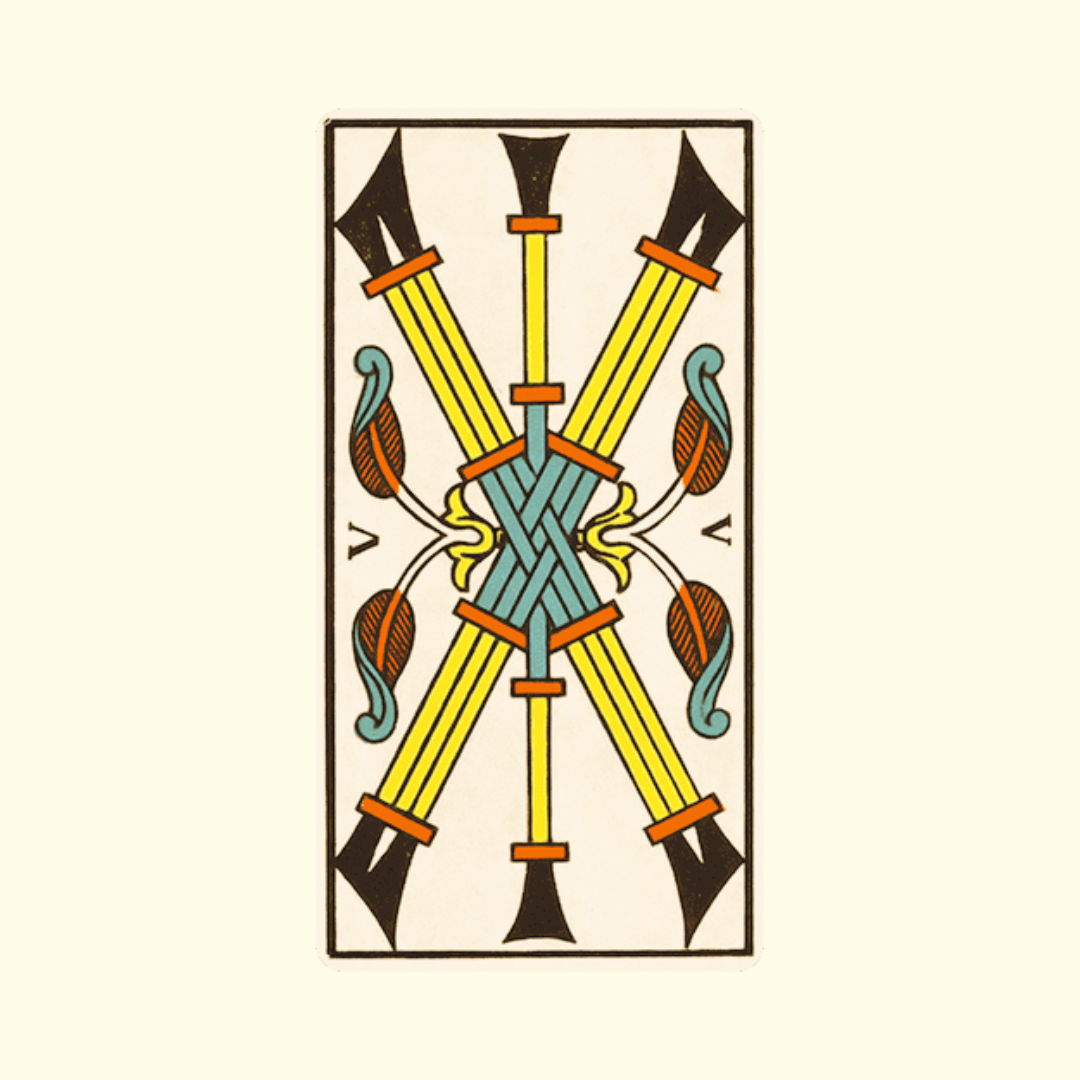

Five staffs disrupt the established order. In the Tarot de Marseille, their crossing tightens the composition around a central axis. In the Waite-Smith, five young men raise their staffs in a mêlée that Waite specifies resembles play as much as a struggle. The Five of Wands shows conflict, but also training, competition, and the energy of a group that has not yet found its rules.
This card does not describe every opposition as a war. It can signal a lively discussion, a competition, a trial, interests being measured against one another, or several active people without coordination. Conflict becomes useful when it reveals skills, forces the rules to be clarified, and brings the best solution to light. It becomes destructive when no one knows the goal or when winning matters more than building.
The older record is less uniform than current manuals. Mathers gives the Five wealth, gold, inheritance, and fortune, then reserves legal action and the court for the reversal. The Golden Dawn calls it the “Lord of Strife” and assigns it Saturn in Leo. Waite connects these two paths through fierce competition in the pursuit of money and success.
From the five staffs to training combat
In a Tarot de Marseille, five staffs form a dense pattern amid vegetal motifs. The central staff crosses or stabilizes the interweaving, depending on the models. No fighter appears. The reader first encounters an organization that has become denser: the forces collide, support one another, or compete for the same center.
Smith transforms geometry into a scene. Five young men brandish staffs that cross above them. Their postures are agitated, but no wounded person or victor stands out. Their clothes bear different colors, and no leader directs the group. Waite speaks of simulated war, play, struggle, and demanding competition.
Iconographic landmark. The mêlée of the five young men belongs to the Waite-Smith. The Marseille shows neither an opponent nor training. In both decks, the center receives several forces at once; the context determines whether they compete, learn to work together, or genuinely seek to harm one another.
Divinatory transmission
In The Tarot, published in 1888, Mathers attributes gold, opulence, gain, inheritance, wealth, fortune, and money to the Five of Scepters. Reversed, the card receives legal proceedings, judgment, law, lawyer, and court. This list shows that the modern association with conflict does not sum up all 19th-century cartomancy.
Book T gives it the title “Lord of Strife” and Saturn in Leo. Five torches cross, and a flame bursts forth at the center. The text evokes violent struggle, daring, recklessness, harshness, desire, extravagance, and generosity depending on the card's surroundings. The tension here arises from an expansive force that Saturn limits or frustrates.
Waite links struggle and gain. His figures engage in a mock battle, but the card also represents the harsh competition that accompanies the pursuit of wealth and fortune. Reversed, it takes up disputes, arguments, trickery, and contradiction. A contemporary reading can therefore distinguish between practice, economic rivalry, disagreement over methods, and open conflict.
Meaning in a spread
In a favorable reading
The Five of Wands can announce a confrontation that improves the result. Each person presents their solution, a team tests its reflexes, a candidate measures their level, or a negotiation reveals the true balance of power. The card encourages debate when the rules, timing, and common goal are known.
It can also indicate a phase of learning through trial. The querent has not yet mastered their technique, but progresses through opposition. Success comes less from an immediate victory than from the ability to listen, adapt their technique, and choose the battles that deserve their energy.
In a tension reading
The melee becomes sterile when everyone speaks at once, roles overlap, or a minor disagreement absorbs the objective. The card then shows internal rivalry, unfair competition, provocation, litigation, ego conflict, or an expenditure of energy without measurable results.
A position of tension calls for distinguishing between an adversary, a partner, and a mere objector. Not every raised wand poses the same threat. The useful question becomes: what rule can turn this clash into a fair contest, and which conflict should instead be left behind?
Love, work, and finances
The Five introduces several wills into the same space. The area being examined indicates what they seek to obtain and the rule that can prevent confusion.
| Area | Favorable interpretation | Tension aspect | Question to ask |
|---|---|---|---|
| Love | Frank disagreement, desire to clarify one's place, relationship stimulated by strong personalities. | Jealousy, romantic competition, repeated arguments, or the need to have the last word. | Does the disagreement concern a fact, a boundary, or a power struggle? |
| Work | Emulation, call for bids, exchange of ideas, team testing several solutions. | Confused roles, internal rivalry, meeting without arbitration, territorial conflict. | Who decides, according to what criteria and on what date? |
| Finances | Price negotiation, commercial competition, effort to secure a contract. | Impulsive bidding, costly dispute, gain pursued without calculating the margin. | Does the potential benefit justify the cost of the struggle? |
| Creation | Stimulating workshop, useful criticism, style tested through confrontation. | Constant comparison, work modified to defeat a rival. | Which criticism genuinely serves the project? |
| Justice | Disagreement that can be arbitrated, arguments confronted within a framework. | Lengthy procedure, bad-faith opposition, desire to punish. | Can mediation or evidence reduce the conflict? |
Reading associations
The Five brings competition or disorder. The neighboring card shows whether the struggle produces a result, requires a rule, or turns into a lasting confrontation.
| Association | Possible dynamic | Point of caution |
|---|---|---|
| Five of Wands + Six of Wands | A competition finds its winner, or a team gains recognition after the ordeal. | Public success can prolong rivalries. |
| Five of Wands + Seven of Wands | The debate becomes a defense of a position against several opponents. | Avoid treating every objection as an attack. |
| Five of Wands + Three of Pentacles | Professional disagreement resolved through expertise and task allocation. | Cooperation requires an arbitrator or a set of specifications. |
| Five of Wands + Justice | Dispute, regulated contest, arbitration, or decision based on explicit criteria. | Facts and evidence matter more than personal conviction. |
| Five of Wands + Devil | Intense rivalry, power struggle, competition charged with desire or self-interest. | Manipulation, humiliation, or coercion can make the game dangerous. |
| Five of Wands + Temperance | Opposing forces learn to coordinate and share resources. | Reconciliation must not erase a real disagreement. |
Correspondences according to the schools
The five interlaced wands belong to French tarots. Saturn in Leo and the title of Strife come from the Golden Dawn. The young people in simulated combat are a creation of Smith, commented on by Waite.
| Reference point | Attribution | Historical scope |
|---|---|---|
| Family | Minor Arcana, Five of Wands | Fifth numeral card of the suit. |
| Marseille Tarot | Five interlaced wands and botanical ornaments | Suit card without combatants. |
| Mathers, 1888 | Gold, opulence, gain, inheritance, fortune, money | Reversed: procedure, judgment, law, lawyer, court. |
| Golden Dawn | Lord of Strife | Title from Book T. |
| Element | Fire | Occult attribution to the color of Wands. |
| Astrology | Saturn in Leo | First decan of Leo in the Golden Dawn grid. |
| Waite-Smith | Five young people, crossed wands, simulated combat | Scene published in 1909. |
| Hebrew letter | No letter specific to the card | The numbered cards are not each assigned a letter in this system. |
| Stone and plant | No common historical agreement | Recent additions must remain distinct from the cited sources. |
| Reading keywords | Competition, trial, debate, friction, training, conflict | The context distinguishes emulation from confrontation. |
Reading advice
First identify what each person wants to gain. If the five people are pursuing the same goal without rules, the first task is to define the roles and the decision criterion. If the goals are incompatible, negotiation or separating the areas will be more useful than another collective effort.
Do not automatically turn the card into a serious dispute. Observe the faces, injuries, positions, and outcome cards. In a financial or legal question, base the reading on figures, contracts, and qualified advice rather than on symbolic intensity alone.
Choosing a tarot deck to work with this card
To find this arcana in a complete deck, compare the Tarot de Marseille, the Rider-Waite-Smith, and all of our divinatory tarot decks. If you are a beginner, also see How to choose your first tarot deck?.
Sources and reference texts
For the history of decks and suits: Victoria and Albert Museum, A History of Tarot Cards; British Museum, reproduction of Nicolas Conver’s Tarot de Marseille.
For divinatory and occult texts: S. L. MacGregor Mathers, The Tarot, 1888, card meanings; Liber LXXVIII, “The Lord of Strife,” publication of material from Book T; Arthur Edward Waite and Pamela Colman Smith, The Pictorial Key to the Tarot, Five of Wands, 1911.










