















































































































































































































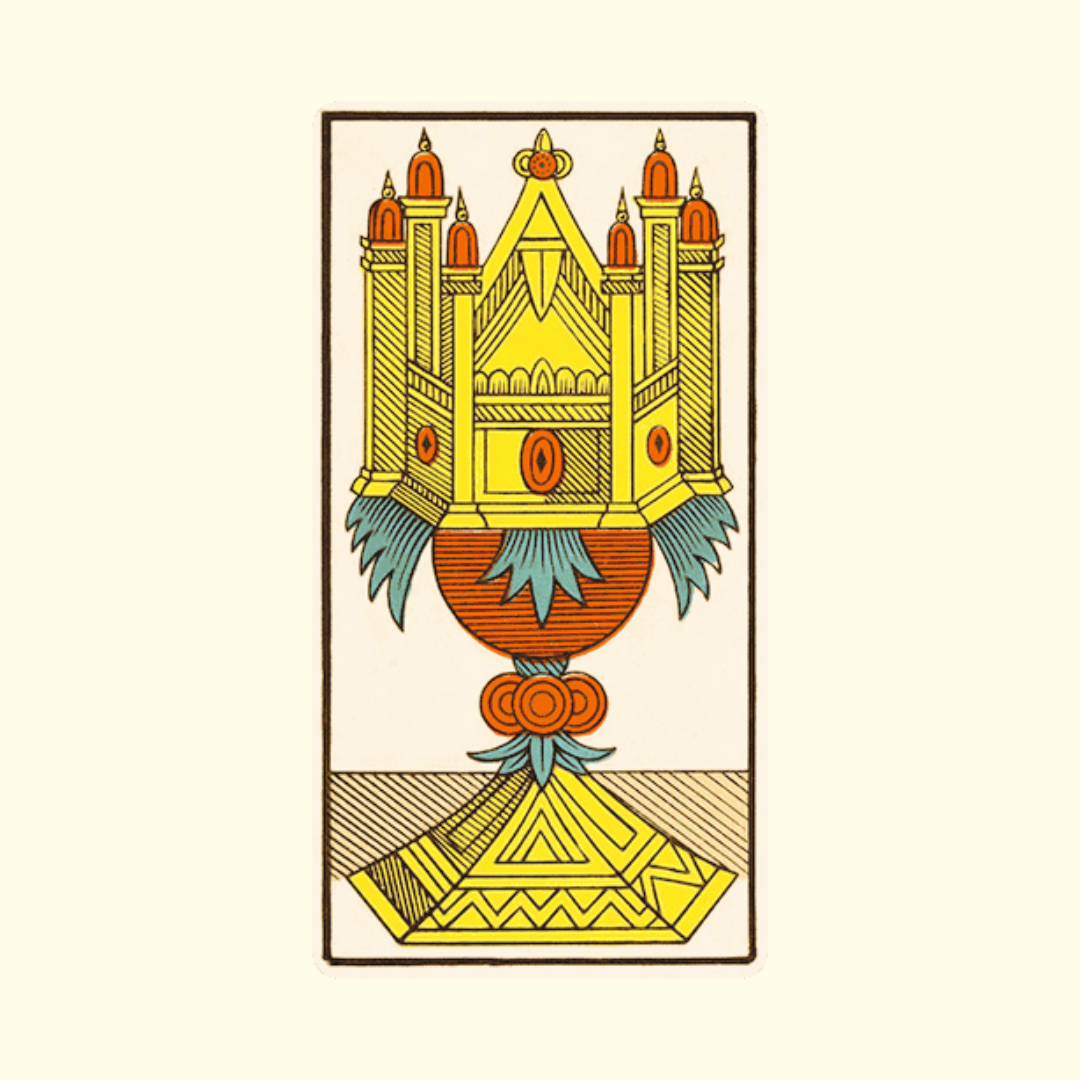

A chalice occupies almost the entire space. In the old decks, the Ace of Cups appears as the sovereign emblem of its suit: an ornate, upright, available vase. In the Waite-Smith, a hand emerges from a cloud and supports a cup whose water spills out. Between these two images, the card shifts from a playing-card emblem to a scene of offering, reception, and emotional beginning.
The Ace concentrates the suit without mechanically announcing its outcome. It may indicate that an emotion is forming, that a relationship is becoming possible, that a creative work is seeking its first container, or that a welcome is being offered. Nothing obliges the querent to drink from this cup: the card describes an openness, then the neighboring cards show what is made of it.
The reading becomes more precise when it separates three layers. The Tarot de Marseille provides the chalice and the rank of Ace. Nineteenth-century divinatory lists speak of feasting, celebration, and change. The Golden Dawn and then Waite assign Water to the suit and develop a religious and vegetal iconography. These layers can interact, provided they are named.
From the Marseille chalice to the offered cup
In a Nicolas Conver-style Tarot de Marseille, the Ace of Cups shows neither a figure, nor a cloud, nor a dove. A large symmetrical vessel, resembling an ornamental vase or miniature architecture, fills the card. Its monumental form asserts the cup before any narrative. The deck reproduced by the British Museum makes it possible to compare this suit with the numbered cards that follow: the object remains at the center, while the number organizes the series.
In 1909, Pamela Colman Smith composed an entirely narrative image. A hand emerging from a cloud holds the cup above water covered with water lilies. Streams and droplets fall, while a dove approaches a host marked with a cross. Waite himself describes this whole composition as a Eucharistic emblem. The W inscribed on the cup belongs to this English composition; it does not appear on the old Marseille Aces.
Iconographic marker. In a Marseille deck, the large chalice can be read as a capacity, a container, or the beginning of the suit of Cups. In the Waite-Smith, the offered hand, the water poured out, and the Eucharistic motif add reception, giving, and fertility. Using the second scene to comment on the first deck is a methodological choice, not an obvious conclusion drawn from the image.
The divinatory transmission
In The Tarot, published in 1888, S. L. MacGregor Mathers associates the Ace of Cups with the banquet, fine food, and celebration; reversed, he associates it with change, novelty, transformation, and inconstancy. He specifies that several remarks in his catalogue come from Etteilla. This source reminds us that the old cartomantic lists do not yet reduce the card to romantic beginnings alone.
The Golden Dawn document later circulated under the title Book T calls the Ace the “Root of the Powers of Water.” Its description already shows a radiant hand, a fountain cup, calm water, and lotuses. The text attributes fertility, productivity, beauty, pleasure, and happiness to it. Water here belongs to an occultist construction from the late 19th century; it is not found on the French tarot decks of earlier centuries.
Waite retains part of this heritage. In The Pictorial Key to the Tarot, he cites joy, contentment, the home, nourishment, abundance, and fertility. For the reversed card, he takes up instability and revolution. A contemporary reading may retain emotional openness, but it would lose part of the older record if it set aside the table, hospitality, the household, and the act of receiving.
Meaning in a spread
In a favorable reading
The Ace of Cups indicates that a vessel is ready. A feeling can be acknowledged, an offer welcomed, a tender word expressed, or a creation given form. The card speaks less of a relationship already built than of the first water being poured: what begins still requires time, a response, and a framework.
In a spread without reversed cards, its favorable aspect appears when the neighboring cards support reciprocity, commitment, or continuity. The Two of Cups provides a counterpart, the Three opens the way to sharing, and the Ten expands toward the household. The Ace alone remains an available promise, not a concluded contract.
In a tension reading
The cup may overflow, remain closed, or receive what cannot yet be contained. The card then signals overwhelming emotion, enthusiasm without follow-through, a need for affection projected onto a situation that is too new, difficulty accepting a sincere gesture, or a change in mood. The useful question then becomes: what can I truly welcome without losing myself or forcing the other person?
The reversal is not essential for reading this aspect. An obstacle position, the Four of Cups, the Devil, or a series of tense Swords may show excess, refusal, dependence, or the gap between momentum and facts.
Love, work, and finances
The Ace opens a possibility in the area being considered. It guarantees neither a meeting, nor a pregnancy, nor healing. The table below transforms its language of welcome into concrete questions.
| Area | Favorable reading | Tension aspect | Question to ask |
|---|---|---|---|
| Love | Emotional momentum, availability, sincere declaration, relationship that can begin. | Idealization of someone still little known, expectation of being fulfilled by the other. | Does the feeling receive a free and explicit response? |
| Work | Meaningful project, welcome into a team, creative proposal. | Decision made solely under the influence of enthusiasm or need for approval. | What conditions will allow the momentum to last? |
| Finances | Resource intended for the household, gift, assistance received, satisfaction linked to a chosen purchase. | Consolatory spending, limitless generosity, appealing offer without structure. | Does the action remain sustainable and verifiable? |
| Creation | First form, available imagination, work that finds its vessel. | Accumulation of ideas without realization or excessive attachment to the first draft. | What concrete support will receive this material? |
| Relationships | Hospitality, possible reconciliation, pleasure in opening one’s table or home. | Hospitality granted against one’s will, overly permeable boundary, expectation of gratitude. | What can I offer without giving up my boundaries? |
Reading combinations
The Ace brings openness and the raw material of the suit. The card accompanying it indicates whether this water is shared, held back, troubled, or directed toward a project.
| Combination | Possible dynamic | Point of caution |
|---|---|---|
| Ace of Cups + Two of Cups | An emotional or relational offer finds a response. | Reciprocity must appear in actions, not only in the querent’s desire. |
| Ace of Cups + Three of Cups | Joy offered to the group, an invitation, celebration, or collective creation. | Watch for excess and scattering within the social circle. |
| Ace of Cups + Four of Cups | An offer exists, but it has not yet been received or understood. | Do not pressure someone who needs time to step back. |
| Ace of Cups + Lovers | Emotional momentum meets a choice, an agreement, or an alliance. | Attraction replaces neither decision nor consent. |
| Ace of Cups + Devil | Powerful desire, intense pleasure, creative or sensual fascination. | Name dependence, control, secrecy, or compensation if the context indicates them. |
| Ace of Cups + Star | Renewed trust after a dry period, simpler expression of feelings. | Do not turn calm into a promise of results. |
Correspondences according to the schools
False tables assign the Ace a planet, a Hebrew letter, a stone, and a plant as if all schools had transmitted them together. The historical record is more restrained: the chalice is ancient, Water and the “root” belong to the Golden Dawn system, while the offering scene comes from Smith and Waite.
| Reference | Attribution | Historical scope |
|---|---|---|
| Family | Minor Arcana, suit of Cups, rank of Ace | Common structure of 78-card tarot decks. |
| Tarot of Marseille | Large ornate chalice | Central emblem without a figure or offering scene. |
| Mathers, 1888 | Celebration, banquet, good food; reversed: change and inconsistency | Divinatory list connected to the legacy of Etteilla. |
| Golden Dawn | Root of the powers of Water | Occultist title from the late 19th century. |
| Element | Water | Attribution from the English occultist grid, adopted by many modern decks. |
| Decan and planet | None | Aces represent the root of their element and do not receive the decan assigned to the cards from Two to Ten. |
| Waite-Smith | Hand in a cloud, cup, water, dove, host, water lilies | Composition published in 1909, explained by Waite in 1911. |
| Hebrew letter | No stable attribution specific to this card | The old Aleph-As table is not a common rule across tarot systems. |
| Stone, plant, season | No historical agreement | A recent editorial attribution must be identified as such. |
| Reading keywords | Welcome, beginning, feeling, hospitality, creative fertility | Reading summary, not an automatic prediction. |
Reading guidance
Start by looking at the state of the vessel. Is it offered, closed, full, overflowing? Then ask who gives, who receives, and what the next card does with this offering. With a Marseille deck, the composition of the chalice, its base, and its opening will guide the reading more strongly. With a Waite-Smith deck, the hand, water, and dove already establish an action.
For a love question, the Ace alone is not enough to announce a lasting relationship. Look for a significator, a decision, and continuity in the rest of the spread. For a physical or family question, do not attribute a pregnancy or healing to it alone: the symbol's fertility remains figurative language.
Choosing a tarot deck to work with this card
To find this arcana in a complete deck, compare the Tarots de Marseille, the Rider-Waite-Smith, and our full range of divinatory tarot decks. If you are a beginner, also see How to choose your first tarot deck?.
Sources and reference texts
For the history of decks and suits: Victoria and Albert Museum, A History of Tarot Cards; British Museum, reproduction of Nicolas Conver's Tarot de Marseille.
For divinatory and occult texts: S. L. MacGregor Mathers, The Tarot, 1888, card meanings; Liber LXXVIII, publication of material from Book T; Arthur Edward Waite and Pamela Colman Smith, The Pictorial Key to the Tarot, Ace of Cups, 1911.










