















































































































































































































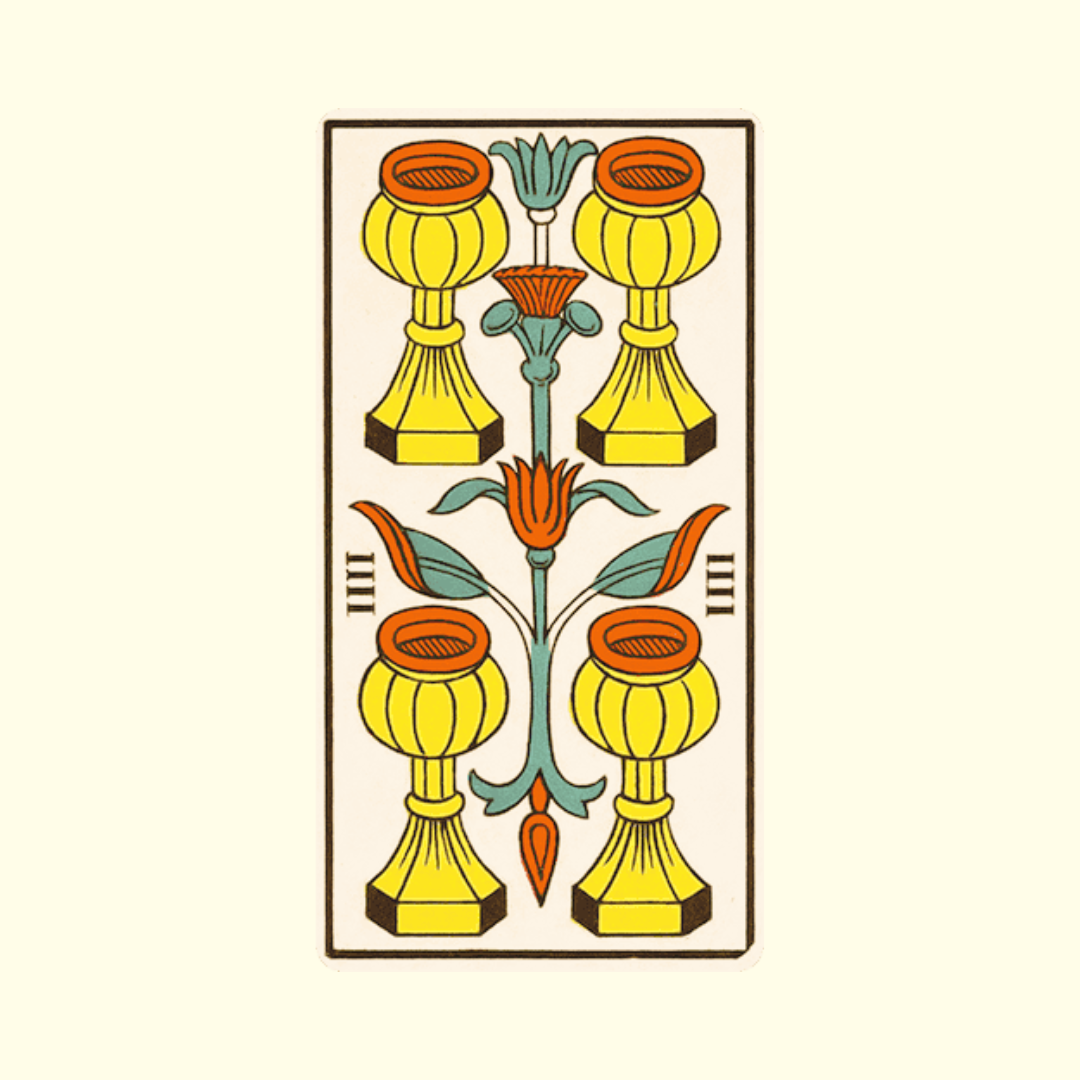

Four cups can form a stable, almost motionless order. In the Tarot de Marseille, they frame a vegetal axis and stand in closed symmetry. In the Waite-Smith, a young man seated beneath a tree looks at three cups while a hand presents him with a fourth. The number becomes a scene of satiety: everything is there, but nothing yet touches the one who is looking.
The Four of Cups speaks of pleasure that has reached a plateau, withdrawn attention, an offer being evaluated, or weariness. It does not command you to accept what is offered. It asks you to examine whether the refusal protects a justified boundary, responds to genuine fatigue, or comes from a confinement that can no longer see any possibility.
This card shows how much the schools transform the minor arcana. The Marseille shows neither a tree, nor a character, nor a hand in a cloud. Boredom appears in the divinatory lists of the 19th century, the Golden Dawn adds the Moon in Cancer and “blended pleasure,” then Smith gives this suspension a face and a posture.
From four chalices to the refused offer
In a Tarot de Marseille, four chalices are arranged in pairs around a central motif. Their balance can create an impression of structure, restraint, or repetition, but no figure refuses a cup. The reader can observe whether the ornament flows freely between the four objects or whether the composition appears saturated. This attention to structure respects the card actually laid on the table.
In Smith, a man sits with his arms and legs crossed. Three cups are lined up in front of him; a fourth is offered to him from a cloud. Waite emphasizes his discontent and describes fatigue, disgust, aversion, and imagined troubles. He also reprises the title “blended pleasure.” The character’s closed posture does not indicate why he refuses: that cause must come from the question and the neighboring cards.
Iconographic reference. The cup offered by an invisible hand belongs to the Waite-Smith. In a Marseille, the Four is read through the stability of the number, the repetition of the chalices, and the central axis. Both approaches can lead to the idea of a plateau or saturation, but they do not arrive there through the same image.
Divinatory transmission
Mathers associates the Four of Cups with boredom, displeasure, discontent, and dissatisfaction. Reversed, he mentions new acquaintance, conjecture, sign, and premonition. He also advises reading the following cards to understand the object of the displeasure, and the preceding cards to seek its origin. This advice remains fully relevant: the Four describes a state, not its cause.
In Book T, the card becomes the “Lord of Mixed Pleasure,” attributed to the Moon in Cancer. Two upper cups overflow into two lower cups, which do not overflow. The text speaks of a pleasure nearing its end, a stationary period in happiness, and a benefit received with discomfort. This nuance is richer than the simple refusal of an opportunity.
Waite takes up Mathers's boredom and the Golden Dawn's mingled pleasure. Smith brings them together in a man who no longer finds consolation in the three cups already present or in the one approaching. The modern card therefore emerges from a precise combination of a cartomantic list, a Hermetic title, and visual invention.
Meaning in a spread
In a favorable reading
The Four may authorize a pause. The querent does not have to respond immediately, feel cheerful on command, or accept a proposal simply because it seems generous. The card favors temporary withdrawal, sorting through needs, protection from excessive demands, and examining an offer before committing.
It can also show that a familiar pleasure no longer nourishes you in the same way. This realization does not require an abrupt breakup. It opens the way to a review: what needs to be renewed, reduced, left behind, or received differently?
In a tension reading
The pause becomes closure when no proposal is considered, general discontent replaces an examination of the facts, or comparison with an ideal makes every experience disappointing. The card may then speak of apathy, sulking, saturation, an ignored opportunity, or a habit that has become sterile.
It cannot diagnose depression. If the question concerns lasting distress, a loss of drive, or isolation that prevents one from living fully, tarot can help put what is happening into words, but a healthcare professional remains the appropriate person to consult.
Love, work, and finances
The Four asks you to distinguish a sound pause, specific dissatisfaction, and generalized refusal. The table helps turn the impression of being stuck into something that can be verified through observation.
| Area | Favorable interpretation | Tension aspect | Question to ask |
|---|---|---|---|
| Love | Need for perspective, desire to renew the relationship, refusal of an unsuitable proposal. | Distance maintained without discussion, partner kept at arm's length, weariness mistaken for absence of love. | Does the withdrawal have a stated duration and reason? |
| Work | Time for reflection, choosing not to accept a poorly defined assignment, seeking a fairer role. | Disengagement, boredom, an opportunity ignored on principle, complaint without action. | What specific condition would make the offer acceptable? |
| Finances | Refusal of an impulsive purchase, pause before investing, chosen frugality. | Indifference to finances, rejection of all help, compensatory spending after frustration. | Does the no protect the budget or avoid a necessary decision? |
| Social life | Withdrawal after a busy period, choosing a quieter circle. | Isolation, invitations refused without genuine desire, resentment toward the group. | What contact remains possible without exhaustion? |
| Creation | Time for things to settle, selection among several ideas, refusal of an unsuitable commission. | Blockage fueled by perfectionism, inability to see what is already working. | What limited attempt could help restore movement? |
Reading associations
The Four slows the sentence. The associated card indicates what is being refused, what led to satiety, or what can set attention in motion again.
| Association | Possible dynamic | Point of caution |
|---|---|---|
| Four of Cups + Ace of Cups | An emotional or creative offer arrives during a period of withdrawal. | Acceptance should be neither forced nor deferred indefinitely. |
| Four of Cups + Hermit | Voluntary withdrawal, patient examination, need for silence. | Solitude can become avoidance if no deadline is set. |
| Four of Cups + Wheel of Fortune | A stagnant situation changes and calls for a new response. | External change alone does not resolve the discontent. |
| Four of Cups + Eight of Cups | The assessment leads to leaving what no longer nourishes. | Check what has already been tried before leaving. |
| Four of Cups + Devil | Satiety, pleasure turned into habit, attachment that no longer satisfies. | Compulsion, dependence, or denial may call for outside help. |
| Four of Cups + Sun | Attention returns, an offer becomes clear, and joy can be received. | Do not demand immediate enthusiasm. |
Correspondences according to the schools
The attributions of the Four shed light on its modern construction, but they should not obscure the suit card. The number four suggests the framework; boredom comes from the divinatory tradition; the Moon in Cancer belongs to the Golden Dawn; the man beneath the tree is Smith’s image.
| Reference point | Attribution | Historical scope |
|---|---|---|
| Family | Minor Arcana, Four of Cups | Fourth numbered card of the suit. |
| Tarot de Marseille | Four chalices arranged in pairs around an axis | Suit card with no figure or offered cup. |
| Mathers, 1888 | Boredom, displeasure, discontent, dissatisfaction | Reversed: new knowledge, conjecture, sign, presentiment. |
| Golden Dawn | Lord of Blended Pleasure | Title of Book T. |
| Element | Water | Occult attribution of the color of the Cups. |
| Astrology | Moon in Cancer | Third decan of Cancer in the Golden Dawn system. |
| Waite-Smith | Man beneath a tree, three cups on the ground, a fourth offered | Scene published in 1909. |
| Hebrew letter | No letter specific to the card | The numbered cards do not each receive a letter in this system. |
| Stone and plant | No historical agreement | Lapis lazuli and lotus do not form a shared heritage in the cited sources. |
| Reading keywords | Pause, satiety, withdrawal, refusal, reassessment | The context distinguishes protection, weariness, and closure. |
Reading advice
First read what the figure is looking at, then what they are not looking at. In a Waite-Smith deck, the three cups on the ground may represent what has been gained, habit, or options already considered; the offered cup brings something new. In a Marseille deck, look instead for the balance or confinement created by the four chalices and their central pattern.
Set a time limit for withdrawal: when will the decision be revisited, what information is missing, and what concrete sign will indicate that the pause has served its purpose? This practice avoids glorifying immobility or condemning a legitimate refusal too quickly.
Choosing a tarot deck to work with this card
To find this arcana in a complete deck, compare the Tarot de Marseille, the Rider-Waite-Smith, and all of our divinatory tarot decks. If you are just starting out, also see How to choose your first tarot deck?.
Sources and reference texts
For the history of decks and suits: Victoria and Albert Museum, A History of Tarot Cards; British Museum, reproduction of Nicolas Conver’s Tarot de Marseille.
For divinatory and occult texts: S. L. MacGregor Mathers, The Tarot, 1888, card meanings; Liber LXXVIII, “The Lord of Blended Pleasure,” publication of material from Book T; Arthur Edward Waite and Pamela Colman Smith, The Pictorial Key to the Tarot, Four of Cups, 1911.










