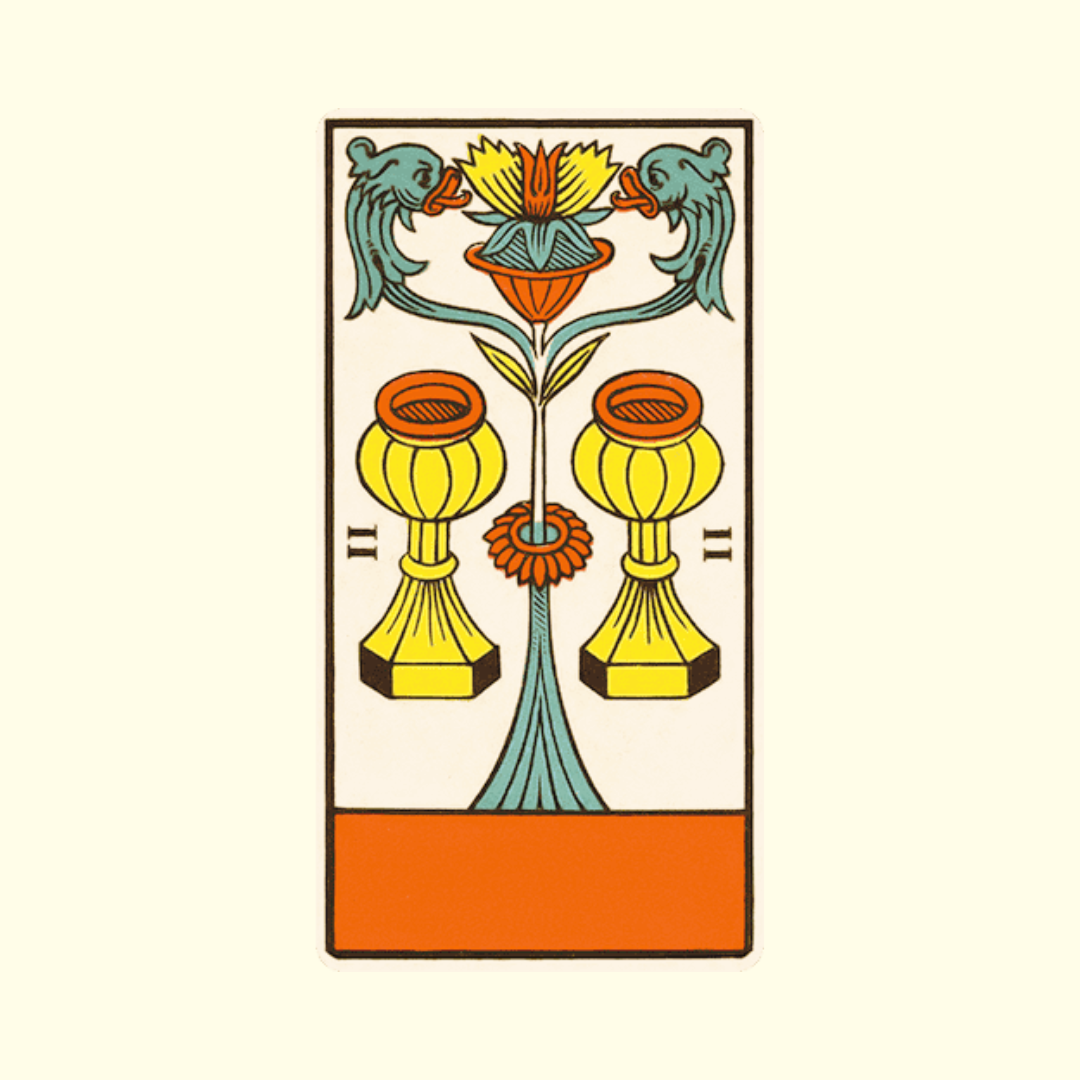

Two cups answer each other. In the Tarot de Marseille, they are connected by the vegetal ornament and by the balance of the composition. In the Waite-Smith, two people exchange their cups beneath a caduceus topped by a lion's head. The card becomes a visible encounter: each person holds their own vessel, each makes a gesture, and agreement can exist only in both directions.
The Two of Cups belongs to the vocabulary of connection: affection, friendship, alliance, reconciliation, work agreement, or exchanged words. It does not exclusively designate a romantic couple. Its strength comes from reciprocity, and its difficulty from the gap between what each person offers, understands, or consents to.
A rigorous reading avoids two shortcuts. The couple scene does not belong to Marseille cards, whose suits remain non-narrative. The association with Venus in Cancer is not a Renaissance datum: it comes from the astrological system developed by the Golden Dawn at the end of the 19th century.
From the two chalices to the encounter
On a Marseille Two of Cups, the two chalices occupy symmetrical positions around a stem, flower, or central motif. Nothing requires us to see two people in them. The card first offers a structure: two distinct containers, a shared axis, and the space connecting them. In a reading attentive to the image, this interval can speak of a proper distance, exchange, or mirroring.
Smith transforms this arrangement into a human scene. A young woman and a young man raise their cups toward each other. Between them rises the caduceus of Hermes, and a winged lion's head presides over the encounter. Waite describes a reciprocal commitment and links the card to love, friendship, affinity, union, harmony, and sympathy. The figures' posture matters as much as the symbol placed above them: each remains standing, facing the other, with their cup in hand.
Iconographic reference. In a Marseille deck, interpretation arises from the number two, symmetry, and the ornamental link. In a Waite-Smith deck, the scene already presents two figures who recognize each other. In both cases, the card preserves the difference between the partners: union does not mean fusion.
Divinatory transmission
In 1888, Mathers attributed love, attachment, friendship, sincerity, and affection to the Two of Cups. For the reversed card, he indicated frustrated desires, obstacles, opposition, and hindrance. This list, which he partly linked to Etteilla, already contains the core of modern interpretation without evoking either a predestined partner or a guaranteed bond.
In Book T, the Two is given the title “Lord of Love” and the correspondence Venus in Cancer. The text describes two cups fed by lotuses and two crossed dolphins; it retains harmony, pleasure, and union, with folly, waste, or thoughtless action when the card is poorly surrounded. This vocabulary belongs to the Golden Dawn, not the Tarot de Marseille.
Waite and Smith give this data an immediately readable form. Waite lists love, passion, friendship, affinity, union, harmony, and sympathy. Yet his card does not say that every encounter is good or lasting. An exchange can be sincere and remain brief; an agreement may require clauses; a reconciliation may require acknowledging what separated the two parties.
Meaning in a reading
In a favorable reading
The Two of Cups shows two wills capable of meeting. It may announce a frank conversation, a balanced agreement, mutual attraction, a working alliance, or the return of mutual attentiveness. The card favors simple gestures that make reciprocity visible: responding, apologizing, naming a boundary, sharing a commitment, or confirming a choice.
Its presence does not dissolve differences. On the contrary, the image works because two cups remain distinct. A good partnership protects each person’s identity, voice, and freedom. When the reading concerns a contract, the card encourages agreement but still calls for precise terms.
In a tension reading
The card may show an asymmetry: one person gives more, the other responds out of politeness, expectations remain unspoken, or the agreement conceals a conflict. It may also speak of thwarted desire, emotional dependence, premature reconciliation, or a partnership based on an unnamed third person.
Reversal is only one method among others. An obstacle position or cards such as the Seven of Swords, the Devil, or the Tower are enough to question loyalty, constraint, and the strength of the connection.
Love, work, and finances
The Two emphasizes the quality of the exchange. The area changes the form of the connection, but not the need to verify consent, balance, and genuine commitment.
| Area | Favorable reading | Tension aspect | Question to ask |
|---|---|---|---|
| Love | Mutual attraction, dialogue restored, commitment chosen by both people. | Projection, dependence, a relationship defined by only one partner. | What does each person give and receive? |
| Work | A complementary partnership, fair negotiation, a client and provider who reach an understanding. | A vague verbal agreement, poorly distributed roles, complacency that avoids a useful disagreement. | Are the responsibilities and boundaries written down? |
| Finances | A shared expense decided together, fair sharing, agreement on a contribution. | Emotional debt, an unbalanced joint account, trust substituted for documentation. | Does the sharing remain clear and sustainable for both parties? |
| Friendship | Listening, reparation, solidarity between two people. | Exclusivity, jealousy, an exchange maintained by guilt. | Does the relationship leave room for each person? |
| Negotiation | Common ground, mediation, a compromise that respects the common goal. | Outward peace or a concession granted under pressure. | Can the agreement be refused without hidden penalty? |
Reading associations
The Two gives the spread's sentence a relationship. The neighboring card indicates what brings the parties together, what they build, or what disrupts their balance.
| Association | Possible dynamic | Point of caution |
|---|---|---|
| Two of Cups + Ace of Cups | An offer or feeling receives a response. | Do not announce the duration before examining the continuity cards. |
| Two of Cups + Three of Pentacles | Alliance that produces joint work, with both parties' skills recognized. | Define each person's role to avoid emotional and professional confusion. |
| Two of Cups + Justice | Balanced agreement, shared decision, contract, or mediation. | The legal form must remain distinct from the personal understanding. |
| Two of Cups + The Lovers | Attraction and choice converge; the alliance requires a clear decision. | An alternative or hesitation may still weigh on the situation. |
| Two of Cups + The Devil | Magnetism, a pact of interest, a relationship charged with desire. | Control, debt, secrecy, jealousy, or domination must be named if the context confirms them. |
| Two of Cups + The Tower | Broken agreement, truth that changes the relationship, encounter that disrupts a balance. | Avoid repairing too quickly what has just revealed its fragility. |
Correspondences according to the schools
The number, suit, and composition are visible in early decks. The hermetic title and astrology belong to a dated school. Bringing them together remains possible if each layer retains its origin.
| Reference point | Attribution | Historical scope |
|---|---|---|
| Family | Minor Arcana, Two of Cups | Second numbered card of the suit. |
| Tarot de Marseille | Two chalices joined by a vegetal ornament | Pip card, with no couple depicted. |
| Mathers, 1888 | Love, attachment, friendship, sincerity | Reversed: thwarted desires, obstacles, opposition. |
| Golden Dawn | Lord of Love | Title of Book T. |
| Element | Water | Occult attribution to the color of the Cups. |
| Astrology | Venus in Cancer | First decan of Cancer in the Golden Dawn grid. |
| Waite-Smith | Two figures, two cups, caduceus, winged lion's head | Scene published in 1909. |
| Hebrew letter | No letter specific to the card in this system | The letters are attributed to the twenty-two trumps, not to the numbered cards. |
| Stone and plant | No historical correspondence | Rose quartz and jasmine come from contemporary lists that are not common to the cited sources. |
| Reading words | Reciprocity, agreement, affection, alliance, recognition | The card calls for two free and observable responses. |
Reading advice
In a relationship spread, first look at whether both people are actually represented or whether the querent alone carries the image of the couple. The cards placed on either side of the Two may show what each person contributes. This method prevents turning the desire for a connection into proof of reciprocity.
For a work-related question, translate union into concrete terms: who decides, who carries it out, who pays, who responds in case of failure? For a love-related question, maintain the same standard. The Two of Cups speaks of a possible or existing exchange; it certifies neither exclusivity, nor marriage, nor a shared destination.
Choosing a tarot deck to work with this card
To find this arcana in a complete deck, compare the Tarots de Marseille, the Rider-Waite-Smith, and all of our Divination Tarots. If you are a beginner, also see How to choose your first tarot deck?.
Sources and reference texts
For the history of decks and suits: Victoria and Albert Museum, A History of Tarot Cards; British Museum, reproduction of Nicolas Conver’s Tarot de Marseille.
For divinatory and occult texts: S. L. MacGregor Mathers, The Tarot, 1888, card meanings; Liber LXXVIII, “The Lord of Love,” publication of the material from Book T; Arthur Edward Waite and Pamela Colman Smith, The Pictorial Key to the Tarot, Two of Cups, 1911.