















































































































































































































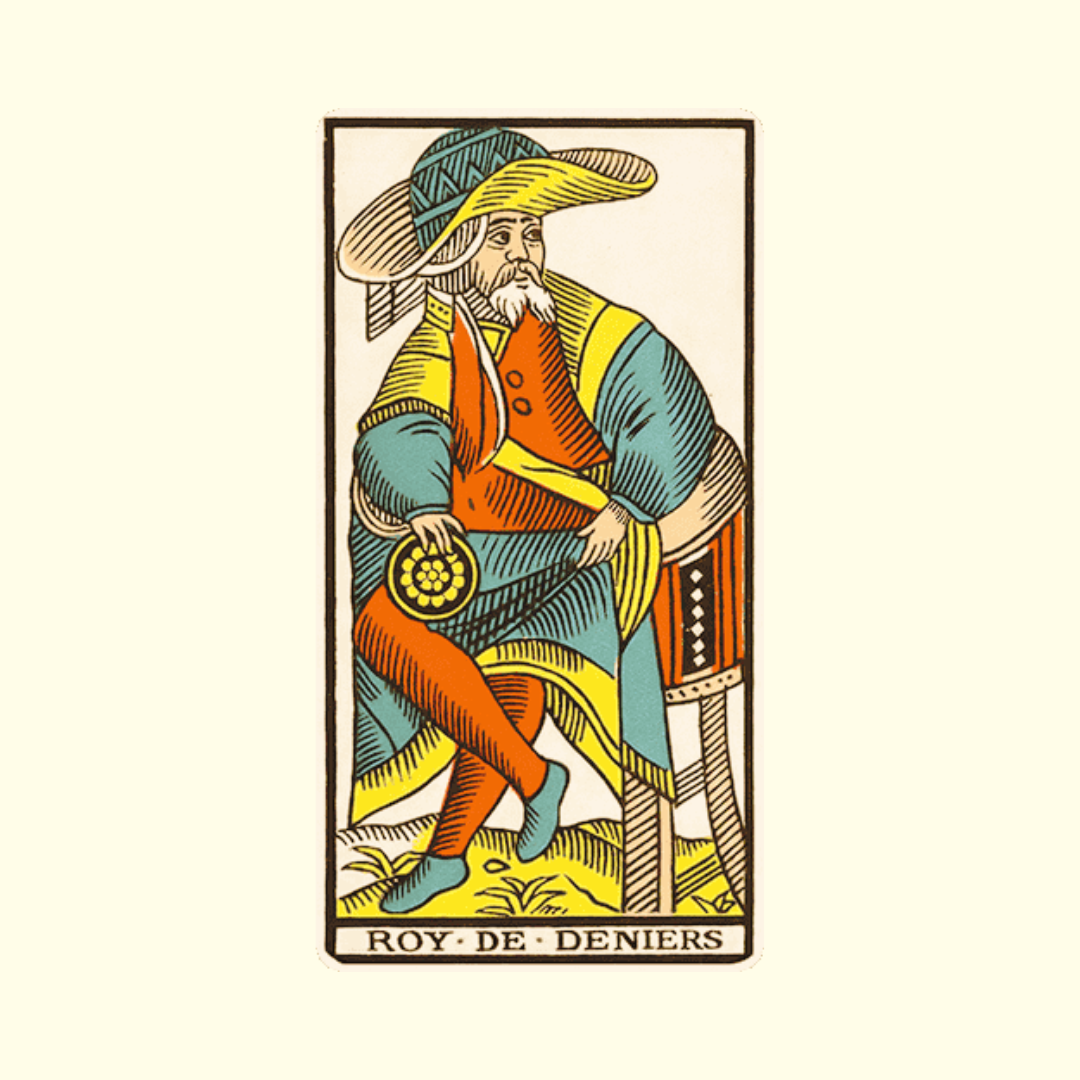

The King holds the denier as an exercised power. In French tarot decks, he bears the emblem of matter at the top of his court. In the Waite-Smith, his throne with bull heads stands amid vineyards, before a fortified city. The King of Pentacles knows how to turn a resource into lasting work, a skill into a result, and authority into protection; but his success becomes corrupted when it serves only accumulation, control, or the preservation of his rank.
The earlier article made the King a guarantee of prosperity, stability, and leadership. The texts are more ambivalent. Mathers brings together victory, courage, and success, then sets doubt, fear, and danger against them. The Golden Dawn emphasizes the ability to increase, consolidate, and apply material resources, but opposes this with selfishness, heaviness, and anger. Waite gives him an intelligence for achievement, aptitudes for business, and even mathematics, without declaring him morally just.
The King can represent a leader, an owner, or anyone who decides how a resource is used. His gender belongs to the court. The reading examines mastery, responsibility, and beneficiaries.
From the sovereign to the administered domain
In the Tarot de Marseille, the King is seated, crowned, and holds the denier as an insignia. The position of the disk, the posture, and the scepter vary according to the workshops. Nothing shows a business, a fortune, or a castle. Rank signals authority; the neighboring cards reveal how it is used.
Smith depicts a sovereign covered by a robe adorned with fruit and foliage. He holds a scepter and a pentacle. Bull heads decorate the throne, grape clusters surround the scene, and a city appears behind him. Waite draws attention to the bull sign repeated four times. This visible abundance shows an organized and possessed domain, but it does not by itself establish the character's generosity.
Iconographic marker. The bulls, the vine, the castle, and the vegetal robe belong to the Waite-Smith. The Marseille King is a court figure holding a denier, with no narrative of commercial success. In the English image, material power has already taken shape around the seat: the question is no longer merely how to produce, but how the domain is governed and who benefits from it.
Divinatory transmission
In Mathers’s 1888 The Tarot, he describes a dark-haired man and gives victory, bravery, courage, and success. Reversed, the figure becomes old and vicious, with doubt, fear, peril, and danger. This 19th-century catalogue neither allows someone to be identified by their appearance nor justifies associating age with vice.
In the published material of Book T, the figure corresponding to the French King is given the title “Prince of the Chariot of Earth” and the formula Air of Earth. A winged sovereign drives a chariot drawn by a bull. He increases, consolidates, and applies matter reliably. Poorly surrounded, he becomes selfish, materialistic, dull-witted, and furious once provoked. His domain extends from the 20th degree of Aries to the 20th degree of Taurus.
Waite adds value, constructive intelligence, business aptitude, and possible talent for mathematics. Reversed, he lists vice, weakness, perversity, corruption, and peril. The card combines technical mastery with moral risk. Knowing how to produce, calculate, or lead guarantees neither fairness nor honesty: actions must establish them.
Meaning in a spread
In a favorable reading
The King of Pentacles indicates an authority capable of turning resources into results. A budget becomes a work, expertise a decision, and an estate a maintained framework. The person understands constraints, weighs expenses, pays skilled people, and takes responsibility for what endures. Their success is verified by the solidity of what they administer and by the protection granted to those who depend on the system.
The card favors a realistic strategy or a leadership role with explicit responsibilities. It may indicate turning to an accountant, contractor, or expert. Their title is not enough: documents, results, conflicts of interest, and recourse must remain visible.
In a tension reading
The domain becomes a personal fortress. A person confuses value with price, buys obedience, or refuses change that would threaten their rank. Commercial skill can serve corruption, rent-seeking, or accumulation. Slowness becomes inertia, then anger arises when authority is challenged.
The King promises no fortune, promotion, or financial security. In a purchase, company, or investment, check the accounts, clauses, fees, liquidity, and advice. Distinguish legal power, real expertise, and informal dominance. Mastery becomes favorable when it produces a framework that accepts contradiction.
Love, work, and finances
The King decides how resources are used, sets a rule, and takes responsibility for an area. Every reading should examine the result produced, the legitimacy of the authority, and how the benefit is shared.
| Area | Favorable reading | Tension aspect | Question to ask |
|---|---|---|---|
| Love | Commitment supported by actions, security built, and material responsibilities assumed. | Affection measured in money, household control, or status used to avoid vulnerability. | Who decides how shared resources are used, and according to what rule? |
| Work | Competent leadership, realistic objectives, allocated resources, and lasting results. | Hereditary authority, corruption, withholding information, or priority given to rank. | Is power accountable for its decisions before an identifiable body? |
| Finances | Experienced management, documented investment, maintained assets, and calculated risk. | Avarice, concentration of power, conflict of interest, or returns promised without proof. | Which figures, costs, and unfavorable scenarios have been checked? |
| Project | Consolidated resources, an actionable plan, assembled expertise, and maintenance provided for. | A project turned into a personal monument, hidden costs, or refusal to adapt the plan. | Who will benefit from the result, and who will be responsible for maintaining it? |
| Decision | Arbitration based on facts, available capacity, and lasting consequences. | Choice dictated by prestige, fear of losing control, or the decision-maker's interests. | What rule would make this decision open to challenge and verifiable? |
Reading associations
The King of Pentacles governs a resource that already exists or could be established. The associated card shows the rule, purpose, work, or temptation that directs this material power.
| Association | Possible dynamic | Point of caution |
|---|---|---|
| King of Pentacles + Emperor | Institutional authority supported by resources, territory, or a solid structure. | Check the countervailing powers and the separation between role and ownership. |
| King of Pentacles + Justice | Contract, audit, allocation, or material decision placed under an explicit rule. | Formal compliance is not enough if the agreement remains unbalanced. |
| King of Pentacles + Ten of Pentacles | Assets, business, or inheritance managed over time. | Identify the heirs, contributors, and people excluded from the benefit. |
| King of Pentacles + Four of Pentacles | Tight control of capital and defense of an established position. | Conservation can turn into greed or block a necessary use. |
| King of Pentacles + Devil | Economic power, desire for possession, and dependence combined. | Examine debt, coercion, conflicts of interest, and the true price of the advantage. |
| King of Pentacles + Magician | Technical skill supported by the means to produce and negotiate. | Talent can serve a deceptive demonstration; ask for a verifiable result. |
Correspondences according to the schools
Saturn, spring, jasper, oak, and Shin appeared in the old table, without forming the common historical attribution of the King of Pentacles. The Golden Dawn assigns it Air of Earth and a domain from Aries to Taurus. Shin belongs to Judgment in this system, not to this figure.
| Reference | Attribution | Historical scope |
|---|---|---|
| Family | Minor arcana, court figure, King of Pentacles | Higher rank of the suit in French tarot decks. |
| Tarot de Marseille | Crowned sovereign holding a denarius | Rank figure with no imposed castle or enterprise. |
| Mathers, 1888 | Victory, bravery, courage, success | Reversed: doubt, fear, peril, and danger. |
| Golden Dawn | Prince of the Chariot of Earth, Air of Earth | Title and elemental formula of the Book T material. |
| Element | Earth for the color; Air of Earth for the figure | English occultist attributions. |
| Astrology | From the 20th degree of Aries to the 20th degree of Taurus | Zodiacal domain of the figure in Book T, not Saturn alone. |
| Waite-Smith | King with a pentacle, throne with bulls, vine, and city | Composition published in 1909. |
| Hebrew letter | No letter specific to the card | Shin belongs to Judgment in the Golden Dawn system. |
| Stone, plant, season | No common historical correspondence | Jasper, oak, and spring do not come from the cited sources. |
| Reading words | Mastery, achievement, business, authority, consolidation, corruption | The context measures the use of material power. |
Reading advice
Name the domain entrusted to the King: capital, business, home, contract, team, or decision. Identify the resources, expected results, people exposed, and oversight body. A power worthy of trust publishes its rules, accepts verification, and plans for succession.
If the card represents an adviser or leader, ask about their qualifications, compensation, and conflicts of interest. If it represents the querent, turn ambition into a budget, timeline, and responsibility. The King fulfills his role best when he does not merely possess: he makes a resource productive, protects what depends on it, and leaves behind a usable framework that does not require his presence.
Choosing a tarot deck to work with this card
To find this arcana in a complete deck, compare the Tarot de Marseille, the Rider-Waite-Smith, and all our divinatory tarot decks. If you are a beginner, also see How to choose your first tarot deck?.
Sources and reference texts
For the history of decks and figures: Victoria and Albert Museum, A History of Tarot Cards; British Museum, reproduction of Nicolas Conver’s Tarot de Marseille.
For divinatory and occult texts: S. L. MacGregor Mathers, The Tarot, 1888, card meanings; Liber LXXVIII, “The Prince of the Chariot of Earth,” publication of material from Book T; Arthur Edward Waite and Pamela Colman Smith, The Pictorial Key to the Tarot, King of Pentacles, 1911.










