















































































































































































































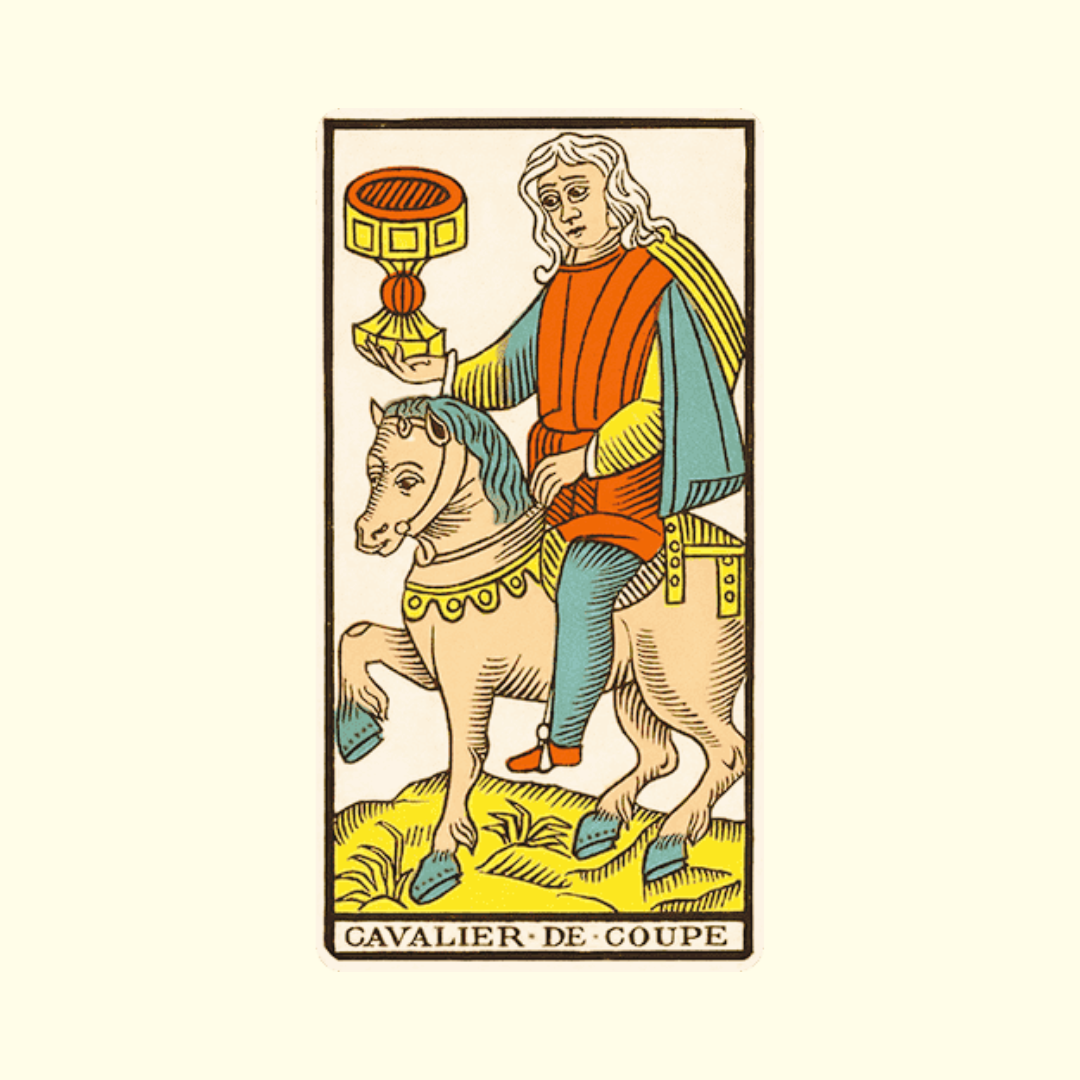

A knight advances with a cup in hand. In the Tarot de Marseille, his mount carries the emblem forward. In the Waite-Smith, a white horse proceeds without any warlike burden, and the knight presents his chalice as an offering. The card announces an approach, an invitation, a proposal, or the arrival of what the next card names. Its elegance attracts, but the quality of the message depends on what is actually in the cup.
The Knight of Cups sets feeling in motion. It may represent someone approaching, a mediator, a suitor, an artist, an invitation, or a diplomatic overture. Unlike the Page, who receives and studies, the Knight transports and presents. Its difficult side involves duplicity, seductive promises, fraud, or an initiative driven by image rather than commitment.
The court cards of tarot do not follow identical nomenclature in every school. The Knight of the Marseille and the Knight of the Waite-Smith are mounted figures. In Book T, the mounted figure is also called the Knight, but it fulfills the function of the King in the elemental order of the Golden Dawn. This difference must remain visible to avoid contrived correspondences.
From the cup-bearing knight to the invitation
In a Tarot de Marseille, the Knight rides in profile and holds a large cup. His movement gives the suit a destination. The horse, gaze, and orientation of the body make it possible to examine the speed, control, and purpose of the approach. The card does not yet show the recipient: the cards placed in front of the rider may reveal what he is approaching.
Smith slows the movement. The white horse walks calmly, the rider wears a winged helmet, and he holds out his cup. A watercourse runs through the landscape. Waite emphasizes a graceful rather than warlike figure, associated with arrival, approach, advances, proposal, and invitation. The rider does not brandish a weapon: he negotiates access by presenting something.
Iconographic reference. The winged helmet, white horse, and watercourse belong to the Waite-Smith. The Marseille Knight already carries a cup on horseback, but its design varies between workshops. In both decks, movement matters as much as the emblem.
Divinatory transmission
Mathers summarizes the Knight of Cups as arrival, approach, and advance. Reversed, it indicates duplicity, breach of trust, fraud, and cunning. He adds a very concrete reading rule: the Knight shows the arrival of the card that follows it. Placed before the Three of Cups, it may announce an invitation; before the Five of Cups, disappointing news or the arrival of an emotional difficulty.
Book T describes the Knight of Cups as the “Lord of the Waves and the Waters.” A winged warrior rides a white horse above the sea and holds a cup from which a crab emerges. The figure is graceful, poetic and capable of enthusiasm, but also indolent; ill-disposed, it becomes sensual, idle and deceitful. It is assigned “Fire of Water” and governs an area extending from the last decan of Aquarius to the first two decans of Pisces in the Golden Dawn grid.
Waite emphasizes arrival, approach, advances, proposal, conduct, invitation and inducement. Reversed, it takes up deception, artifice, subtlety, swindling and fraud. The Knight's charm is therefore not proof of loyalty. Its movement must be assessed by the destination, duration and verifiable commitments.
Meaning in a spread
In a favorable reading
The Knight of Cups announces an approach that seeks agreement rather than confrontation. Someone proposes a meeting, presents an offer, returns with gentler words or carries an artistic project. The card favors diplomacy, courtesy, imagination set in motion and the ability to present an intention in an acceptable way.
It can also represent the moment when a feeling becomes action. The querent no longer contents themselves with thinking: they write, invite, ask, travel or submit work. The favorable quality comes from the link between grace and responsibility.
In a tension reading
The movement may remain theatrical. The Knight then shows a brilliant promise, seduction used to gain time, a proposal without means, a person more in love with the approach than the relationship, or an intermediary who distorts the message to their advantage.
In a commercial or financial question, its difficult aspect requires clear verification: identity, contract, price, deadline, recourse and reputation. In an emotional question, observe consistency after the invitation. An arrival is not yet a settlement.
Love, work and finances
The Knight brings a proposal in motion. The area indicates what it carries, while the following cards show the offer's destination and solidity.
| Area | Favorable reading | Tension aspect | Question to ask |
|---|---|---|---|
| Love | Invitation, declaration followed by action, courteous return, rapprochement. | Seduction without stability, repeated promise, person who likes to conquer and then withdraws. | What happens after the initial progress? |
| Work | Proposal, appointment, mediation, creative presentation or assignment that comes through. | Flattering offer without a framework, unreliable intermediary, rhetoric stronger than the means. | Who assumes responsibility, and under what terms? |
| Finances | Friendly negotiation, financing proposal or progressing refund. | Fraud, hidden terms, purchase guided by the prestige of the offer. | Do the figures and recourse confirm the presentation? |
| Creation | Project directed toward an audience, commission, study trip, inspiration put into practice. | Aesthetic without structure, enthusiasm that fades after the presentation. | What schedule will give the movement a continuation? |
| Relationships | Visit, invitation, apology delivered in person, mediation. | Interested messenger, embellished words, conflict avoided through courtesy alone. | Does the message remain accurate once transmitted? |
Read the associations
The Knight brings arrival, offer, and movement. The card placed after it names what is coming; the one preceding it shows what motivates its approach.
| Association | Possible dynamic | Point of caution |
|---|---|---|
| Knight of Cups + Two of Cups | Relational proposal, date, or approach toward a mutual agreement. | The invitation does not yet prove commitment. |
| Knight of Cups + Three of Cups | Invitation to a celebration, friendly visit, happy news brought to the group. | Maintain balance and clarity within the circle. |
| Knight of Cups + Justice | Formalized offer, mediation, or proposal submitted to a precise framework. | Read the terms before responding to the charm of the presentation. |
| Knight of Cups + Seven of Swords | Deceptive messenger, incomplete proposal, or person moving forward with a hidden intention. | Verify identity, facts, and documents. |
| Knight of Cups + Eight of Cups | Arrival followed by departure, invitation to leave a situation, or transitional offer. | Do not leave solely to follow a promise. |
| Knight of Cups + World | Favorable journey, proposal from afar, or approach that reaches its recipient. | Prepare the practical aspects before considering the cycle complete. |
Correspondences according to the schools
Arrival and approach come from Mathers, the Lord of the Waves and the Fire of Water from the Golden Dawn, and Waite and Smith’s calm invitation. The Marseille Knight already brings the horse, movement, and cup.
| Reference | Attribution | Historical scope |
|---|---|---|
| Family | Minor Arcana, Cups court card | Mounted figure between the Page and the Queen in the Marseille. |
| Tarot de Marseille | Mounted knight carrying a cup | The destination remains off the map. |
| Mathers, 1888 | Arrival, approach, advance | Reversed: duplicity, breach of trust, fraud, and cunning. |
| Golden Dawn | Lord of the Waves and the Waters | The mounted figure fulfills the function of the King in the nomenclature of Book T. |
| Element of the rank | Fire of Water | Attribution of the mounted figure in the Golden Dawn. |
| Astrology | From the 20th degree of Aquarius to the 20th degree of Pisces | Area assigned to the Knight of Cups by Book T. |
| Waite-Smith | Calm Knight, white horse, winged helmet, cup, and river | Composition published in 1909. |
| Hebrew letter | No letter specific to this card | The letters are assigned to the trumps in this system. |
| Stone and plant | No historical agreement | Recent associations vary depending on the authors. |
| Reading words | Arrival, invitation, proposal, diplomacy, duplicity | The next card clarifies what the Knight brings. |
Reading advice
Place the Knight in the direction of the spread. Which card is he looking at? Which card is behind him? This directional reading follows Mathers’s observation: the Knight brings or announces what follows him. It works with a deck whose figures’ orientation remains clear.
Then assess the offer based on facts. Who is making it, what do they ask in return, what deadline applies, and what evidence accompanies the statement? The favorable Knight withstands these questions. The deceptive Knight relies on the effect produced by his arrival and seeks to avoid scrutiny of the substance.
Choosing a tarot deck for working with this card
To find this arcana in a complete deck, compare the Tarots de Marseille, the Rider-Waite-Smith, and our full range of Divination Tarots. If you are a beginner, also consult How to choose your first tarot deck?.
Sources and reference texts
For the history of decks and figures: Victoria and Albert Museum, A History of Tarot Cards; British Museum, reproduction of Nicolas Conver’s Tarot de Marseille.
For divinatory and occult texts: S. L. MacGregor Mathers, The Tarot, 1888, card meanings; Liber LXXVIII, “The Lord of the Waves and the Waters,” publication of material from Book T; Arthur Edward Waite and Pamela Colman Smith, The Pictorial Key to the Tarot, Knight of Cups, 1911.










