















































































































































































































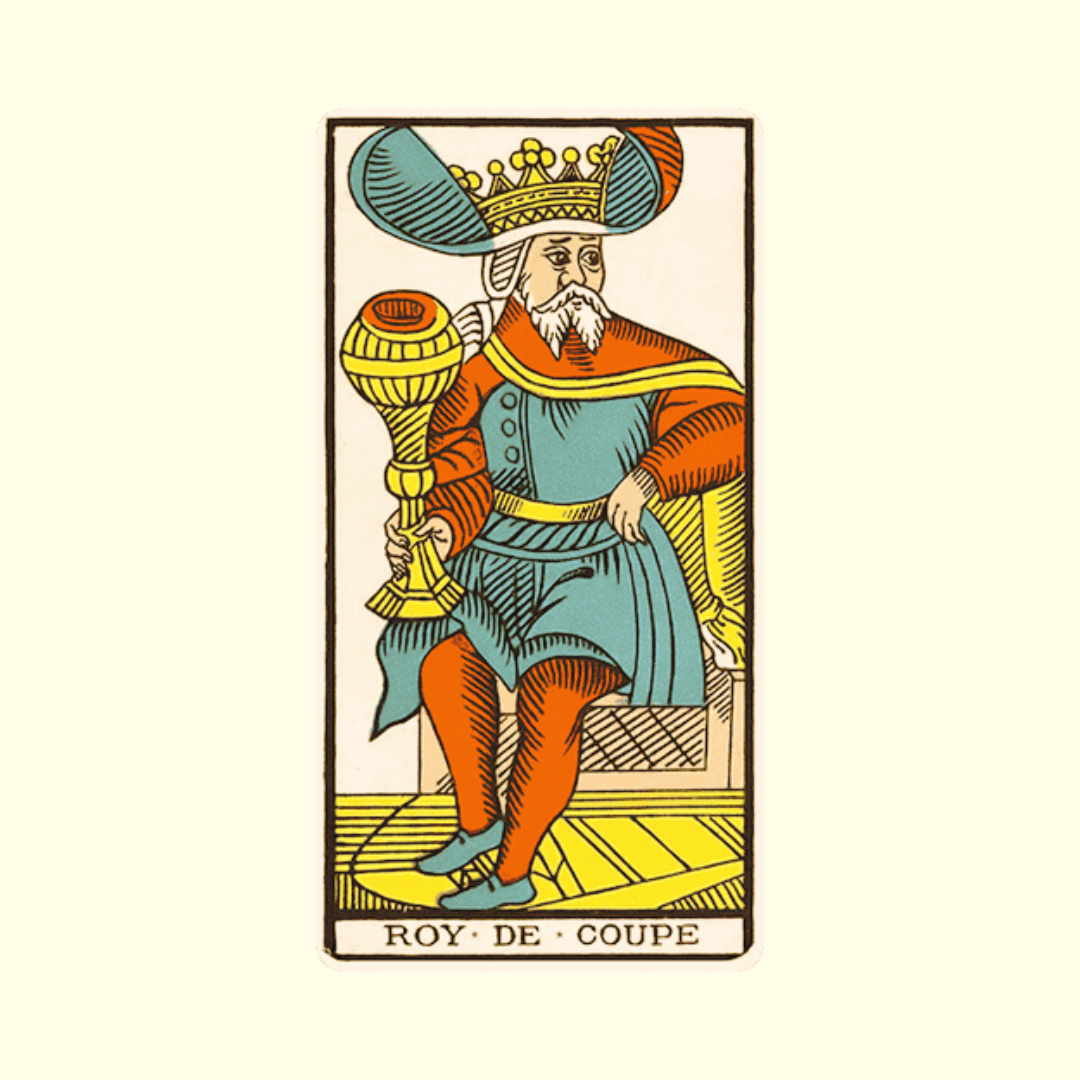

A king sits with the cup under his authority. In the Tarot de Marseille, the crowned figure completes the hierarchy of the suit. In the Waite-Smith, his throne rests amid a turbulent sea while a ship passes and a dolphin leaps. The King of Cups does not make the movements of the water disappear: he remains steady amid them. The card speaks of relational, creative, or moral authority that preserves its judgment without denying what it feels.
The King of Cups may represent a responsible person, a leader, an adviser, a mediator, a legal, arts, science, or religious professional. He combines kindness, fairness, generosity, creative intelligence, and the ability to make a decision acceptable. His difficult side involves duplicity, injustice, breach of trust, or the use of charm to protect a hidden interest.
Like all court figures, the King can designate a person, a function, or a way of acting. Gender and age are not the heart of the reading. The card describes a position of responsibility toward the contents of the cup: who has the power to receive, grant, refuse, or distribute?
From the sovereign of the chalice to measured authority
In a Nicolas Conver-style Tarot de Marseille, the King is crowned and seated. He holds the cup that names his suit. His posture completes the progression begun with the Page: the contents are no longer a surprise, a message to carry, or an object of contemplation. They enter the realm of governance and decision-making.
Smith places the King on a stone throne surrounded by water. He holds a large cup in his right hand and a short scepter in his left. The sea remains in motion, a ship advances on one side, and a dolphin leaps up on the other. Waite connects water with all the figures of the Court of Cups. The King remains seated without cutting himself off from the movement: he maintains a firm position within a changing environment.
Iconographic marker. The sea, the ship, the dolphin, and the short scepter belong to the Waite-Smith. The King of Marseille already holds the cup as an emblem of his rank, without a throne set upon the waves. In both decks, the crown transforms sensitivity into responsibility.
The Divinatory Tradition
Mathers describes the King of Cups as a clear-minded, good, kind, liberal, and generous man. Reversed, he becomes a man of good standing but unreliable in his affairs, surrounded by distrust, doubt, or suspicion. This opposition concerns less the feeling itself than the social use of power: an honorable appearance may support generosity or conceal dubious conduct.
The nomenclature of Book T requires a clarification. The card called King of Cups there bears the title “Prince of the Chariot of the Waters” and the attribution “Air of Water.” The winged figure stands in a chariot drawn by an eagle, above a lake, holding a cup and a lotus. The text attributes subtlety, artistic power, contained violence, and cunning to him. He governs the area between the 20th degree of Libra and the 20th degree of Scorpio. This image does not correspond to the seated King of the Marseille or Waite-Smith, although the card name is the same.
Waite presents a responsible man connected with business, law, or religion, willing to help the querent. He associates him with fairness, art, science, and creative intelligence. Reversed, he signifies dishonesty, double-dealing, extortion, injustice, scandal, plunder, and significant loss. The favorable King is therefore not defined by calm alone: he must be able to account for his decisions.
Meaning in a spread
In a favorable reading
The King of Cups shows an authority capable of remaining approachable. Someone listens, understands the human stakes, and nevertheless makes a decision. The card favors mediation, arbitration, support, fair governance, and creative work grounded in a solid knowledge of the public or the subject.
It can also indicate self-mastery: the querent recognizes anger, fear, attachment, or desire without immediately turning them into a command. This restraint does not mean coldness. It creates the time needed to respond appropriately.
In a tension reading
The King can use his relational intelligence to manipulate, divide, or make an unfair decision more acceptable. The card then shows soothing discourse masking a loss, a promise of help in exchange for a favor, charming but opaque authority, or someone demanding trust without providing evidence.
Its difficult aspect can also indicate anger held beneath a calm appearance. The querent would benefit from examining the consequences, the interests at stake, and the remedies available. Power becomes reliable when it accepts oversight, contradiction, and a written record.
Love, work, and finances
The King brings responsibility, decision-making, and mastery of the relational climate. The area reveals the extent of his power, while the neighboring cards show whether this authority serves fairness or his own interests.
| Area | Favorable reading | Tense aspect | Question to ask |
|---|---|---|---|
| Love | Stable partner, responsible communication, ability to weather disagreement without humiliation. | Emotional control, charm used to avoid commitment, concealed anger. | Can decisions and vulnerabilities be shared without fear? |
| Work | Fair leader, mediator, reliable adviser, creative intelligence placed at the service of the project. | Favoritism, double talk, opaque authority, or a promise intended to buy time. | Who controls the decision, and according to what criteria? |
| Finances | Measured management, responsible negotiation, assistance provided within a clear framework. | Breach of trust, hidden conditions, extortion, or loss connected to an influential person. | What documents and remedies protect the agreement? |
| Law and mediation | Arbitration, counsel, pursuit of a fair and humanly acceptable solution. | An unequal arrangement presented as peaceful, pressure exerted under the guise of protection. | Can each party refuse and obtain an independent opinion? |
| Creation | Coherent artistic direction, strong culture, work capable of moving people without losing its structure. | Aesthetic used to conceal a weakness, excessive power held by the director or commissioner. | Does the form truly serve the message and the people concerned? |
Reading combinations
The King brings authority, fairness, and relational mastery. The associated card shows what he decides, the quality of his power, or the hidden risk behind his calm.
| Combination | Possible dynamic | Point of caution |
|---|---|---|
| King of Cups + Justice | Mediation, balanced decision-making, an adviser or leader who combines law with human understanding. | A reading does not replace the examination of a case file. |
| King of Cups + Emperor | Stable authority combining structure, responsibility, and relational intelligence. | Power can become paternalistic if no one can contradict it. |
| King of Cups + Queen of Cups | Agreement between listening and decision-making, mature couple or complementary pair. | Verify the actual distribution of power and care. |
| King of Cups + Seven of Swords | Leader with a double message, opaque negotiation or withheld information. | Keep the evidence and request written confirmation. |
| King of Cups + The Devil | Powerful charisma, agreement of interests, authority mingled with desire or dependence. | Examine control, debt, corruption and consent. |
| King of Cups + The Tower | Destabilized authority, scandal, truth that shatters a calm façade. | Protect the people affected before rebuilding the framework. |
Correspondences by school
Kindness and generosity come from Mathers, Air of Water and the Prince of the Chariot of the Waters from the Golden Dawn, and the sea and creative authority from Smith and Waite. The King of Marseille retains the crown, seat and cup.
| Reference | Attribution | Historical scope |
|---|---|---|
| Family | Minor arcana, Cups court card | Highest court figure of the suit in the Marseille and Waite-Smith. |
| Tarot de Marseille | Crowned and seated king holding a cup | No ship or dolphin appears in the scenery. |
| Mathers, 1888 | Fair man, kindness, friendliness, liberality, generosity | Reversed: dubious dealings, mistrust and suspicion. |
| Golden Dawn | Prince of the Chariot of the Waters | Title given to the King of Cups in the nomenclature of Book T. |
| Rank element | Air of Water | Attribution of the King or Prince of Cups in the Golden Dawn. |
| Astrology | From the 20th degree of Libra to the 20th degree of Scorpio | Area attributed to this figure by Book T. |
| Waite-Smith | King, throne on the sea, cup, scepter, ship and dolphin | Composition published in 1909. |
| Hebrew letter | No letter specific to this card | Letters are assigned to the trumps in this system. |
| Stone and plant | No historical consensus | Recent lists are not shared by the cited sources. |
| Reading Keywords | Authority, fairness, generosity, creative intelligence, double dealing | Actions and responsibilities assess the King's quality. |
Reading Tips
When the King represents a person, do not be satisfied with their calm or reputation. Look at their concrete power: what can they decide, grant, withhold, or lose? Then examine how they account for their actions. A favorable authority can withstand precise questions.
With a Waite-Smith, compare the stillness of the throne with the movement of the sea, the ship, and the dolphin. With a Marseille, observe the King’s grip on the cup and the direction of his gaze. The card placed before him shows the subject of his decision; the one that follows reveals the effect of his rule.
Choosing a tarot deck to work with this card
To find this arcana in a complete deck, compare the Tarots de Marseille, the Rider-Waite-Smith, and all of our Divinatory Tarots. If you are just starting, also see How to choose your first tarot deck?.
Sources and reference texts
For the history of decks and figures: Victoria and Albert Museum, A History of Tarot Cards; British Museum, reproduction of Nicolas Conver’s Tarot de Marseille.
For divinatory and occult texts: S. L. MacGregor Mathers, The Tarot, 1888, card meanings; Liber LXXVIII, “The Prince of the Chariot of the Waters,” publication of material from Book T; Arthur Edward Waite and Pamela Colman Smith, The Pictorial Key to the Tarot, King of Cups, 1911.










