















































































































































































































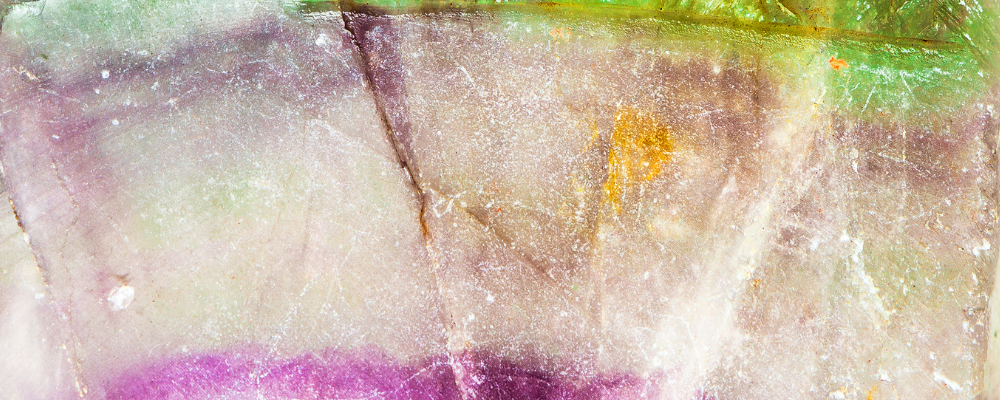
Yttrium Fluorite bears a name that already calls for discernment. It remains Fluorite, but part of the Calcium in its lattice is replaced by Yttrium. An invisible difference thus changes the composition without erasing the original architecture.
This stone accompanies identities that evolve without losing their structure. It speaks of proper qualification, the place granted to the minor element, and inner reform. Its color does not prove its composition: the name rests on analysis, not on a simple shade.
To place this stone among related minerals, compare it with Fluorite, Halite, and Creedite.
Yttrium-enriched Fluorite
Ordinary Fluorite has a structure based on Calcium Fluoride, CaF2. In Yttrium Fluorite, a notable amount of trivalent Yttrium replaces part of the Calcium. Other chemical adjustments then maintain charge balance.
A crystal-chemical study by the University of St Andrews examines these substitutions. The composition requires analysis: neither violet, blue, nor a lavender shade is sufficient to establish the presence of Yttrium.
Yttrofluorite, a variety name
The term Yttrofluorite was first used as a mineral name. Current classification treats it as a variety of Yttrium-rich Fluorite rather than as an autonomous species. The Mindat entry retains this status and the history of the name.
This correction does not make the stone any less interesting. It clarifies what it is: a known structure that accommodates a measurable substitution. In a collection as in ritual work, the right nuance is better than a spectacular title.
Ytterby and the elements hidden in the rock
Yttrium takes its name from Ytterby, a Swedish village whose quarry yielded an ore studied at the end of the 18th century. Johan Gadolin recognized a new earth there in 1794. The same place later gave its name to Ytterbium, Terbium, and Erbium.
A single rock can contain several names that are still unknown. Yttrium Fluorite accompanies situations in which a familiar structure houses an aptitude, function, or part of oneself that has not yet received its exact designation.
Mercury, Saturn, Air, and Earth
Mercury governs names, analyses, categories, and movement between several places. Saturn fixes the structure, rule, and threshold at which a difference becomes significant. Air distinguishes; Earth maintains the network.
Wednesday is suitable for examinations, files, and changes in qualification. Saturday helps embed the change within a lasting framework. Pale violet, white, gray, and black form a sober palette.
Identity, qualification, and reform
Yttrium Fluorite accompanies a change of title, status, or function. It supports the person who preserves their foundations and has a previously invisible skill recognized.
It also serves to correct a label, distinguish a resemblance from an identity, and accept that an old name has become too broad. Its symbolic action is not to erase history, but to make it more precise.
The Rite of the Recognized Element
Draw a gray square and write the name of your current structure at its center: profession, project, role, or commitment. Add a violet dot inside the square to represent the new element to be recognized.
Place the Yttrium Fluorite at the edge of the drawing and say: “What enters my structure receives its place and its true name.” Then write down the specific change to request or carry out, and date the sheet.
Correspondences and reference points
| Reference point | Correspondence |
|---|---|
| Nature | A variety of Fluorite containing a notable amount of Yttrium |
| Status | Mineralogical variety, not an independent species |
| Celestial bodies | Mercury and Saturn |
| Elements | Air and Earth |
| Days | Wednesday and Saturday |
| Ritual colors | Pale violet, white, gray, and black |
| Areas | Identity, qualification, analysis, reform, and recognition |
| Ritual gesture | Adding a new element to an established framework |










