















































































































































































































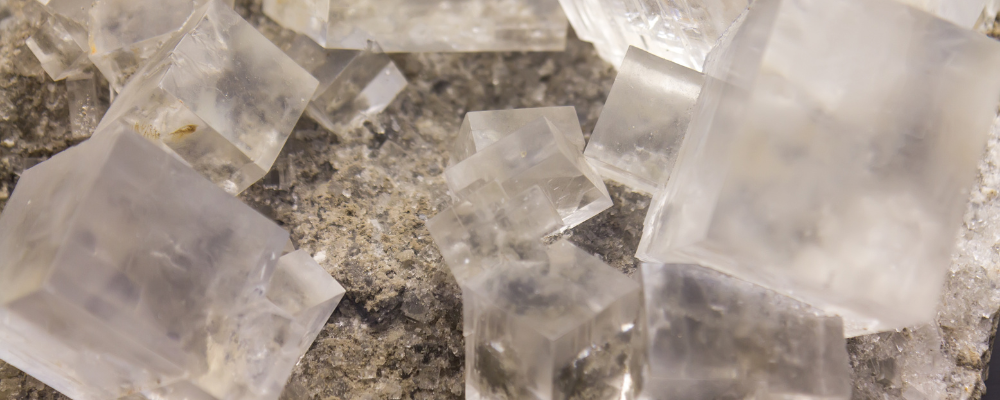
Halite is salt when it becomes crystal. Its transparent or colored cubes give mineral form to a substance that preserves, seasons, serves as currency, seals covenants, and protects thresholds. Few stones connect everyday life, sacred text, and ritual action with such clarity.
Here, the esoteric association did not arise from a recent trend. Salt accompanies biblical covenants, Christian blessings, and European alchemy. However, food salt must be distinguished from the mineralogical specimen: a collectible Halite is intended for observation and dry ritual, not for consumption.
To place this stone among related minerals, compare it with Fluorite, Yttrium Fluorite, and Creedite.
Salt turned into crystal
Halite comes from the Greek hals, meaning salt. The name refers to the mineral form of sodium chloride, NaCl. The Handbook of Mineralogy describes its hardness of 2 to 2.5, cubic cleavage, and crystals formed in evaporite deposits.
Colorless in its pure state, Halite can become pink, blue, violet, or gray due to inclusions, crystal lattice defects, or natural irradiation.
The cube and evaporation
Halite is deposited when saltwater evaporates and the solution can no longer hold all the dissolved salt. The cube reflects the internal arrangement of sodium and chloride ions.
This formation through the removal of water provides a clear symbol: when the superfluous disappears, a structure becomes visible. But the same property makes the crystal vulnerable to moisture.
Covenant, blessing, and alchemy
In Leviticus, salt accompanies every offering and is called the “salt of the covenant”. It marks what must not become corrupted and the duration of a commitment.
Catholic ritual has also included the blessing and exorcism of salt, used with holy water as a sign of purification and protection. A text from the old ritual of salt and water preserves its formula.
In 16th-century Paracelsian alchemy, Salt, Sulfur, and Mercury make up the tria prima. A historical study recalls the role of Salt as a principle of stability and substance, distinct from a simple Halite specimen.
Salt connects preservation to the pact. Its ritual use has a real history. The Halite crystal can serve as its material witness, provided the cited tradition is respected and symbol, sacrament, and mineralogy are not confused.
Saturn, Earth, and Water
Saturn corresponds to preservation, boundaries, and keeping one's commitments. Earth provides the cubic structure and stability; Water recalls the saline origin and the power to dissolve what seemed fixed.
Saturday is suitable for closing off a space. White, gray, and pale violet form its palette. A key, a knotted cord, and an empty bowl can accompany the specimen.
Preserve, Purify, Seal
Halite is suited to work involving threshold protection, clarifying a commitment, or preserving a memory. Here, purification means sorting: determining what enters, what leaves, and what must remain intact.
It also accompanies personal pacts. A commitment gains strength when it is expressed with a defined boundary, duration, and responsibility.
The Threshold Pact
Place the Halite inside your space, away from any moisture. Tie a cord around a key while stating a simple rule for this place: what you welcome there and what you refuse.
Say: “I guard this threshold with measure. My agreement is clear; my boundary remains.” Place the key near the stone. To draw a line of salt on the ground, use clean culinary salt, never a ground specimen.
Correspondences and references
| Reference | Correspondence |
|---|---|
| Nature | Crystallized sodium chloride |
| Celestial body | Saturn |
| Elements | Earth and Water |
| Day | Saturday |
| Ritual colors | White, gray, pale violet |
| Domains | Preservation, pact, threshold, purification |
| Associated objects | Key, cord, empty bowl |
| Gesture | Set a boundary and seal the agreement |










