


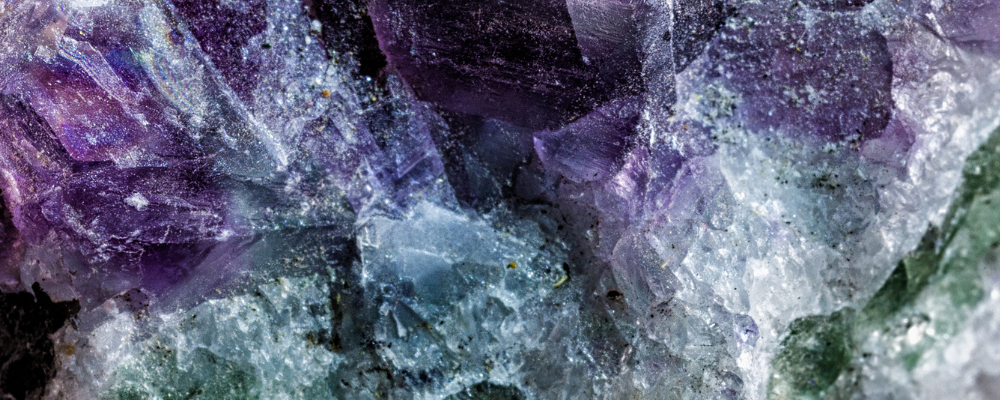
A stone of mental order and discernment in contemporary magic, Fluorite supports study, the classification of ideas, and decisions clouded by emotion. Its cubes and areas of color form a visible architecture: an appropriate aid for separating facts, hypotheses, and desires before making a choice.
Fluorite does not possess the long talismanic history of Carnelian or Onyx. Its magical identity took shape in the late 20th century, when Scott Cunningham linked it to the conscious mind, analysis, and the assimilation of knowledge. This recent reception is precise enough to provide a rich profile without inventing an ancient past for it.
To place this stone among related minerals, compare it with Yttrium Fluorite, Halite, and Creedite.
The crystal with colored cubes
Fluorite is a calcium fluoride, CaF₂. It forms cubes and has perfect cleavage that can produce octahedra. Purple, green, blue, yellow, or colorless, it gets its colors from lattice defects and trace elements.
The Handbook of Mineralogy describes a soft stone, with a hardness of 4, that is sensitive to impacts. Its geometric shapes and colored bands provided a powerful image of order, classification, and structured thought.
From melting to fluorescence
The name comes from the Latin fluere, “to flow.” Fluorite was used as a flux to facilitate the melting of ores. The word “fluorescence” itself derives from the stone, as some specimens emit visible light under ultraviolet light.
Neither its use as a flux nor its fluorescence proves occult action. However, they offer two coherent ritual images: making a passage smoother and revealing information that remained invisible under ordinary light.
A magical stone from the late 20th century
In his encyclopedia published in 1988, Cunningham writes that Fluorite has no long magical history and places its uses in his own era. He associates it with the conscious mind, analysis, sound perspective, and the assimilation of information.
This frankness makes the text a particularly useful source. Fluorite is not presented as a forgotten ancient legacy, but as a contemporary magical tool based on form, color, and the experience of 20th-century authors.
A recent reception is not an empty reception. Fluorite has a precise framework: conscious thought, analysis, study, and putting emotion at a distance. Its place in the Grimoire comes from this coherence, not from a fabricated past.
Ordering conscious thought
Place a piece of Fluorite on the desk when several pieces of information need to be compared. Assign a question to each visible face of the crystal: What do I know? What do I assume? What do I want? What can I verify?
The stone accompanies study, memorization, and theory. It is suitable for exams, research, inventories, and administrative decisions. Its role is to bring thought back to a clear structure.
Colors as a working language
In color magic, purple is associated with spiritual study and reflection; green with business and growth; blue with communication; yellow with exchange and movement. A multicolored Fluorite can bring together several stages of the same working.
These correspondences do not alter the stone's identity. They serve to choose the focus of the ritual. For a business decision, green and purple can unite practical calculation and perspective; for an exam, blue and yellow support expression and the flow of ideas.
The discernment square
On a sheet of paper, draw a square divided into four sections: facts, hypotheses, wishes, and risks. Place the Fluorite in the center, then fill in each section without mixing the categories. Light a white candle and reread everything aloud.
Then move the stone to the square that calls for immediate action. Write that action on the back and carry it out before resuming the ritual. The Fluorite remains on the document until the decision has been made.
Correspondences and references
| Reference | Correspondence |
|---|---|
| Nature | Calcium fluoride |
| Lineage | Late-20th-century stone magic |
| Element | Air through its contemporary mental use |
| Day | Wednesday |
| Areas | Study, analysis, memory, discernment, and classification |
| Colors | Purple for reflection; green for business; blue for speech |
| Ritual image | Cube, grid, and revealed information |
| Ritual gesture | Place it in the center of written categories, then choose an action |