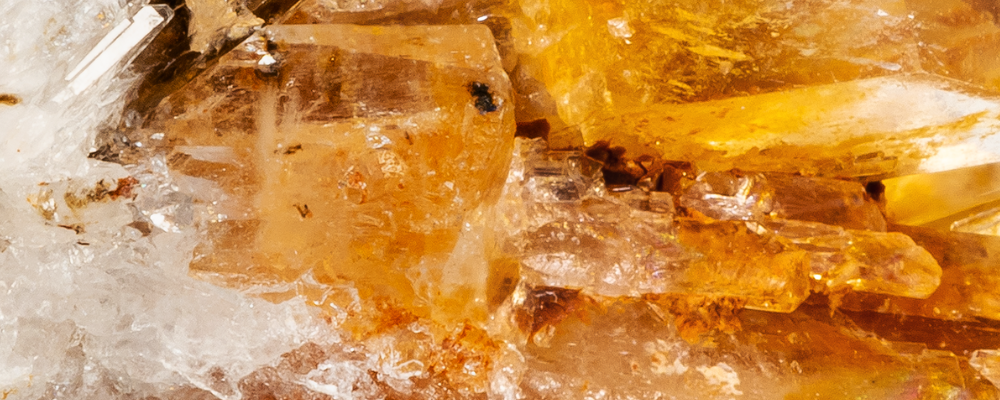
Creedite grows in slender prisms, blades, and radiating sprays. White, colorless, violet, or orange, it reveals a center extending in several directions. Its name comes from a territory in Colorado, not from a religious creed: its first lesson is that of an intention finding concrete paths.
Described at the beginning of the 20th century, Creedite has no ancient magical tradition. Its current esoteric use can remain close to its form. The Sun establishes the center, Mercury distributes the actions, Air carries the rays, and Earth connects them to their place of origin.
To place this stone among related minerals, compare it with Fluorite, Yttrium Fluorite, and Halite.
The name Creede
Creedite is named after the Creede region in Colorado. The Mindat directory associates the species with the Wagon Wheel Gap district and the Creede quadrangle.
The similarity in sound between Creedite and the English word creed, “credo,” therefore does not constitute its etymology. The name first connects the mineral to a place.
Prisms and radiating sprays
Creedite is a hydrated fluorinated sulfate of calcium and aluminum. The Handbook of Mineralogy describes it as monoclinic, with a hardness of 4, perfect cleavage, and prismatic or acicular crystals.
Radiating aggregates emerge from a core and multiply the terminations. This growth provides a clear image of ordered expansion: several actions can serve the same center.
From Colorado to large crystals
Creedite was described in 1916 from Colorado. It occurs in hydrothermal deposits rich in Fluorite. Localities in Mexico and Bolivia later yielded remarkable violet, white, or orange crystals.
The Webmineral database recalls the formula, locality, and geographical origin of the name. The diversity of colors does not change the identity of the structure.
To radiate is not to scatter. Each action must be traceable to the center that justifies it. A branch without a link to the intention becomes an expense, not an expansion.
Sun, Mercury, Air, and Earth
The Sun corresponds to the center, visibility, and the guiding intention. Mercury governs relays, messages, and tasks. Air diffuses; Earth maintains the link with the origin.
Sunday is suitable for defining the center, and Wednesday for deployment. A white circle, six violet lines, and a golden pin accompany the stone.
Center, diffusion, and coherence
Creedite supports a launch, a communication effort, or a project adapted across several media. It invites you to check that each action conveys the same intention, without mechanically repeating the same form.
It also suits teams: a clear center allows roles to differentiate without losing their coherence.
The Rite of Useful Rays
Draw a circle and write the central intention in no more than five words. Draw six rays. At the end of each, write an action, relay, or support. Cross out any ray that does not clearly return to the center, then place the Creedite near the circle.
Say: “My center gives direction to my gestures. I radiate without scattering myself.” Begin with the shortest ray.
Correspondences and references
| Reference | Correspondence |
|---|---|
| Nature | Mineral species, hydrated fluorinated sulfate |
| Celestial bodies | Sun and Mercury |
| Elements | Air and Earth |
| Days | Sunday and Wednesday |
| Ritual colors | White, violet, orange, gold |
| Areas | Center, diffusion, coherence, deployment |
| Associated objects | White circle, six lines, golden pin |
| Gesture | Relate each action to the central intention |