
























































































































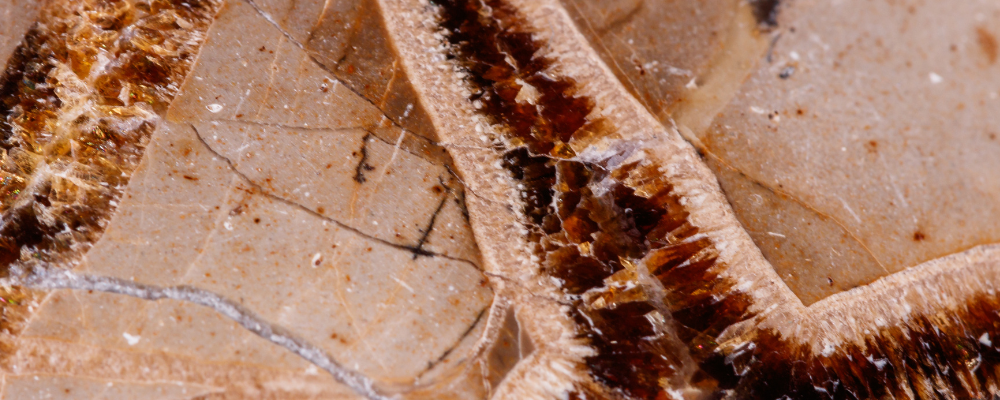
Septaria is a sedimentary rock formed millions of years ago, characterized by its crack-like patterns filled with minerals such as Calcite, Aragonite, and clay. Its distinctive appearance, reminiscent of a dragon egg, makes it a very special stone.
What is the technical and scientific profile of Septaria?
Septaria is a sedimentary concretion composed primarily of Calcite (CaCO₃), clay, and sometimes Aragonite. It forms through the dehydration and contraction of carbonate-rich mud, creating cracks that later fill with precipitated minerals, giving rise to its characteristic patterns. Its hardness varies from around 3 to 4 on the Mohs scale, and its density ranges between 2.6 and 2.7 g/cm³. The dominant colors of Septaria are brown, yellow, and beige, resulting from the presence of various minerals and oxides. It has no defined crystal system due to its composite nature.
Where are Septaria deposits found?
Septaria deposits are found in various regions around the world. Notable specimens have been discovered in the United States, particularly in Utah, as well as in Canada, Australia, Morocco, Madagascar, and France, especially in the Drôme region. These formations are generally found in ancient marine sedimentary environments, where specific conditions enabled their formation.
How rare is Septaria?
Septaria is relatively common in certain regions, but large specimens or those displaying particularly attractive patterns are rarer and sought after by collectors. Its popularity in lithotherapy and decoration has also contributed to increasing demand on the market.
What are the psychic properties and benefits of Septaria?
In lithotherapy, Septaria is renowned for its balancing and stabilizing properties. It helps strengthen self-confidence, improve communication, and encourage personal expression. Emotionally, it brings calm and serenity, helping to overcome stress and anxiety. It is also beneficial for grounding, helping one connect with the Earth's energy and feel more centered.
What is the history and origin of the name Septaria?
The name Septaria derives from the Latin septum, meaning "partition" or "barrier," referring to the natural partitions formed by mineral-filled cracks within the rock. Discovered in the 18th century, Septaria was used by James Parker in 1796 to create a natural cement known as Roman cement.
What are the known varieties of Septaria?
Septaria varies in appearance according to its mineral composition and the conditions under which it formed. Some specimens display star-shaped or mosaic-like patterns, with colors ranging from brown to yellow, as well as gray and black. Differences in shades and patterns depend on the types of minerals present and how the cracks filled over time.
What are the correspondences of Septaria?
In lithotherapy, Septaria is associated with the root chakra, promoting grounding and stability, as well as the solar plexus chakra, helping to strengthen willpower and self-confidence. Astrologically, it is often associated with Taurus and Sagittarius because of its stabilizing and energizing properties.
What legends are associated with Septaria?
Septaria is nicknamed "Dragon Stone" because of its appearance, which resembles fossilized dragon eggs. One legend tells of a canoe in New Zealand loaded with Septaria nodules that sank, forming a reef at the site of the shipwreck.
How should Septaria be cleansed and recharged?
To cleanse Septaria, it is recommended to rinse it under running water or purify it by fumigation with white sage or palo santo. As it is a relatively soft stone, it is advisable to avoid using salt or chemicals. To recharge it, exposure to moonlight is ideal, particularly during the full moon. It can also be placed on a quartz cluster or an amethyst geode to enhance its energies.
What are the other names for this stone?
In addition to "Dragon Stone," Septaria is also called Septarian Concretion because of its unique structure. However, the name Septaria remains the most commonly used term for this stone with its fascinating patterns.