















































































































































































































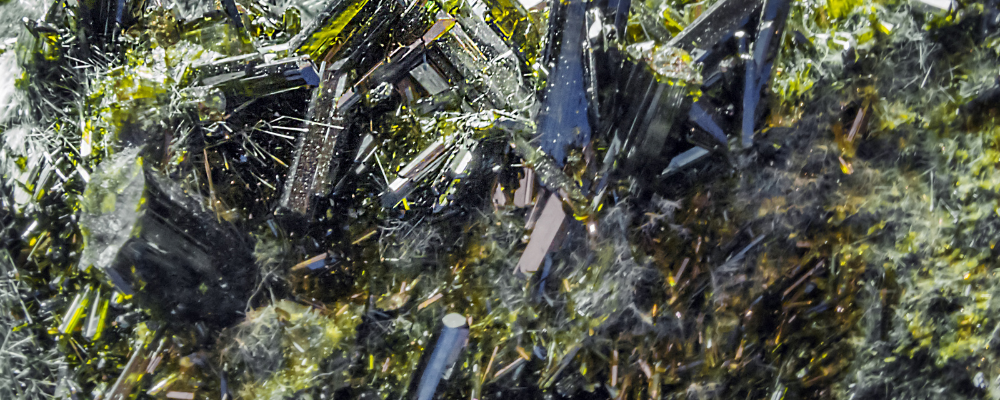
Epidote carries the idea of increase in its name. In 1922, Isidore Kozminsky linked it to Taurus and to fruit and grain growers. This attribution provides a solid foundation for its magic: making what has already been sown grow, strengthening a resource, and attracting more of what one truly nurtures.
It does not transform an empty intention into abundance. It amplifies a tendency, a habit, or a foundation. Its use therefore requires choosing carefully what one wants to see grow.
To place this stone among related minerals, compare it with Moss Agate, Green Tourmaline, and Heliodor.
The Pistachio Green of the Epidote Group
Epidote is a calcium, aluminum, and iron silicate. It forms elongated crystals that are pistachio green, dark green, brownish, or nearly black. Its hardness is around 6 to 7 on the Mohs scale.
It appears in rocks transformed by heat, pressure, or fluids. The Handbook of Mineralogy places it in a mineral group that includes several closely related species. Iron strongly influences its color.
A Stone Named for Increase
René Just Haüy adopted the name Epidote in 1801. It comes from the Greek epidosis, increase. Haüy was referring to the geometry of the crystal, one side of which seemed to have received an addition.
The Mindat entry traces this history and its localities. The mineralogical meaning of the name then offered an obvious bridge to the magic of increase.
The Talisman of Fruit and Grain
In The Magic and Science of Jewels and Stones, published in 1922, Isidore Kozminsky recalls the Greek meaning of the name. He places Epidote under Taurus and reports its use as a charm for fruit and grain growers.
This source gives its current uses in attraction, prosperity, and amplification an agrarian root. The action reported in ancient times concerns the harvest: an abundance arising from worked land, a seed, and a cycle.
What receives care also receives strength. Epidote increases not so much an abstract desire as a process already underway. It asks us to look at what we nurture each day, because a bad habit can grow with the same vigor as a good seed.
Venus, Taurus, and Earth
The Taurus transmitted by Kozminsky calls on Venus, fertility, value, and matter made fruitful. Earth governs the field, patience, the body, and the harvest. The Sun can support a maturation process without replacing the Venusian axis.
Friday suits attraction, money, and the growth of a bond; Sunday suits a project’s visibility. Pistachio green, copper, a seed, a coin, and a small basket make up its ritual language.
Growth, attraction, and harvest
For a project, place the Epidote on the proof that it already exists: a first product, first text, order, or registration. Then ask what needs to be repeated rather than what should appear without a foundation.
For money, place it near a coin and a statement. Choose a real path to increase: sell more, reduce an expense, improve an offering, or request a payment that is owed.
For a relationship, write down the gesture you would like to see grow on both sides. Venusian attraction remains an invitation to reciprocity, not a hold over another person’s will.
The Rite of the Increased Share
On a Friday, place three seeds in a line. The first represents what exists, the second the care to be provided, and the third the desired harvest. Place the Epidote beside the second.
Light a green candle and say: “I increase what I sow; I nourish what I want to harvest.” Perform the care ritual described that same day, then keep the stone beside the project until the result.
Correspondences and references
| Reference | Correspondence |
|---|---|
| Nature | Calcium, aluminum, and iron silicate |
| Name | From the Greek epidosis, increase |
| Sign | Taurus according to Isidore Kozminsky |
| Planet | Venus |
| Element | Earth |
| Day | Friday |
| Areas | Growth, agriculture, attraction, prosperity, and harvest |
| Ritual action | Place the stone beside the care that nourishes the seed |










