















































































































































































































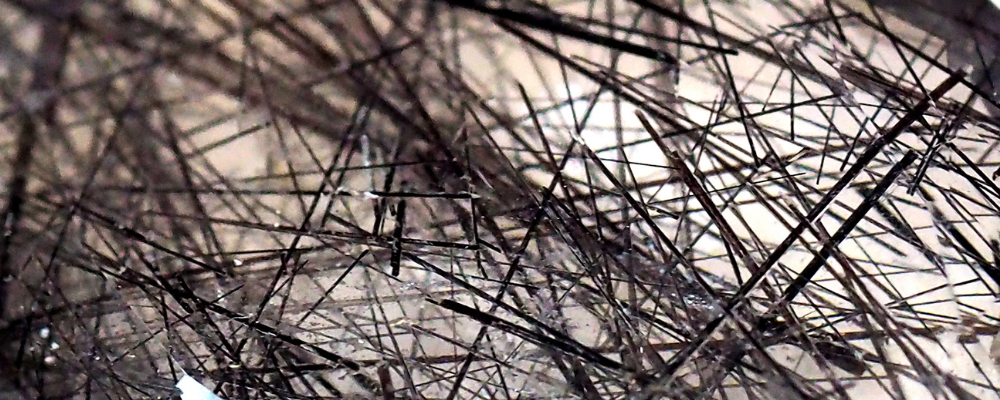
Rutilated Quartz encloses needles of gold, copper, or fire within the transparency of Quartz. The old names collected in the early 20th century—Venus's Hair, Thetis's Net, and Arrows of Love—make it a stone of launched desire, vision, and connection. Its magic directs and amplifies: it gives intention a trajectory.
Quartz opens the space, while Rutile draws lines through it. This alliance suits declared love, divination, success, and operations that require a will to pass from idea to action.
To place this stone among related minerals, compare it with Quartz, Clear Quartz, and Rose Quartz.
Rutile needles in Quartz
Rutilated Quartz is Quartz containing elongated crystals of Rutile, a titanium oxide. The needles may be golden, red, copper-colored, brown, or black. They were already present as the Quartz grew, gradually becoming enclosed within it.
The outer hardness remains that of Quartz, around 7 on the Mohs scale. The inclusions give each stone its visual identity without being added cracks. The GIA notably shows a network of Rutile radiating around a Hematite core.
Stars, hair, and networks of light
The needles may cross chaotically, align like a lock of hair, or form a six-pointed star. These structures inspired evocative names long before the composition of Rutile was understood.
Lapidary work seeks to make the strands visible from the best orientation. Another article from Gems & Gemology illustrates how a cut can showcase a Rutile pattern. The stone thus becomes a landscape of lines captured in light.
Venus, Thetis, and the arrows of desire
In The Magic and Science of Jewels and Stones, published in 1922, Isidore Kozminsky brought together several names: Venus's Hair, Thetis's Net, and Arrows of Love. He associated it with Sagittarius, forthcoming knowledge, and vigorous hair.
In 1988, Scott Cunningham described Rutilated Quartz as a projective-energy stone that increases the effectiveness of a magical operation. The arrow gives direction; the Quartz gives range.
An intention needs a path. Rutilated Quartz does not represent diffuse light. Its threads connect points, pierce space, and show a direction. It suits requests whose goal and first movement can be named.
Jupiter, Venus, Fire, and Air
Sagittarius calls upon Jupiter, the planet of momentum, reach, and vision. Venus comes from the Hair and the Arrows of Love. Fire supports projection, ambition, and the golden needles; Air carries the message, divination, and the line that crosses through.
Thursday is suited to success and expansion; Friday to love and attraction. Gold, red, a drawn arrow, a golden thread, and a mirror compose its ritual vocabulary.
Amplification, vision, and success
For a project, place the stone on an arrow drawn between your starting point and your goal. Write the two actions that make the passage possible beneath the line. Amplification has value only when the intention already has a direction.
For love, write what you wish to offer as well as what you wish to receive. Venus’s thread connects two wills; it is not meant to capture a person or circumvent their consent.
For vision, observe the needles before a reading. Choose one with your gaze and follow it to its end. Then read the card placed in that direction as the next movement, not as a fixed destiny.
The arrow in the light
On a Thursday, draw a golden arrow on a sheet of paper. Write your intention at the point and your immediate action at the fletching. Place the Rutilated Quartz in the middle of the line.
Light a white or yellow candle and say: “The light carries my act to its rightful goal.” Slide the stone toward the point, then carry out the action written down before relighting the candle.
Correspondences and references
| Reference | Correspondence |
|---|---|
| Nature | Quartz containing Rutile needles |
| External hardness | Approximately 7 on the Mohs scale |
| Sign | Sagittarius according to Isidore Kozminsky |
| Planets | Jupiter and Venus |
| Elements | Fire and Air |
| Days | Thursday and Friday |
| Areas | Amplification, success, love, vision, and divination |
| Ritual gesture | Move the stone from the starting point toward the goal |










