















































































































































































































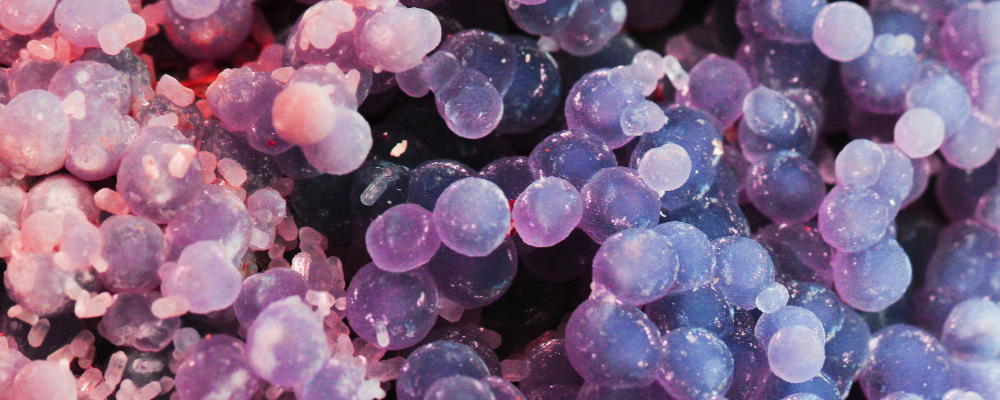
Grape Agate consists of small spheres packed closely together, like a mineral fruit. Its surface catches the light on each grain and gives violet, green, or gray a velvety presence.
Its name belongs to contemporary commerce. The material itself is entirely natural: botryoidal Chalcedony whose form speaks of community, multiplication, and gathered resources.
To place this stone among related minerals, compare it with Agate, Blue Agate, and Dendritic Agate.
A Clustered Chalcedony
Specimens sold under the name Grape Agate are made of botryoidal Chalcedony. “Botryoidal” describes a surface composed of rounded globules, resembling a bunch of grapes. Each globe results from the radiating growth of microcrystalline silica.
The Mindat mineral gallery presents this material under the commercial name Grape Agate. The entry devoted to Chalcedony places it within the quartz family.
A highly evocative commercial name
The material was introduced to the international market after its discovery in the Mamuju region, in western Sulawesi, Indonesia, around 2015. Mindat lists this locality and the botryoidal Chalcedonies that made it famous.
Despite its name, it generally does not display the bands that define Agate in the strict sense. It is more accurate to call it botryoidal Chalcedony known as “Grape Agate.” This clarification highlights its true nature without diminishing its appeal.
From the cluster to sharing
This recent name has no ancient magical use associated with the stone itself. However, its image echoes a very ancient symbol: several fruits borne on the same stem, a harvest obtained over time, and wealth meant to circulate.
The cluster does not represent solitary accumulation. It shows distinct units connected to the same base. In modern magical work, the stone is therefore better suited to shared abundance, groups, and cooperation than to the promise of effortless gain.
Venus, Moon, Earth, and Water
Venus governs attraction, connection, and the fertility of exchanges. The Moon corresponds to groups, cycles of maturation, and mutual support. Earth sustains growth; Water nourishes cohesion.
Friday supports alliances and shared prosperity, while Monday supports the life of the home or circle. Grains, a bowl of fruit, a shared coin, or a green candle can surround the stone.
Growing Together
The Cluster Agate supports teams, creative communities, shared meals, and projects whose success depends on multiple contributions. It reminds us that abundance is also measured by the quality of connections and the circulation of resources.
Placed in a shared space, it can represent cohesion without erasing differences. In an individual practice, it helps recognize the real network supporting a project: loved ones, clients, suppliers, readers, or companions on the journey.
The Rite of Shared Resources
On a Friday, draw a circle and write the relevant project at its center. Around it, note the people, skills, and resources that nurture it. Place the Cluster Agate in the middle.
Say: “What grows through many hands returns to the circle with justice.” Choose an act of reciprocity to carry out during the week: give thanks, pass along a contact, pay for work, or share knowledge.
Correspondences and references
| Reference | Correspondence |
|---|---|
| Nature | Botryoidal chalcedony |
| Known origin | Western Sulawesi, Indonesia |
| Celestial bodies | Venus and Moon |
| Elements | Earth and Water |
| Days | Friday and Monday |
| Ritual colors | Green, purple, white |
| Areas | Community, sharing, alliance, harvest |
| Ritual gesture | Name the resources, then return them to the circle |










