
























































































































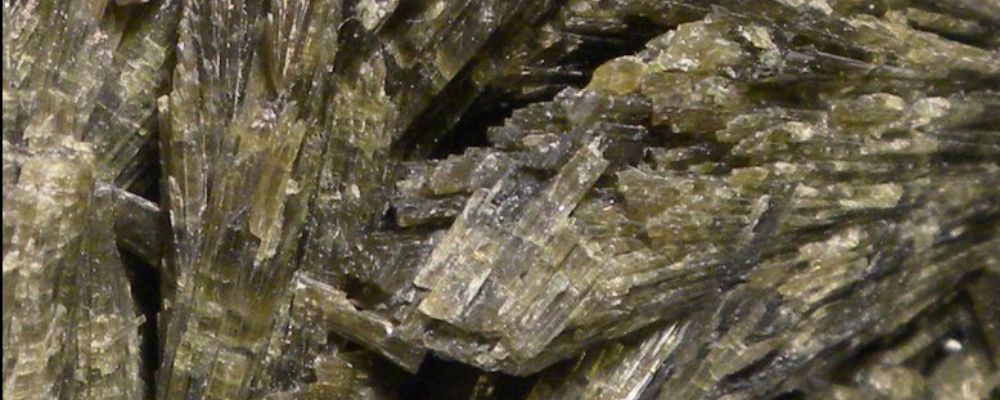
Clinozoisite carries in its name a way of holding oneself: the same kinship as Zoisite, a different orientation of the crystal. Its green, gray, yellow, or pinkish tones accompany a firm, structured material, capable of changing angle without losing its composition. It invites us to seek adjustment rather than rupture.
Described under its current name at the end of the 19th century, it has no distinct ancient magical tradition. Its contemporary interpretation is based on its geometry. Mercury governs the change of perspective; Saturn maintains the framework; Air shifts the gaze while Earth preserves the foundation.
To place this stone among related minerals, compare it with Tanzanite, Epidote, and Betafite.
An inclined Zoisite
The name combines the monoclinic form with its connection to Zoisite. The Mindat entry notes that Alfred Lacroix named it Fouquéite in 1889, before Ernst Weinschenk introduced “Clinozoisite” in 1896.
The prefix clino- does not describe an unstable stone. It indicates an inclined crystal arrangement. This nuance gives the name its symbolic axis: changing a posture without abandoning what must remain.
The Epidote family
Clinozoisite is a calcium aluminum sorosilicate from the Epidote group. The Handbook of Mineralogy indicates a hardness of 6.5, perfect cleavage, and a range from colorless to green, gray, yellow, pink, or red.
Some of the aluminum can be replaced by iron, bringing it closer to Epidote. Color alone is therefore not enough to identify a specimen with certainty.
Two forms of the same composition
Clinozoisite and Zoisite share a chemical composition, but not the same crystal system: one is monoclinic, the other orthorhombic. They are called dimorphs.
This report does not tell a story of opposition between true and false form. It shows that the same elements can find two equilibria. Useful transformation therefore begins with a question: should the content be changed, or only its arrangement?
An inclination can save a structure. Yielding on the angle does not require yielding on the value. The right adjustment protects the heart of a project by changing the way it encounters reality.
Mercury, Saturn, Air, and Earth
Mercury corresponds to movement, adaptation, and reading a situation. Saturn preserves form, limits, and continuity. Air opens a new angle; Earth maintains the point of support.
Wednesday is suitable for examining options, and Saturday for confirming a boundary. A folded sheet, a green pencil, and a ruler accompany the stone.
Adjustment, posture, and continuity
Clinozoisite accompanies a negotiation, a change of method, or a relationship that requires a new posture. It helps distinguish the principle one preserves from the form one can modify.
It is also suitable for projects blocked between stubbornness and abandonment. Before starting over completely, it invites you to shift a schedule, an interlocutor, an order, or a presentation.
The Rite of the Chosen Angle
Fold a sheet in half. On the left, write what must not change. On the right, write down three ways to approach it differently. Place the Clinozoisite on the fold and pivot the sheet until an option appears workable to you.
Say: “I keep my axis and modify my approach. My flexibility serves what must remain.” Make the first adjustment during the day.
Correspondences and references
| Reference | Correspondence |
|---|---|
| Nature | Mineral species of the Epidote group |
| Celestial bodies | Mercury and Saturn |
| Elements | Air and Earth |
| Days | Wednesday and Saturday |
| Ritual colors | Green, gray, pale yellow |
| Domains | Adjustment, posture, continuity, method |
| Associated objects | Folded sheet, ruler, green pencil |
| Gesture | Change the angle without abandoning the axis |