


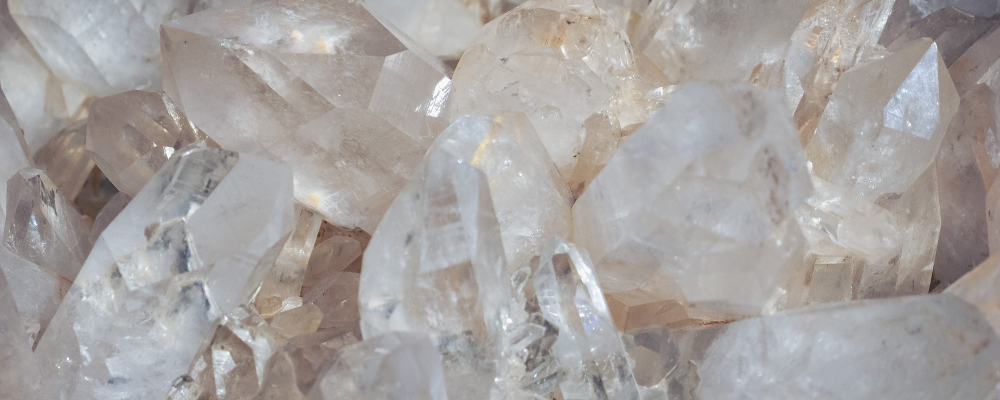
An instrument of vision, protection, and consecration, Rock Crystal has long held a place in scholarly cabinets as well as in divinatory arts. Its transparency invites one to look through it rather than project every power onto it: it becomes a mirror of attention, a witness to an oath, and a support for words made clear.
This colorless Quartz inspired the idea of ice that does not melt, followed by practices of crystal contemplation. European collections preserve crystals associated with 16th-century divination. Contemporary magic adds the idea of amplification, but this notion should remain a ritual image, not a physical property.

To place this stone among related minerals, compare it with Quartz, Clear Quartz, and Herkimer Diamond.
Transparent Quartz
Rock Crystal is colorless Quartz, with the formula SiO₂ and a hardness of 7. Its clarity varies: veils, fissures, and inclusions tell the story of its growth without necessarily diminishing its ritual interest. A natural point indicates the direction of the crystal’s growth; it also offers a simple orientation for the magical gesture.
The Smithsonian presents Quartz as one of the most widespread minerals in Earth’s crust. This common material can produce crystals of remarkable clarity: an alliance that may explain its role as a mediator between the ordinary world and what one seeks to discern.
Ice That Does Not Melt
The word crystal comes from the Greek krystallos, “ice.” Ancient authors passed on the idea that transparent Quartz was water frozen by extreme cold. The explanation is false, but the image has survived: coldness, purity, stillness, and captive light.
In a rite, this old language can be used without being mistaken for science. The crystal represents what becomes visible when agitation settles. A sphere, point, or clear pebble can receive an intention of lucidity, truth, or preservation of a commitment.
John Dee and crystal gazing
The Science Museum collection preserves a crystal associated with John Dee, astrologer and adviser to Elizabeth I. Dating from 1582, the object recalls that consulting a crystal belonged to the visionary arts of the Renaissance. The seer fixed their gaze on the surface, the light, and the forms that appeared there in order to receive and then interpret images.
Rock Crystal was not the only material used: Beryl and black mirrors also served. This point prevents a varied practice from being turned into a uniform tradition. The object prepared the attention; the setting, prayers, and method gave the session meaning.
Seeing is not guessing at random. Crystal gazing calls for a limited period of time, a written question, and a faithful transcription of what was perceived. Interpretation comes afterward. This separation protects against answers being shaped after the fact.
Clarity, oath, and protection
In his 1922 work, Kozminsky reports the use of Rock Crystal against deception and imposture. He reserves it for a sincere person and associates it with Pisces. Transparency here becomes a moral requirement: asking for the truth also requires not concealing one’s own intention.
The crystal can hold a written promise, mark the center of an altar, or accompany a decision that calls for clear facts. In protection work, it is entrusted less with attacking than with revealing contradictions, double-dealing words, and agreements whose terms remain unclear.
Amplify without mixing everything together
At the end of the 20th century, Scott Cunningham popularized Rock Crystal for divination, protection, and the amplification of a ritual. A point directed outward accompanies sending or demarcation; directed toward oneself, it supports contemplation and reception.
This framework is useful if each crystal is given a specific function. A stone used for threshold protection gains nothing by changing its assignment every day. Purify it, name its role, and keep it in the same place until the work is complete.
A sober scrying session
Place the crystal on a dark cloth, with a candle outside the direct field of vision to avoid glare. Write an open-ended question, then look at the stone for ten minutes without forcing images to appear. Note shapes, words, memories, and sensations in the order they arise.
Close the session with a clear statement, cover the crystal, and reread your notes the next day. Do not make an important decision based solely on this: compare the reading with the facts. The rite then becomes a structured tool for reflection, not an authority that replaces judgment.
Correspondences and references
| Reference | Correspondence |
|---|---|
| Nature | Colorless quartz |
| Planet | Moon in many modern systems |
| Sign | Pisces according to Isidore Kozminsky |
| Element | Water for vision; Air for clarity |
| Day | Monday for reception; Wednesday for examination |
| Uses | Divination, clarity, oath, protection, and consecration |
| Forms | Sphere for contemplation; point for directing; tumbled stone for keeping |
| Ritual action | Look, write, cover, then interpret from a distance |