















































































































































































































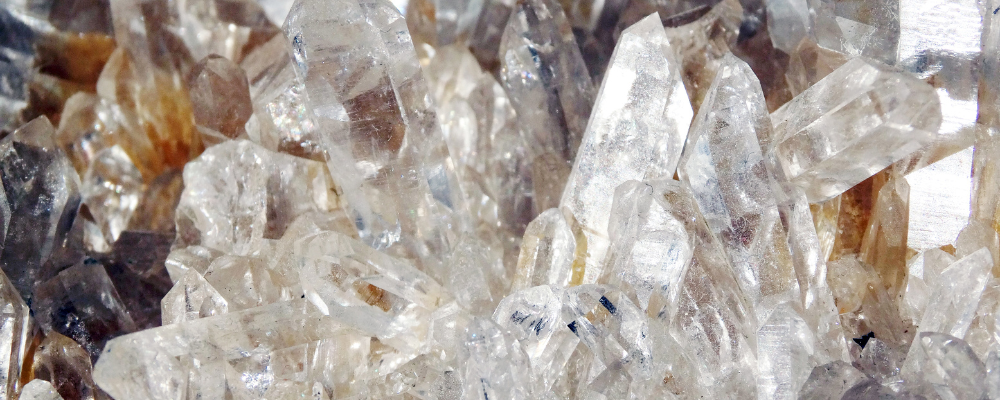
The matrix of Amethyst, Citrine, Rock Crystal, Smoky Quartz, and so many other faces, Quartz runs through the history of magic in the form of a point, seal, sphere, and scrying stone. Its strength lies in a simple alliance: a common material can become a precise instrument when its form, color, and function are clearly chosen.
The Ancients took it for ice that the cold could no longer return to water. The arts of vision polished Rock Crystal into spheres; engravers turned it into talismans. The magic of the 20th century developed the idea of amplification. This image remains useful as long as it does not replace intention, method, or the specific correspondence of each variety.
To place this stone among related minerals, compare it with Clear Quartz, Rose Quartz, and Smoky Quartz.
One Species, Many Faces
Quartz is silicon dioxide, SiO2, with a hardness of 7. The Handbook of Mineralogy describes a species capable of forming transparent crystals, opaque masses, and a vast range of colors produced by traces, defects, or inclusions.
This diversity explains the richness of its ritual language. The common family provides a capacity for consecration and orientation; the specific variety adds its celestial body, color, and domain. An Amethyst therefore does not receive exactly the same treatment as a Citrine or Smoky Quartz.
The Ice That Did Not Melt
The word crystal comes from the Greek krystallos, “ice.” In Book 37 of his Natural History, Pliny explained Rock Crystal as ice that had turned to stone due to such intense cold. The explanation is false, but it conveyed a lasting imagery of purity, cold, and light frozen in place.
In ritual, this ancient image serves to fix a word, calm agitation, and make an intention legible. Quartz does not become petrified water; it takes on the symbolic role of what remains clear when movement ceases.
Spheres, Intaglios, and Scrying Stones
The British Museum holds a Rock Crystal sphere, a form that has become emblematic of contemplation. The museum also possesses a magical intaglio engraved in Quartz, a reminder that the stone could receive figures, names, and rays.
The sphere gathers the gaze; the point provides direction; the engraving fixes a formula. These uses provide a more solid grammar than the idea of a stone capable of doing everything indiscriminately.
Form determines the action. A sphere is used for contemplation, a point for directing, a pebble for keeping, and a plate for supporting an object. The function must follow the Quartz’s actual form.
Pisces, the Moon, and Modern Amplification
Isidore Kozminsky places Rock Crystal under Pisces in The Magic and Science of Jewels and Stones, published in 1922. He reports uses for vision and protection against deception. Water and the Moon are suited to receptivity, dreaming, and contemplation.
In 1988, Scott Cunningham developed divination, protection, and amplification. Amplification here means making a device more readable and maintaining its intention, not producing measurable physical power.
Consecration, Protection, and Direction
To consecrate Quartz, give it a limited function and duration. A point directed outward supports sending, guarding a threshold, or closing. Turned toward oneself, it supports contemplation and reception.
In divination, cover the sphere between sessions and note your perceptions before interpreting them. For protection, place the Quartz near the rule it must uphold: contract, boundary, password, or commitment.
In an arrangement, it can serve as a center and connect several stones. Each one nevertheless retains its role; the Quartz organizes the circle without erasing the differences.
The Oriented Crystal
Choose a point and write an intention in one sentence. Place the crystal along the axis of the text. To attract a quality, point the tip toward the center of the paper; to repel an obstacle, turn it outward.
Light a white candle, read the sentence, and keep the arrangement in place for the stated period. At the end, turn the point onto its side, give thanks, and remove the paper. Closing prevents a temporary function from becoming an indefinite expectation.
Correspondences and references
| Reference | Correspondence |
|---|---|
| Nature | Silicon dioxide in many varieties |
| Sign | Pisces for Rock Crystal according to Kozminsky |
| Planet | The Moon in several modern systems |
| Elements | Water for vision; Air for clarity |
| Days | Monday and Wednesday |
| Areas | Consecration, guidance, protection, divination, and oath |
| Shapes | Sphere, point, tumbled stone, plate, and intaglio |
| Ritual act | Choose a shape, name a function, then close |










