















































































































































































































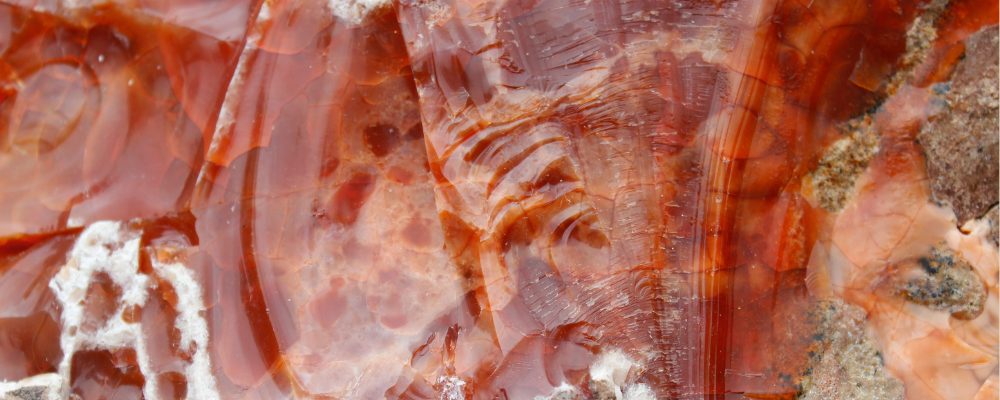
In Hematoid Quartz, the clarity of the crystal meets the red of iron. Rust-colored clouds, dark flashes, and orange flames run through a material that remains visible. This union makes it a stone of lucid action: it supports courage, willpower, concentration, and the passage from intention to action.
Its esoteric language brings together two legacies. Quartz provides vision and the fixation of an intention. Hematite provides symbolic blood, iron, Mars, and the ancient function of protection. The current name encompasses several iron-bearing assemblages, but this meeting between crystal and iron gives the stone a strong ritual coherence.
To place this stone among related minerals, compare it with Quartz, Clear Quartz, and Rose Quartz.
The Crystal and Iron
“Hematoid Quartz” refers to Quartz threaded with Hematite or other iron-rich materials. Depending on the specimen, they form red clouds, orange patches, needles, flecks, or deposits lodged in fractures.
The color gives the impression that fire has been enclosed within the crystal. The stone thus becomes a support for intentions that need direction, rhythm, and tangible realization.
Hematite, the Blood-Colored Stone
The name Hematite comes from the Greek haima, meaning blood, because of the red powder this iron ore can produce. In The Magic and Science of Jewels and Stones, Isidore Kozminsky brought together ancient and medieval sources in 1922 that connect Hematite with blood, engraved seals, protection of the dead, and mastery over wounds.
These uses belong to Hematite, not to the modern commercial name Hematoid Quartz. The presence of iron nevertheless makes it possible to draw on its symbolic language: courage, defense, endurance, and authority over one’s own actions.
Red must be given direction. Hematoid Quartz does not represent agitation without restraint. The crystal gives the fire of iron a form: deciding, beginning, continuing, and finishing.
Mars, Aries, Iron and Fire
Kozminsky places Hematite under Aries and recalls the connection between iron and Mars. Red, the cup, combat, and momentum belong to this sphere. Tuesday is suited to rites of courage, defense, renewed activity, and victory over inertia.
Earth comes from iron ore and the stability of Quartz. Fire comes from Mars and the color red. Their union creates a force that acts in matter: not a passing impulse, but energy directed toward a result.
Strength Guided by Clarity
Clear Quartz was associated with the Moon, vision, and truth, while Hematite belongs to Mars. In Hematoid Quartz, the Moon receives the image and Mars carries it out. The stone is therefore suited to moments when we understand what needs to be done but still cannot manage to begin.
Place it on a work surface, near a contract to be prepared or a decision already made. It reminds us that will becomes real when it is given time, a tool, and a first step.
Courage, work, and accomplishment
Hematoid Quartz accompanies projects that require consistency, discipline, and presence. It supports exams, administrative procedures, resuming interrupted work, defending a position, and completing a task.
In a courage ritual, hold the stone and name the danger precisely. Replace vague wording with a real risk, then choose a measure: call, write, refuse, ask for help, prepare a document, or leave a place.
The stone can also help contain anger before a confrontation. Mars does not disappear; it takes form. Write down what must be defended, what must not be said, and the desired outcome. Keep the Quartz on the third sentence.
The Rite of the First Act
On a Tuesday, light a red candle and place the Hematoid Quartz in front of it. Write the objective on a sheet of paper, then break it down until you have an action that can be completed in less than an hour.
Tie a red thread around the stone without tightening it and say: “May my strength receive direction; may my decision enter matter.” Carry out the action before extinguishing the candle. Remove the thread when the entire objective has been achieved.
Correspondences and references
| Reference | Correspondence |
|---|---|
| Nature | Quartz associated with Hematite or other iron-rich materials |
| Planets | Mars for iron and Hematite; Moon for the crystal’s clarity |
| Sign | Aries for Hematite according to Kozminsky |
| Elements | Fire and Earth |
| Day | Tuesday |
| Areas | Courage, willpower, concentration, defense, work, and accomplishment |
| Associated objects | Red thread, red candle, work tool, action list |
| Gesture | Reduce the intention to a first act, then carry it out |










