














































































































































































































The history of occultism tends to highlight only male figures. We readily imagine the medieval alchemist in his laboratory or the Victorian mage in his cabinet of curiosities. Yet many women played a decisive role in the development of the occult sciences throughout the centuries. From Antiquity to the occultist movements of the 19th century, these women—sometimes going against the norms of their time—practised, taught, or disseminated esoteric knowledge. Their contributions, long overlooked or eclipsed by the “black legend” attached to some of them, are essential to understanding the evolution of occultism. Discover them.
From the Alchemists of Antiquity to Medieval Witches
One of the earliest female figures in Western esotericism dates back to Hellenistic Antiquity. She was Mary the Jewess, also known as Maria Hebraea or Miriam the Prophetess, whom tradition credits with nothing less than pioneering alchemy. Probably active in Alexandria between the 3rd and 2nd centuries BC, Mary is credited with inventing several instruments and chemical techniques—including the well-known bain-marie, the heating vessel that bears her name. Mentioned by the alchemist Zosimos of Panopolis in the 3rd century, she was held in high esteem by medieval adepts of the Secret Art. Her aphorisms, such as her mysterious axiom of Maria concerning unity arising from the ternary, nourished Hermetic thought for centuries. Mary the Jewess thus symbolizes the pioneering role women could play in the early development of esoteric knowledge.
During the Middle Ages and the Renaissance, very few women had the opportunity to assert themselves publicly as occultists—the period being cruel to anyone suspected of witchcraft. Nevertheless, this does not mean they were absent. In the countryside, healers and “witches” passed on traditional remedies and popular magical practices. Some entered the black legend: Alice Kyteler, in Ireland, was one of the first women accused of witchcraft, as early as 1324; in reality, her story mainly reflects the fears of medieval society. More broadly, throughout the Inquisition’s burnings, thousands of women—often ordinary villagers—were persecuted for supposedly occult practices. Despite the repression, female occult knowledge survived informally: knowledge of herbs, spells, clairvoyance, and divination. These women of the shadows, anonymous for the most part, ensured the continuity of a vernacular esotericism passed down from generation to generation.
Sorceresses and Prophetesses from the Renaissance to the Early Modern Period
With the Renaissance and the modern era, occultism partially emerged from secrecy to reach educated elites—and certain powerful women took a keen interest in it. An emblematic example is Catherine de’ Medici, queen of France in the 16th century. Italian by birth, Catherine was known for her pronounced taste for astrology and the occult arts: historians have extensively documented her interest in these matters. After becoming a widow and then regent, she surrounded herself with astrologers, alchemists, and magicians in an attempt to predict or influence the fate of her dynasty. Thus, around 1555, she invited the famous seer Nostradamus to court and relied on the advice of her appointed astrologer Cosimo Ruggieri—for whom she even had an observation tower built in Paris. Legends accused her of practising black magic—she was said to use poisons and talismans, and even to hold black masses; although these accounts often stemmed from hostile defamation, they testify to the occult aura surrounding the Florentine queen. In any case, Catherine de’ Medici truly lived surrounded by astrologers and seers, so that the stars and omens might help her protect her family during a century of Wars of Religion. Her open allegiance to astrology and magic left a lasting impression and contributed to her image as the “sorceress queen” in the history of France.
A century later, under the reign of Louis XIV, another fascinating female figure could be found in the capital’s more underground circles: Catherine Monvoisin, known as La Voisin. She remained famous for her role in the “Affair of the Poisons” (1679–1682), a vast scandal involving witchcraft, crimes, and the aristocracy. La Voisin was a Parisian fortune-teller, something between a seer and an improvised apothecary, offering a whole range of occult services to clients from every social class. In her shop, one could obtain an horoscope or love potion just as easily as a lethal poison to get rid of an inconvenient husband. She even reportedly organised black masses and impious rites for certain prominent figures at court, in the hope of gaining the favour of hell. Executed at the stake in 1680, La Voisin took many secrets of her trade with her, after confessing the extent of the dark occult network that had developed in the heart of Paris under the Sun King. Her capture revealed that a crowd of shadowy women and men—fortune-tellers, poisoners, and clandestine midwives—orbited the powerful, exploiting their fears or desires through magic. La Voisin embodies these sorceresses of the Ancien Régime: denounced and hunted by the authorities, they nevertheless played an influential occult role, responding to distress or ambition through esoteric means.
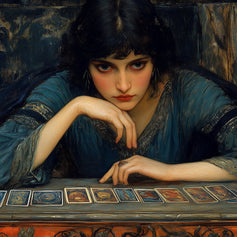
In the Age of Enlightenment, while reason triumphed, occultism persisted on the margins and saw the emergence of several notable female figures. In France, cartomancy—divination by cards—became fashionable after the Revolution, and Mademoiselle Lenormand became its most famous practitioner. Marie-Anne Adélaïde Lenormand (1772–1843), her real name, gained immense fame under the Empire as a fortune-teller and card reader for the Parisian elite. She advised figures such as Robespierre, Marat, and Empress Joséphine, presenting herself as the Sibyl of the Faubourg Saint-Germain. Despite the authorities’ suspicions, this cartomancer published her memoirs and divination manuals throughout her life, laying the foundations for a style of cartomancy that would bear her name (the Lenormand cards are still used for divination in Europe). Leaving behind a considerable fortune and inspiring the creation of popular fortune-telling decks, Mlle Lenormand strongly influenced the French divination tradition in the 19th century. Her success highlights how, at the imperial court as well as in bourgeois salons, the words of fortune-tellers could be heard at the highest levels.
Mediums and Theosophists of the 19th Century: The Female Spiritual Revival
The 19th century saw a true renaissance of occultism, driven in large part by women. It was the age of spiritualism and esoteric societies, in which female voices found a new audience. The spiritualist movement began precisely thanks to two sisters in the United States: Kate and Maggie Fox, aged only 12 and 15 in 1848, caused a sensation by claiming to communicate with a poltergeist in their home in Hydesville, New York State. What began as little more than entertainment for these teenagers took on unexpected proportions: their “séances” involving turning tables and rapping noises became public, triggering a national and then international enthusiasm for communication with the dead. Very soon, the Fox sisters and their demonstrations attracted the press and spread widely; other mediums, often women, began offering contact with the afterlife in salons or on stage. Thus began the wave of spiritualism—a movement according to which the living can converse with the dead—which swept not only across America but also through Europe during the second half of the 19th century. In France, the phenomenon took root through Allan Kardec, founder of the spiritualist doctrine, and numerous French mediums studied by scholars such as Camille Flammarion and Charles Richet. Spiritualism was distinctive in giving women a central place: considered more sensitive or intuitive according to the mentality of the time, they were highly represented among its star mediums. Women such as Florence Cook in England, famous for her ghost materialisations; Eusapia Palladino in Italy; and Mrs d’Esperance (Élisabeth d’Esperance) in Sweden became occult celebrities. Without degrees or official status, through their gift alone, they fascinated both the general public and researchers. Spiritualism thus offered Victorian women an unprecedented space for expression, a form of spiritual power in a still deeply patriarchal world. Through trances and messages from the afterlife, these mediums established the idea that women could be privileged intermediaries with the invisible—somewhat reversing the age-old stigma of the witch and transforming it into a psychic ability.
Alongside spiritualism, the late 19th century saw the birth of organised occultist movements in which women played a leading role, notably through the Theosophical Society. Founded in New York in 1875, this esoteric society had an extraordinary cofounder: Helena Petrovna Blavatsky. Born in Russia in 1831, Blavatsky—nicknamed “Madame Blavatsky”—was a multilingual adventurer passionate about esotericism. After numerous initiatory journeys to the East, she settled in the United States, where she launched this theosophical movement with others, blending Eastern religions, Western occultism, and clairvoyance. H. P. Blavatsky became the author of two monumental works of occultism: Isis Unveiled (1877) and The Secret Doctrine (1888), which sought to synthesise Eastern wisdom and esoteric science. Her influence was immense: hailed by her supporters as “the greatest occultist of the 19th century,” Blavatsky indeed popularised notions such as karma, ascended masters, and the comparative study of religions in the West. Despite the controversies—some accused her of fraud—Helena Blavatsky is recognised as a major figure in modern occultism, cofounder of the Theosophical Society and theorist of modern “theosophy.”
Alongside Blavatsky, other notable women distinguished themselves in the theosophical and occultist movement of the late century. Annie Besant (1847–1933) is a striking example: a British lecturer initially known for her feminist and socialist activism, she converted to theosophy in 1889 after reading The Secret Doctrine. Annie Besant later became worldwide president of the Theosophical Society, from 1907 onward, succeeding its founders, and played a crucial role in spreading theosophical ideas across the globe. A brilliant intellectual and tireless orator, she embodied the emancipated Western woman who found in occultism a new form of action and spiritual influence. Besant settled in India, promoted esoteric education, and even advocated political autonomy; she campaigned for Indian independence alongside the young Gandhi. Her life, combining mysticism and politics, illustrates how fin-de-siècle occultism was often associated with an ideal of human progress—an ideal that women like her championed fervently. In France, the Countess of Adhémar (Lady Caithness) founded an active theosophical branch in Paris in the 1880s, demonstrating that these new ideas also resonated among French elite women.
Anna Kingsford (1846–1888), an unconventional English figure, must also be mentioned: a physician—one of the first women to earn a medical degree—devout vegetarian, and Christian mystic, she served as president of the London Theosophical Society and later founded her own Hermetic Society. Anna Kingsford was convinced that women should play an equal, if not superior, role in spiritual life. She advocated a form of esoteric Christianity incorporating reincarnation and assigning a central place to the divine feminine principle. Her influence on English occultism was such that Aleister Crowley would claim that “she, and she alone, made possible the wave of interest in the occult that followed,” thereby laying the foundations for equal participation by women and men in the esoteric orders of the 20th century.
Women in Initiatory Orders at the Beginning of the 20th Century
At the dawn of the 20th century, the momentum created by spiritualists and theosophists continued through the creation of magical orders and initiatory societies, in which women’s place would, for the first time, be explicitly recognised as equal to that of men. This was the case in the highly influential Hermetic Order of the Golden Dawn, founded in London in 1888, which left its mark on the history of Western occultism. From the outset, the Golden Dawn innovated by welcoming female members on an equal footing with their male counterparts in rituals and initiatory grades—a first in the predominantly male world of secret societies. Not only did women participate, but several established themselves as central figures, becoming true magicians and priestesses of the occult tradition. Historian Mary K. Greer has highlighted four of them, whom she considers “the heart and soul” of the Order:
-
Florence Farr (1860–1917), a renowned actress and scholar of mystical Egypt, led the Golden Dawn’s London lodge and contributed to its rituals through her visionary creativity.
-
Moina Mathers (1865–1928), born Mina Bergson, sister of philosopher Henri Bergson, painter, and wife of cofounder S. L. MacGregor Mathers, served as a priestess during ceremonies and channelled teachings she attributed to the Secret Chiefs.
-
Annie Horniman (1860–1937), a wealthy patron, financed the Order’s activities and later founded a theatre, applying the principles of artistic and esoteric emancipation she cherished.
-
Maud Gonne (1866–1953), a passionate Irish nationalist and muse of the poet W. B. Yeats, used ceremonial magic as well as the political platform in her efforts to transform society.
These women, along with other lesser-known initiates, contributed greatly to shaping the Golden Dawn’s rituals, philosophy, and legacy. Their presence paved the way for mixed-gender participation in 20th-century esoteric movements. Where women had once been excluded or relegated to the role of passive mediums, they became officiants, hierophants, and accomplished magicians. Accounts indicate that these Victorian occultists possessed highly developed gifts of clairvoyance or mediumship, which they devoted to their mystical work. Breaking free from social expectations—several remained unmarried or divorced and led independent lives, a rare occurrence at the time—they embodied the ideal of the late-19th-century “New Woman”: educated, liberated, and invested with an intellectual and spiritual mission. Their contribution was not limited to esoteric circles; indirectly, they influenced literature—Yeats, close to Maud Gonne, infused his poems with mystical symbolism—as well as theatre and even politics, with Maud Gonne once again blending Celtic esotericism and nationalism.
Across the Channel, in France, comparable developments could be seen during the Belle Époque: Parisian occultist salons, notably hosted by female mediums such as Madame Thibaud or Madame Fraya, enjoyed great success. French magicians such as Papus (Gérard Encausse) readily worked with fortune-tellers or sleepwalkers during their experiments in hypnosis and magic. In 1891, Paris even hosted an International Spiritualist and Spiritualistic Congress at which women spoke about their visions or paranormal healings. For some, the esoteric quest became an extension of the feminist impetus: claiming the right to occultism was, in a sense, claiming the right to knowledge, mystery, and the sacred on an equal footing with men. This can be seen particularly in Dion Fortune (Violet Firth, 1890–1946), a British figure of the early 20th century: trained in the Golden Dawn in her youth, she later founded her own esoteric fraternity, the Fraternity of the Inner Light, and published numerous works teaching magic. Dion Fortune is considered the leading female esotericist of the first half of the 20th century, combining psychoanalytic knowledge—she was a psychotherapist—with occult traditions. Like her predecessors, she demonstrated that the female voice in esotericism was no longer an exception but was becoming the norm. Interwar occultists—including Aleister Crowley, who incorporated several “Scarlet Women,” such as Leah Hirsig, into his Thelemic order—generally considered women’s contribution indispensable to maintaining a balance of forces. The initiatory equality inaugurated a few decades earlier therefore continued and expanded.
Surveying this historical panorama, we can see that women were full participants in the history of occultism, even though their names received less media attention or recognition than those of their male counterparts. It should be emphasised that although these pioneers defied the prejudices of their time, they also often suffered defamation: they were labelled devilish witches, charlatans, or hysterics. Ultimately, celebrating these occultists means recognising that the quest for the invisible and the sacred is a shared human adventure, to which women have contributed as much magic, intuition, and knowledge as men—if not more.








1 comment on Occultism in Women