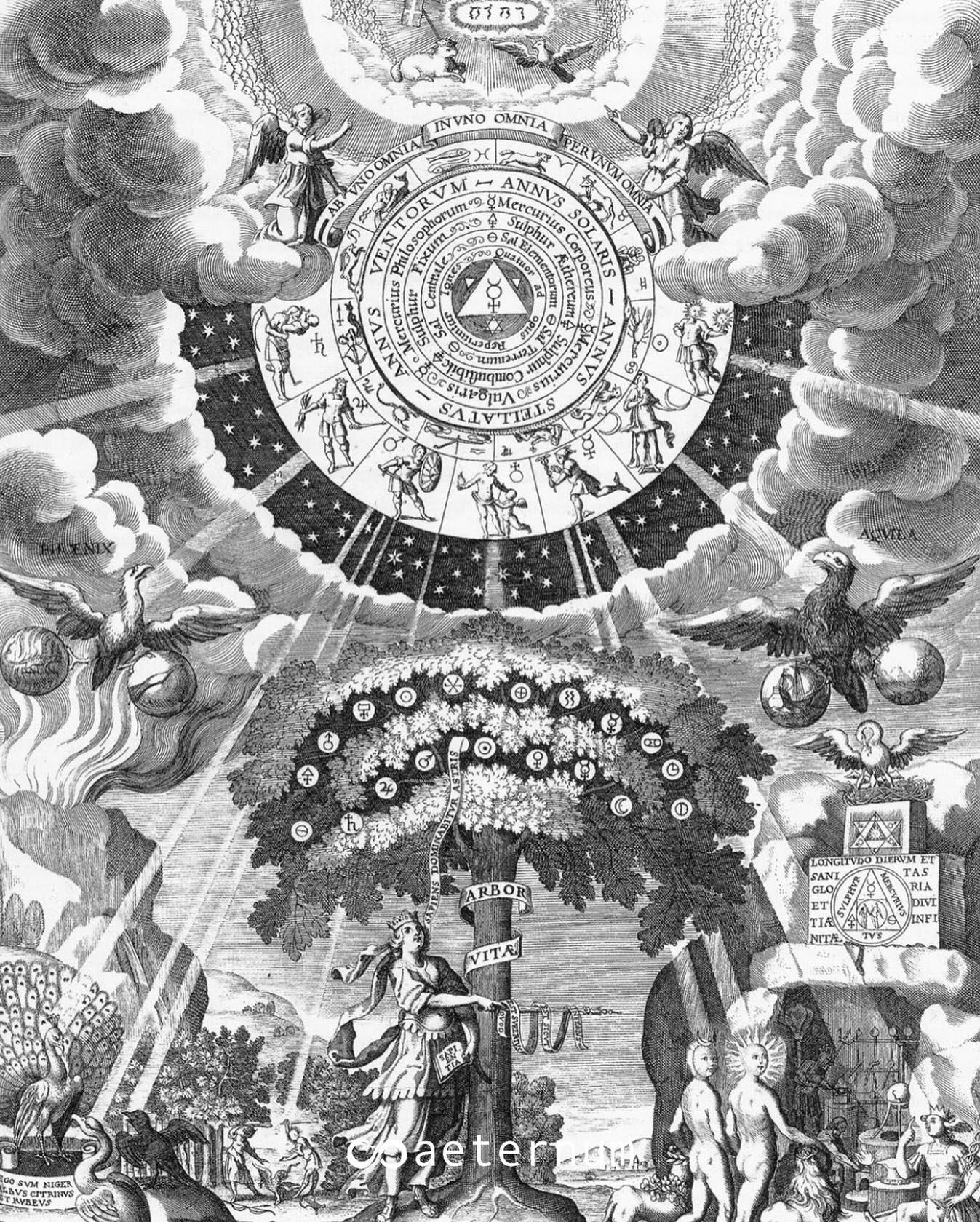




Joséphin Péladan (1858–1918) was a French man of letters known for his major role in fin-de-siècle Symbolism and occultism. A prolific writer, art critic, and esotericism enthusiast, in 1891 he founded the Catholic and Aesthetic Order of the Rose-Cross of the Temple and the Grail, and adopted the exotic title of “Sâr Mérodack,” claiming descent from an ancient king of Babylon. An erudite and eclectic figure of the Belle Époque, Péladan signed numerous novels, manifestos, and essays blending art and spirituality. This is a portrait of this colorful character.
Youth and education
Born in Lyon on March 28, 1858, into a traditionalist Catholic family, Joseph-Aimé Péladan—who would later adopt the first name Joséphin—grew up in an erudite environment imbued with religious fervor and occultism. His father, Louis-Adrien Péladan, was a journalist and founder of a religious journal, while his elder brother Adrien introduced the young Joséphin to esoteric doctrines at an early age. In 1870, the family moved to Avignon, where Péladan was educated by the Jesuits before continuing his education in Nîmes. Independent-minded and fervent, he displayed a nonconformist character that led to several conflicts during his schooling. In 1881, Péladan left “to conquer Paris”: he settled in the capital and frequented literary circles, meeting the writer Léon Bloy. This familial and intellectual environment, between ardent Catholicism and esotericism, shaped Péladan’s dual orientation toward faith and art and prepared the ground for his literary and occult endeavors.
Literary success and esoteric quest
In 1884, Joséphin Péladan became known to the general public with his first novel, The Supreme Vice. This tale of esoteric themes, prefaced by the celebrated author Jules Barbey d’Aurevilly, brought him immediate fame at the age of just 26. Buoyed by this success, Péladan began developing an ambitious fictional body of work (The Latin Decadence), blending decadent Symbolism and mysticism, in which he depicted occult forces battling the moral decadence of the end of the century. During this period, he also fashioned his public persona: he adopted the name Sâr Mérodack Péladan, a pseudonym inspired by Babylon that enhanced his mysterious aura. Alongside his literary career, Péladan became deeply involved in Paris’s occultist milieu. In 1888, together with the occultist writer Stanislas de Guaita and the physician Gérard Encausse (known as Papus), he co-founded the Kabbalistic Order of the Rose-Cross, an esoteric society that attracted numerous initiates. However, disagreements soon emerged within the group: Péladan reproached his colleagues for their pronounced taste for practical magic and the Masonic inspiration they gave the order, which he considered contrary to the spiritualist purity he sought. Drawn to a more artistic and mystical vision of esotericism, he broke away. In May 1891, Péladan created his own fraternity, the Catholic Order of the Rose-Cross of the Temple and the Grail. He proclaimed himself Grand Master of this new Order and announced its foundation with great fanfare in the newspaper Le Figaro. This fraternity, less an initiatory school than a circle of artists, aimed to “restore the worship of the Ideal in all its splendor, with Tradition as its foundation and Beauty as its means,” convinced that only the “magic of art” could save Western civilization from decadence. To this end, Sâr Péladan thereafter directed his movement toward an original project blending art and spirituality: the Rose-Cross Salons.
The Rose-Cross Salons
In 1892, Joséphin Péladan implemented his great aesthetic-spiritual project by organizing the first Rose-Cross Salon. Conceived as an “aesthetic gesture” in service of the ideal, this art exhibition brought together around sixty French and foreign artists selected by Péladan from March 10 to April 10, 1892, at the Durand-Ruel gallery in Paris. Symbolist painters and sculptors exhibited works imbued with spirituality and mythology. The opening of this first Salon caused a sensation throughout the Parisian art world: figures such as Paul Verlaine, Émile Zola, and Stéphane Mallarmé were among the many visitors, welcomed by the sound of the prelude to Wagner’s Parsifal—a composer revered by Péladan. The atmosphere was deliberately imbued with sacred mystery: neo-Gothic decorations, enchanting music, and esoteric symbols reinforced the ritual dimension desired by the Sâr. Other Rose-Cross Salons followed annually until 1897, each constituting a highly anticipated event for the Symbolist avant-garde. These successive exhibitions attracted leading artists—many students of the painter Gustave Moreau, such as Félix Vallotton, Émile Bernard, and Georges Rouault, took part—even though others, including Puvis de Chavannes and Gustave Moreau himself, declined the invitation. Over the course of the six Salons organized between 1892 and 1897, Péladan established himself as a fervent advocate of an idealistic and spiritualized art, in direct opposition to the naturalism and materialism dominant under the Third Republic. At this time, he published several aesthetic manifestos—including the work Idealistic and Mystical Art (1894)—which reveal his vast artistic culture and his conviction that art must recover a sacred function in modern society.
The impact of the Rose-Cross Salons was considerable in late-nineteenth-century Paris. The press reported on them, sometimes admiring this revival of idealism and sometimes mocking the organizer’s eccentricity. Péladan willingly cultivated a theatrical image: he appeared in public wearing flamboyant Oriental robes or draped in a black cloak adorned with symbols, with long hair and a beard carefully groomed with cedar oil. These affectations made him the target of numerous caricaturists and satirical journalists, who ironically nicknamed him “the Mage of Épinal” or “the Pedaling Sâr,” ridiculing his claims to be a mage and his taste for theatrical staging. Whatever the case, the public flocked to the Rosicrucian Salons, curious about this unusual alliance between art, religion, and occultism. Péladan saw in them the fulfillment of his mission: to “eradicate ugliness from the modern world” and reconcile Beauty and Faith. Nevertheless, the Rose-Cross Salon experience proved short-lived. Behind the worldly success, tensions were simmering within the movement. Péladan’s Catholic rigorism and uncompromising character eventually tired or irritated some of the artists and collaborators. Ideological quarrels broke out, fueled by outside sarcasm. In 1897, after the sixth exhibition, Sâr Péladan, the victim of controversy, abruptly gave up continuing the Salons and withdrew from the public scene to devote himself once again to writing.
Theater, art criticism, and final years
Although Joséphin Péladan withdrew from major events after 1897, he continued to deploy his creativity on other artistic fronts. Passionate about opera and theater, he tried his hand at playwriting in the spirit of the “total theater” cherished by the Symbolists. From 1895 onward, he composed several esoteric and historical plays, such as The Son of the Stars and Babylon, for which the young composer Erik Satie—also “Choirmaster” of his Rosicrucian Order—wrote original scores. Péladan also staged ambitious adaptations of ancient legends and tragedies: in 1897, he presented Semiramis, followed by Oedipus and the Sphinx, in the grand setting of the Roman Arenas of Nîmes, offering audiences performances imbued with mystical solemnity. His theatrical experiments, blending Symbolist sets, Wagnerian music, and biblical inspiration, impressed even foreign authors such as August Strindberg, whom Péladan met in 1897 and with whom he formed a lasting mutual esteem.
At the same time, Péladan continued his work as an art critic and essayist. A knowledgeable scholar of the Old Masters and the Renaissance, he published numerous works devoted to aesthetics and painting. His expertise on Leonardo da Vinci, for example, earned him recognition from the Académie française: in 1909, his collection Leonardo da Vinci, Selected Texts received the prestigious Charles-Blanc Prize for its contribution to disseminating the work of the Italian genius. In other essays, such as From Parsifal to Don Quixote (1906) and The Philosophy of Leonardo da Vinci (1910), he continued to advocate a lofty artistic ideal nourished by spirituality and the classical heritage. Despite his intellectual achievements, Péladan’s fame declined in the new century. The cultural climate of the Edwardian era and the later Belle Époque was no longer as receptive to his stylistic extravagances and anti-materialist discourse. The writer gradually abandoned his eccentric attire and led a more discreet life, remarrying an admirer, the painter Christiane Taylor, and making a modest living from art criticism published here and there. He nevertheless received some belated recognition, such as in 1914, when the Académie française awarded him the Joest Prize for his work Our Artistic and Historic Churches, honoring his knowledge of religious heritage.
Joséphin Péladan died on June 27, 1918, in Neuilly-sur-Seine, in the midst of the Great War, almost forgotten by the general public. He was buried in Paris at the Batignolles Cemetery. The man who had been a leading figure of fin-de-siècle Symbolism and a self-proclaimed prophet of Ideal Art thus left the stage quietly, after inspiring as much fervent admiration as sarcasm during his lifetime.
Although he fell into relative obscurity during the 20th century—his works were no longer reprinted after 1930, and his name had already disappeared from some literary histories of the interwar period—Joséphin Péladan remains a fascinating figure for historians of art and esotericism today. A pioneer of an unprecedented synthesis between mystical tradition and the artistic avant-garde, he influenced many Symbolist artists of his time and, in his own way, anticipated the role of the modern “critic-curator,” placing art at the service of a vision of the world.