















































































































































































































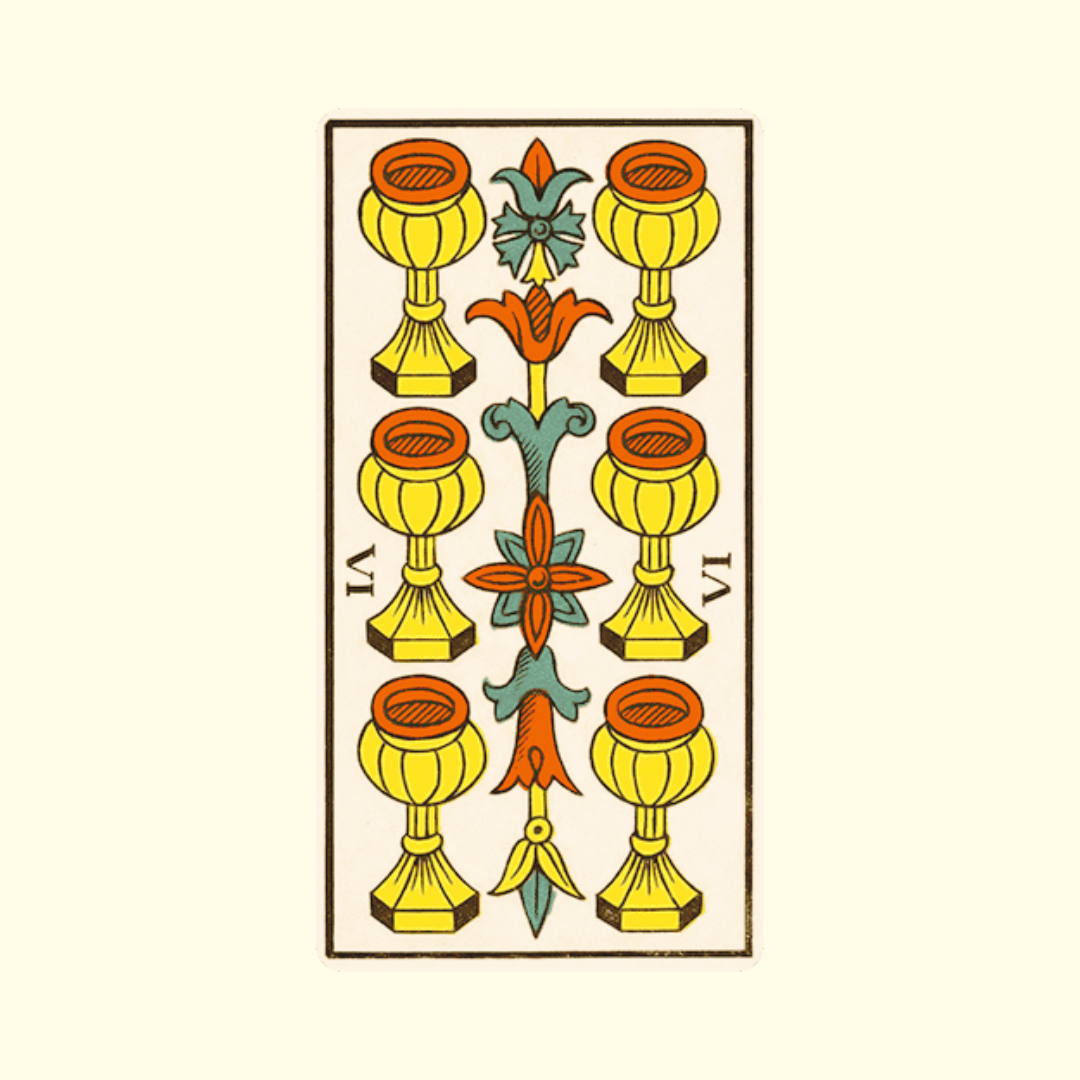

Six chalices create a regular composition in the Tarot de Marseille. In the Waite-Smith, they become vases filled with flowers in the middle of an old garden, where one child holds out a cup to another. The card has established the image of happy memory, childhood, and return. Yet the old texts also turn it toward the future: what returns may be a memory, a person, knowledge, or a new way of inhabiting the present.
The Six of Cups speaks of the past that remains active. It may refer to an old encounter, a gesture passed down, a home left behind, a family habit, or the pleasure of rediscovering what once mattered. However, it asks us to distinguish memory from reconstruction: the past returns through today’s perspective.
The sources present a card more dynamic than the word “nostalgia.” Mathers contrasts the past with the future depending on the card’s orientation. The Golden Dawn describes a beginning of pleasure and growth. Waite adds a second reading involving new connections, new knowledge, and a new environment.
From six chalices to the garden of memory
In a Tarot de Marseille, the six cups are arranged in pairs around a vegetal axis. No childhood scene appears. The symmetry may evoke continuity, an exchange between two sides, or an arrangement that repeats. The reader observes the ornaments connecting the chalices instead of looking for hidden children in the design.
Smith places two children in an old courtyard. The older child offers the younger one a cup filled with white flowers. Five other flower-filled cups occupy the scene, and an adult figure walks away in the background. Waite connects the image with the past, memories, childhood, happiness, and things that have disappeared. He also proposes a reversed reading: new connections, new knowledge, and a new environment.
Iconographic reference. The children, flowers, and old courtyard belong to the Waite-Smith. In a Marseille deck, the Six remains a pip card. Memory can enter through the context of the reading or through the cartomantic tradition, not through a scene printed on the card.
Divinatory transmission
Mathers summarizes the Six of Cups as the past: what has passed, faded, disappeared, or come to an end. Reversed, he directs it toward the future, what will come soon. This simple opposition recalls that the card functions as a temporal axis. The cards placed before and after it may indicate what is returning and what is seeking a continuation.
In Book T, the Six bears the title “Lord of Pleasure” and corresponds to the Sun in Scorpio. Six flowers pour clear water into cups that are not yet full. The text speaks of the beginning of increase, gain, and pleasure. It also mentions vanity, presumption, or conflict when the context deteriorates. Pleasure is therefore neither complete nor guaranteed.
Waite takes up memory and things that have disappeared, then opens the card to novelty. Smith makes this ambivalence visible: an old place welcomes a gesture taking place now. The Six may show a real return, but also the transmission of a quality from the past to a new situation.
Meaning in a reading
In a favorable reading
The Six of Cups favors reunions, gratitude, sharing, and acts of kindness without ulterior motives. A person, skill, or old place may become useful again. The card also makes it possible to recognize what, in childhood or an earlier period, provided a solid foundation for the present.
It may announce a reconciliation with part of one's history, provided that current facts support the rapprochement. Reuniting does not mean returning to exactly the same point: each person has changed since the separation.
In a tension reading
Memory can embellish what was incomplete, maintain a loyalty that has become burdensome, or prevent one from welcoming the present. The Six then shows idealization of the past, family repetition, attachment to an old relationship, an infantile stance, or an imbalanced exchange under the guise of protection.
The card proves neither memories of a past life nor a predestined connection. It speaks of recognizable elements in the querent's story, memory, or the situation described by the reading.
Love, work and finances
The Six connects the current experience to something from the past. The useful question is to identify what is returning, then check whether this return nourishes the present or holds it back.
| Area | Favorable reading | Tension aspect | Question to ask |
|---|---|---|---|
| Love | Reunion, simple tenderness, an old relationship examined with maturity. | Idealization of a former partner, repetition of a family pattern, return out of fear of the new. | What has really changed since the first story? |
| Work | Former contact, skill put back into use, return to a familiar team. | Outdated method, loyalty to a structure that no longer suits you. | What old asset still meets current needs? |
| Finances | Clear family support, well passed on, a forgotten resource rediscovered. | Dependence, emotional debt, a decision guided by an old fear of scarcity. | Does the gift carry an unspoken expectation? |
| Family | Reconciliation, a story passed down, a restorative gesture between generations. | Child role maintained into adulthood, idealized past, secret that still organizes relationships. | Which words belong to the past, and which concern the present? |
| Creation | Return to a beloved practice, revisiting archives, renewed old style. | Copy of oneself, refusal to evolve, project carried solely by nostalgia. | What should be preserved and what should be reinvented? |
Read the combinations
The Six brings the past, transmission, or return. The neighboring card specifies what is returning and how the present can welcome it.
| Combination | Possible dynamic | Point of attention |
|---|---|---|
| Six of Cups + Two of Cups | Reunion, old affection, or restored agreement. | The memory of a bond does not guarantee its current reciprocity. |
| Six of Cups + Judgement | Call from the past, news received, an old situation requiring a response. | Respond to the present rather than the image preserved. |
| Six of Cups + Sun | Happy memory, family reunion, simple joy, or a clear relationship with children. | The combination does not allow announcing a pregnancy. |
| Six of Cups + Devil | Powerful attachment to a person, habit, or old pleasure. | Repetition, dependency, and imposed loyalty must be examined. |
| Six of Cups + Eight of Cups | Necessary departure to stop living in the past. | Leaving a repetition behind does not require disavowing the whole story. |
| Six of Cups + Star | Peaceful memory, restored trust, gentle and fruitful transmission. | Do not confuse comfort with a guaranteed return. |
Correspondences according to the schools
Childhood comes from Smith, the past from the cartomantic list, and Pleasure and the Sun in Scorpio from the Golden Dawn. The Tarot de Marseille retains only the six chalices and their arrangement.
| Reference point | Attribution | Historical scope |
|---|---|---|
| Family | Minor Arcana, Six of Cups | Sixth pip card of the suit. |
| Tarot de Marseille | Six chalices arranged symmetrically around a vegetative axis | Pip card without children or garden. |
| Mathers, 1888 | The past, what has disappeared or faded | Reversed: the future and what will come soon. |
| Golden Dawn | Lord of Pleasure | Title from Book T. |
| Element | Water | Occult attribution to the suit of Cups. |
| Astrology | Sun in Scorpio | Second decan of Scorpio in the Golden Dawn grid. |
| Waite-Smith | Two children, six flowering cups, old courtyard | Scene published in 1909. |
| Hebrew letter | No letter specific to the card | The letters are assigned to the trumps in this system. |
| Stone and plant | No historical agreement | Modern lists are not shared by the cited sources. |
| Reading words | Memory, return, transmission, childhood, renewal | The context distinguishes continuity from idealization. |
Reading advice
When the Six appears, clarify the memory. Who was present, what happened, and what has changed since then? A concrete memory provides a more accurate reading than general nostalgia. Then look for the card that indicates the future of this return.
With a Marseille deck, compare the two columns or pairs of cups: do they respond to one another, repeat one another, or frame a central growth? With a Waite-Smith deck, observe who gives, who receives, and what place the adult in the background occupies. The gentleness of the image should not conceal a possible imbalance.
Choosing a tarot deck to work with this card
To find this arcana in a complete deck, compare the Tarots de Marseille, the Rider-Waite-Smith, and our full range of Divinatory Tarots. If you are just starting out, also see How to choose your first tarot deck?.
Sources and reference texts
For the history of decks and suits: Victoria and Albert Museum, A History of Tarot Cards; British Museum, reproduction of Nicolas Conver’s Tarot de Marseille.
For divinatory and occult texts: S. L. MacGregor Mathers, The Tarot, 1888, card meanings; Liber LXXVIII, “The Lord of Pleasure”, publication of material from Book T; Arthur Edward Waite and Pamela Colman Smith, The Pictorial Key to the Tarot, Six of Cups, 1911.










