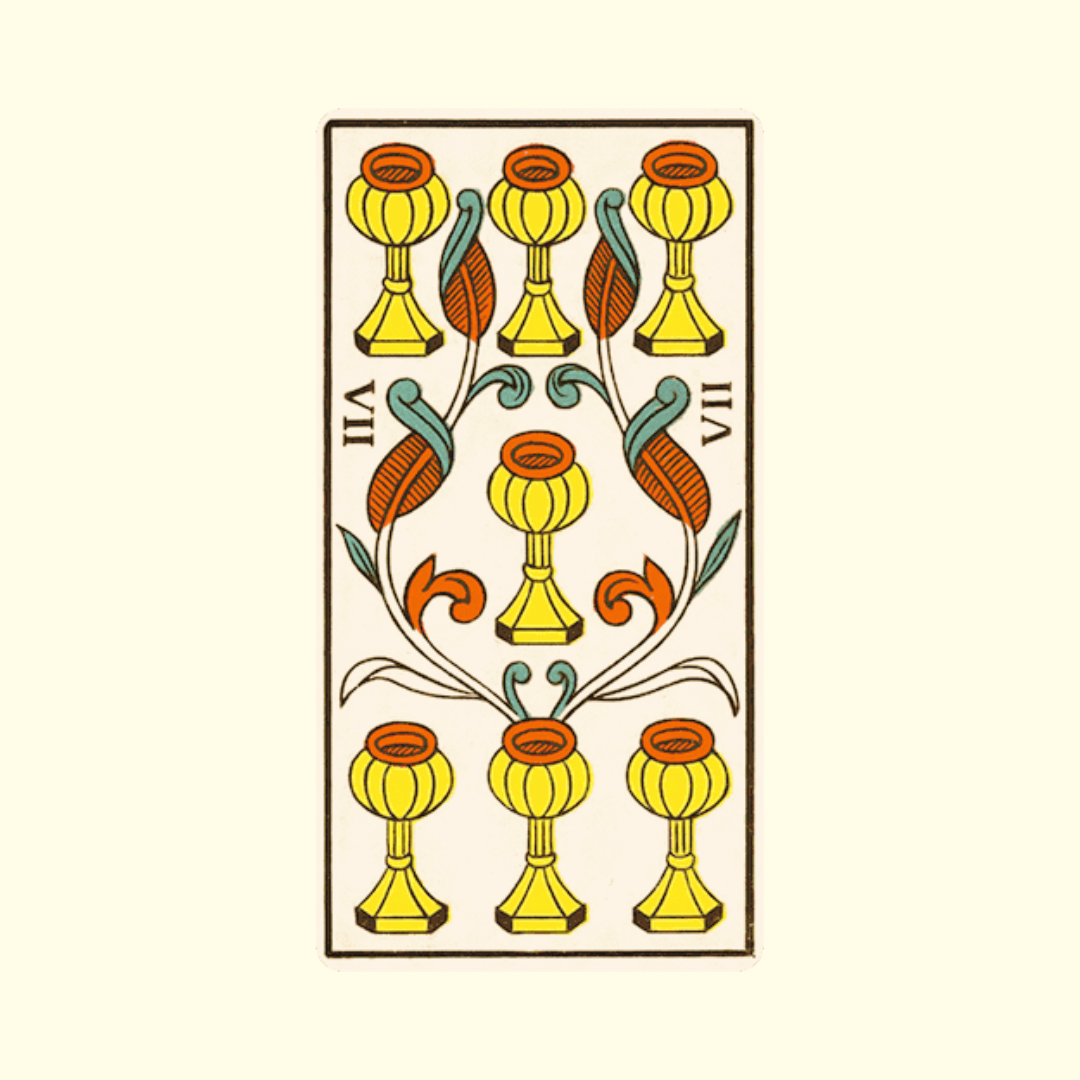

Seven cups unfold in the Tarot de Marseille as a botanical and numerical structure. In the Waite-Smith, they float in a cloud before a figure seen from behind; each contains an apparition, a treasure, a threat, or a promise. The card does not condemn imagination. It asks us to recognize what belongs to desire, what can become a project, and what will remain an alluring image with no hold on reality.
The Seven of Cups appears when several possibilities demand attention. It can encourage conception, exploration, and the desire to choose. It can also show dispersion, an appealing promise, fantasy, indecision, or apparent success that will not be pursued.
The sources trace a clear progression. Mathers gives ideas, feelings, reflection, and plans, then decision when the card is reversed. The Golden Dawn emphasizes illusory success and unfulfilled promises. Waite and Smith bring together imagination, contemplation, and lack of substance in a scene that has become famous.
From the seven chalices to the images of desire
In a Tarot de Marseille, seven repeated chalices are arranged within a network of stems and leaves. No object emerges from the cups. The card invites the reader to consider the odd rhythm, the central element, and the balance between the groups of chalices. The number seven may introduce a stage that is difficult to stabilize, but this idea comes from the reading system, not from a printed narrative.
Smith shows a person facing seven cups set on a cloud. A head, a veiled figure, a serpent, a structure, riches, a crown, and a winged creature occupy the vessels. Waite speaks of images arising from a fantastic mind, of feeling, imagination, and things seen in the mirror of contemplation. He acknowledges a certain fulfillment, without permanence or substantial foundation.
Iconographic reference. The seven visions belong to the Waite-Smith. They do not constitute an ancient code hidden in every Seven of Cups. In a Marseille, the reader works with the number, the suit, and the neighboring cards.
Divinatory transmission
Mathers associates the Seven of Cups with ideas, feelings, reflection, and plans. Reversed, it gives a plan, purpose, resolution, and decision. This progression is useful for readings: the card does not remain trapped in illusion. It can describe the moment when an inner image calls for form, criteria, and a choice.
Book T calls the card “Lord of Illusory Success” and assigns it Venus in Scorpio. The seven cups remain empty despite the lotuses placed above them. The text evokes possible victory neutralized by inaction, unfulfilled promises, error, vanity, and a result obtained and then abandoned. This hermetic framework explains the severity of several modern interpretations.
Waite retains imagination and reflection, then reserves desire, will, determination, and project for the reversed card. His text therefore aligns with Mathers: the difficulty does not come from the dream itself, but from its inability to become a decision followed by action.
Meaning in a spread
In a favorable reading
The Seven of Cups opens a space for design. Several paths can be compared before choosing. The card favors creating hypotheses, examining a desire, symbolic work, and discovering what truly attracts you. It suits a moment when no option should yet be closed off too quickly.
Its best direction is to move from image to project. A choice becomes practicable when it is given a cost, a deadline, a first action, and a success criterion.
In a tension reading
The multiplication of possibilities can prevent any decision. The card then shows fantasy, an offer that is too good to be true, a promise without proof, contradictory desire, distraction, or a project that already provides imaginary satisfaction before it has even begun. It can also indicate a person who maintains several scenarios in order to be accountable for none of them.
The Seven does not say that every vision is false. It calls for a reality check: what facts support the option, what resources exist, what risk accompanies the choice, and what first step can be verified?
Love, work, and finances
The Seven turns each area into a chamber of choice. The task is to reduce the number of options without confusing desire, feasibility, and external promise.
| Area | Favorable interpretation | Tension aspect | Question to ask |
|---|---|---|---|
| Love | Clarified desires, several relationship paths considered before commitment. | Idealization, contradictory expectations, person kept as one option among others. | What relationship exists in actions rather than in the imagination? |
| Work | Design phase, numerous avenues, exploration before decision. | Accumulated projects, embellished position, career promise without concrete evidence. | Which option has a budget, timeline, and identified responsibility? |
| Finances | Comparison of solutions, reflection before purchase or investment. | Dreamed-of gain, opaque offer, expense motivated by social image. | Which figures and documents make comparison possible? |
| Creation | Reservoir of images, sketches, research into forms, fertile imagination. | Dreamed-of perfection that prevents production, multiplication of concepts. | Which prototype can be completed this week? |
| Personal life | Desire named, scenarios assessed, priorities reconsidered. | Escape into possibilities, refusal to give up, decision continually postponed. | What must be rejected to give the chosen option a chance? |
Reading associations
The Seven brings images, options and desire. The associated card indicates what can organize them, make them deceptive or transform them into action.
| Association | Possible dynamic | Point of caution |
|---|---|---|
| Seven of Cups + Magician | A possibility receives resources and can become a first attempt. | Presentation skills can also embellish an empty offer. |
| Seven of Cups + Justice | Choice based on criteria, comparison, acknowledged decision. | Do not seek in the spread a certainty that the facts do not provide. |
| Seven of Cups + Three of Pentacles | An idea finds a team, a technique and a viable form. | The project must be quantified and allocated. |
| Seven of Cups + Moon | Powerful imagination, dream, ambiguity and projection are reinforced. | Wait for clearer information before making a commitment. |
| Seven of Cups + Devil | Captivating desire, temptation, promised pleasure or seduction strategy. | Dependence, control, secrecy and hidden interests require direct examination. |
| Seven of Cups + Eight of Cups | An illusion or a hopeless option is abandoned. | The departure must follow an assessment, not a new seductive image. |
Correspondences according to the schools
The objects in the cups come from Smith. The project and decision appear in Mathers. The title of Illusory Success and Venus in Scorpio belong to the Golden Dawn. These layers complement each other without sharing the same date.
| Reference point | Attribution | Historical scope |
|---|---|---|
| Family | Minor Arcana, Seven of Cups | Seventh pip card of the suit. |
| Tarot de Marseille | Seven chalices in a vegetated setting | Suited card without cloud or visions. |
| Mathers, 1888 | Idea, feeling, reflection, project | Reversed: plan, resolution and decision. |
| Golden Dawn | Lord of Illusory Success | Title from Book T. |
| Element | Water | Occult attribution to the suit of Cups. |
| Astrology | Venus in Scorpio | Third decan of Scorpio in the Golden Dawn grid. |
| Waite-Smith | Silhouette facing seven cups filled with apparitions | Scene published in 1909. |
| Hebrew letter | No letter specific to the card | In this system, the pip cards do not each receive a letter. |
| Stone and plant | No historical consensus | Recent correspondences vary by author. |
| Reading keywords | Imagination, options, desire, illusion, decision | Bringing it into reality is the card’s pivot. |
Reading advice
Give each cup a name. A vague option becomes clear when it is given an objective, a cost, a deadline, and something to give up. Then eliminate anything that depends entirely on an unverified external promise. The reading does not choose in place of the querent; it shows the quality of the available scenarios.
With a Marseille deck, look for the central chalice or the break in symmetry. With a Waite-Smith deck, ask which apparition draws the eye and why. The most dazzling content is not automatically the best, and the unsettling object is not necessarily the one to avoid: the question sets the measure.
Choosing a tarot deck for working with this card
To find this arcana in a complete deck, compare the Tarots de Marseille, the Rider-Waite-Smith, and all of our Divinatory Tarots. If you are a beginner, also consult How to choose your first tarot deck?.
Sources and reference texts
For the history of tarot decks and suits: Victoria and Albert Museum, A History of Tarot Cards; British Museum, reproduction of Nicolas Conver’s Tarot de Marseille.
For divinatory and occult texts: S. L. MacGregor Mathers, The Tarot, 1888, card meanings; Liber LXXVIII, “The Lord of Illusionary Success”, publication of material from Book T; Arthur Edward Waite and Pamela Colman Smith, The Pictorial Key to the Tarot, Seven of Cups, 1911.