















































































































































































































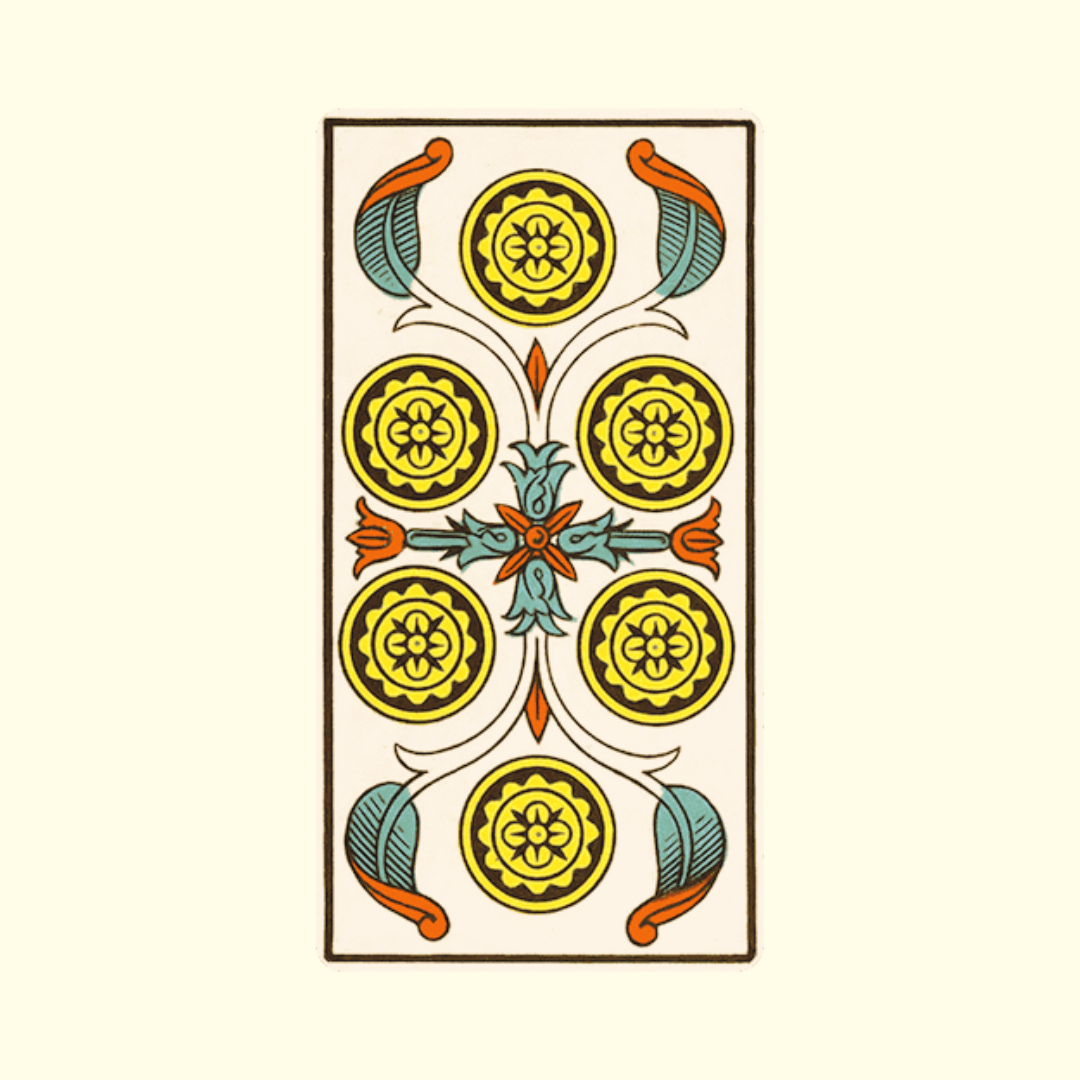

Six pentacles may form a regular circulation. In the Tarot de Marseille, they are arranged amid foliage without a giver or recipient. In the Waite-Smith, a merchant holds scales and distributes coins to two kneeling people. The Six of Pentacles speaks of giving, gratification, and material success, but also of the power held by the one who measures, chooses the time, and decides the share granted.
The card may announce assistance, a bonus, a reimbursement, a grant, a transfer of skills, or a sharing of burdens. It does not claim that the exchange is equal. The giver may set the conditions, while the recipient reveals their need. The scales measure distribution; they do not guarantee that the rule is fair.
Mathers cites gifts and gratification. The Golden Dawn calls the Six “Material Success” and assigns it to the Moon in Taurus. Waite shows the merchant’s prosperity as much as his kind heart, then associates the card with attention and the present moment. A serious reading therefore examines the resource, the timing, and the dependency created by the aid.
From the six pentacles to the scales of giving
In the Marseille, six pentacles are arranged in lines, columns, or symmetrical groups, depending on the design. Leaves and flowers fill the gaps. No figure dominates the whole. The number six brings a complete, balanced composition without indicating who owns the pentacles or how they circulate.
Smith places a richly dressed figure standing before two kneeling people. One hand holds the scales, while the other lets coins fall. Waite presents him as a merchant whose gesture testifies both to success and kindness. Yet the two beneficiaries do not necessarily receive the same thing, and the merchant retains the measuring instrument.
Iconographic reference. The scales, merchant, and kneeling figures belong to the Waite-Smith. The Tarot de Marseille depicts no act of charity. In the English deck, the gift is inseparable from a visible hierarchy: the interpretation must consider the criteria, the conditions in return, and the freedom to refuse.
Divinatory transmission
Mathers attributes gifts, presents, and gratification to the Six of Pentacles. Reversed, it signifies ambition, desire, passion, purpose, and aspiration. His list does not simply contrast generosity with selfishness: the reversal shifts the received gesture toward what is sought or coveted.
Book T names it “Lord of Material Success” and assigns it the Moon in Taurus. Six pentacles are touched by roses and buds. The text cites success in material enterprises, gain, influence, rank, liberality, and justice. Poorly aspected, the card can become pride in one's wealth, insolence born of excess, or prodigality.
Waite returns to gifts and gratification, then adds attention, vigilance, an accepted moment, and present prosperity. Reversed, he mentions desire, greed, envy, jealousy, and illusion. The Six can therefore show sincere help, a calculated reward, a gift that exposes the donor's superiority, or an unspoken expectation of something in return.
Meaning in a spread
In a favorable reading
The Six indicates that a resource is flowing toward a need. A payment arrives, a funder responds, someone shares their time, or an institution grants an entitlement. The gesture becomes fruitful when the amount, duration, and purpose are clear, without humiliation or hidden obligation.
The card can also show fair compensation. Gratification is not merely a gift: it can acknowledge work, offset a burden, or restore a balance. Receiving does not diminish one's dignity, and giving does not confer a claim over the person being helped.
In a tension reading
The gift becomes an instrument of control. Aid is dispensed drop by drop, a bonus depends on opaque criteria, or someone constantly reminds others of what they have given. At the other extreme, prodigality squanders a necessary resource or seeks to buy esteem.
The Six can also show desire, comparison, or the illusion of reciprocity. Giving and receiving different values does not always create an exact debt. It is necessary to name what constitutes a gift, a loan, a salary, compensation, and a legal obligation.
Love, work, and finances
The Six distributes a resource according to a measure. The area indicates what is circulating, while the neighboring cards show who holds the scales, according to which rule, and in exchange for what.
| Area | Favorable reading | Tension aspect | Question to ask |
|---|---|---|---|
| Love | Freely given support, shared expenses, help that respects autonomy. | Purchased affection, emotional debt, power linked to money. | Can the gesture be refused without penalty? |
| Work | Bonus, mentorship, allocated budget, compensation, or better-distributed resources. | Favoritism, opaque criteria, work paid for with a promise of visibility. | What rule determines the share, and who can verify it? |
| Finances | Gift, repayment, grant, regulated loan, or occasional assistance. | Predatory credit, dependence, generosity beyond one’s means. | Is it a gift, a debt, or an obligation? |
| Family | Transfer, temporary support, sharing of costs according to ability. | Inheritance used as a means of pressure, aid reserved for the most compliant. | Are the conditions known to everyone concerned? |
| Social life | Organized solidarity, useful fundraising, resource directed toward an identified need. | Charity for appearances, exposed beneficiary, donor placed at the center. | Does the arrangement protect the dignity of the recipient? |
Reading associations
The Six stages the measure of giving. The associated card reveals the source of the resource, the need it addresses, or the power the exchange establishes.
| Association | Possible dynamic | Point of vigilance |
|---|---|---|
| Six of Coins + Five of Coins | Concrete aid provided for a material difficulty. | Check that the assistance addresses the priority need. |
| Six of Coins + Justice | Distribution based on a right, compensation, or payment owed. | An obligatory gesture must not be presented as a favor. |
| Six of Coins + Emperor | An institution, employer, or authority controls the allocation of resources. | Ask for the criteria, duration, and avenue of appeal. |
| Six of Coins + Devil | Aid tied to a debt, control, or hidden consideration. | Read every clause and preserve the possibility of refusal. |
| Six of Coins + Temperance | Gradual support, measured circulation, lasting assistance. | The rhythm must not artificially maintain dependence. |
| Six of Coins + Sun | Visible sharing, fair recognition, a resource whose use is clear. | Preserve the beneficiaries’ privacy and agreement. |
Correspondences according to the schools
The former chart assigned Jupiter, spring, sapphire, magnolia, and Vav. Book T gives the Six the Moon in Taurus. The other elements do not belong to the same system and do not form a coherent historical table.
| Reference | Attribution | Historical scope |
|---|---|---|
| Family | Minor Arcana, Six of Coins | Sixth pip card of the suit. |
| Tarot de Marseille | Six coins arranged in a plant-filled setting | Card without a merchant, scales, or beneficiaries. |
| Mathers, 1888 | Gifts, presents, gratification | Reversed: ambition, desire, passion, goal, aspiration. |
| Golden Dawn | Lord of Material Success | Title from Book T. |
| Element | Earth | Occult attribution to the suit of Pentacles. |
| Astrology | Moon in Taurus | Second decan of Taurus in the Golden Dawn grid. |
| Waite-Smith | Merchant, scales, coins, and two kneeling people | Scene published in 1909. |
| Hebrew letter | No letter specific to the card | Vav belongs to the Hierophant in the Golden Dawn system. |
| Stone, plant, season | No common historical agreement | Sapphire, magnolia, and spring do not come from the cited sources. |
| Reading keywords | Gift, measure, gratification, aid, success, power, consideration | The framework distinguishes solidarity from control. |
Reading advice
Write down the exact nature of the exchange and place one of these words before it: gift, loan, salary, repayment, grant, or compensation. Add the amount, date, duration, and conditions. This precision reveals both imagined debts and hidden obligations.
Then ask who holds the scales and who defined their unit. If the person being helped can neither discuss the share nor refuse the gesture, generosity may conceal power. For a loan or institutional aid, compare the spread with the actual documents.
Sources and reference texts
For the history of decks and suits: Victoria and Albert Museum, A History of Tarot Cards; British Museum, reproduction of Nicolas Conver’s Tarot de Marseille.
For divinatory and occult texts: S. L. MacGregor Mathers, The Tarot, 1888, card meanings; Liber LXXVIII, “The Lord of Material Success,” publication of material from Book T; Arthur Edward Waite and Pamela Colman Smith, The Pictorial Key to the Tarot, Six of Pentacles, 1911.










