


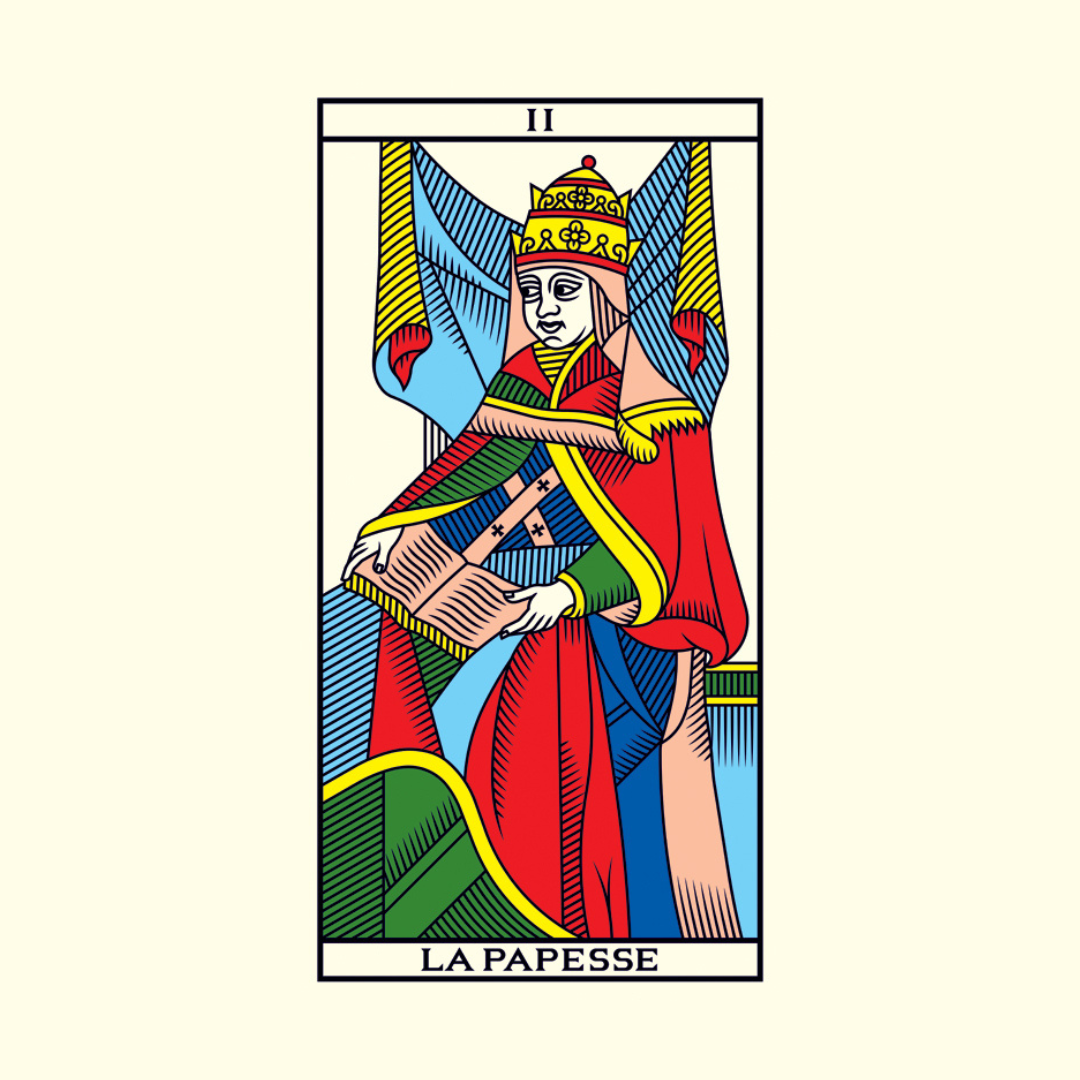

The Popess holds a book that she does not show in its entirety. Her authority comes neither from spectacular gestures nor from command: it resides in what has been learned, kept, and understood before being passed on. This restraint gives the second card a special place, between the religious figure of the old Italian tarots and the guardian of the sanctuary created for the Waite-Smith.
The Popess in the Tarot de Marseille and Pamela Colman Smith’s High Priestess should not be confused. The former wears the papal tiara and belongs to the Christian imagination of Renaissance Europe. The latter sits between the columns marked J and B, with a lunar crescent and a scroll bearing the word Tora. They share the book, silence, and reserved knowledge, but their religious language and occult architecture are not the same.
The Popess in the earliest tarot decks
The figure appears as early as 15th-century Italian tarots. In the Visconti-Sforza deck held by the Morgan Library, a veiled woman wears the triple tiara and holds a cross and a book. This image predates by several centuries the lunar and Kabbalistic associations later added to it. It belongs to the series of earthly and religious dignities placed at the beginning of the trumps. Morgan Library, Visconti-Sforza Tarot, The Popess.
The legend of Pope Joan may have influenced how the card was received, but it is not enough to explain its entire history. Tarot uses immediately recognizable figures of authority: empress, emperor, popess, and pope. In French decks, the open or closed book becomes her primary attribute. It gives the card a meaning of reading, doctrine, memory, and knowledge held in reserve.
Iconographic marker. The High Priestess’s book is not a decorative accessory. It places the card on the side of knowledge acquired and preserved. Depending on the question, this book may represent study, an archive, a secret, a written rule, or information that has not yet been made public.
From the Papesse to the High Priestess
Nineteenth-century occultists transformed the sovereign pontiff into a guardian of hidden science. Mathers calls her the “High Priestess or Papesse” and sees in her book science, wisdom, and knowledge. Papus and Wirth incorporate her into a French Kabbalistic interpretation in which the second card is assigned the letter Beth.
The Waite-Smith deck adopts a different set of correspondences. The High Priestess is assigned Gimel and the Moon. Pamela Colman Smith places her between the J and B pillars of the Temple, before a veil adorned with palms and pomegranates. The partially covered scroll indicates that part of the law is revealed, while another part remains veiled. The crescent at her feet and the lunar crown make visible an attribution that does not belong to the Marseille Papesse.
What the Early Authors Attributed to Her
Mathers summarizes the card as science, wisdom, knowledge, and education. Reversed, it becomes pretension, ignorance, clumsiness, or superficial knowledge. This contrast is illuminating: owning a book does not mean having absorbed its contents.
Waite emphasizes secrets, silence, perseverance, wisdom, and the future that has not yet been revealed. His High Priestess therefore does not mean that everything must remain hidden. She indicates that the time to speak or act has not yet come, or that the answer requires more careful examination. The unfavorable aspect appears when reserve becomes affectation, when knowledge remains superficial, or when emotion clouds judgment.
Meaning in a Spread
In a Favorable Reading
The High Priestess calls for slowing down in order to read, verify, listen, and let information take shape. She favors study, quiet preparation, the safeguarding of a legitimate secret, and attention to what remains unspoken. She may represent an educated person, a reserved adviser, a decisive document, or knowledge the querent already possesses but has not yet put into practice.
The card does not describe empty passivity. Its stillness is that of inner work and maturation. In a project, it advises gathering all the pieces before making an announcement. In a relationship, it asks you to distinguish genuine discretion from silence that maintains ambiguity.
In an unfavorable reading
The High Priestess may indicate information withheld inappropriately, an inaccessible file, a wait that drags on, or someone taking refuge behind silence. It may also refer to book knowledge without experience, a judgment based on suppositions, or an arrogant attitude that refuses dialogue.
Love, work, and finances
| Area | Favorable reading | Shadow side | Question to ask |
|---|---|---|---|
| Love | A guarded feeling, a bond that matures, attentive listening, need for intimacy. | Maintained unspoken matters, distance, hidden relationship, or refusal to answer. | Does silence protect the connection or prevent the truth? |
| Work | Research, training, preparation of a file, advisory role. | Blocked information, incomplete qualification, project that remains theoretical. | What document or learning is still missing? |
| Finances | Review of the accounts, reserve, decision postponed until the data is received. | Hidden fees, incomplete figure, inaction in the face of a necessary decision. | Are all the conditions written down and understood? |
| Project or study | Documentation, memory, methodical reading, maturation before publication. | Accumulation of notes without taking action, copying without understanding. | What must be understood before producing? |
How to read its associations
The High Priestess brings retained knowledge, memory, the document, and preparation time. The neighboring card shows what this knowledge illuminates or what comes to open it up.
| Association | Possible dynamic | Point of vigilance |
|---|---|---|
| High Priestess + Magician | Prepared knowledge moves into action or becomes a demonstration. | Do not act before understanding the method. |
| High Priestess + Empress | A guarded idea takes on a form, a voice, or a means of dissemination. | The study must lead to a tangible result. |
| High Priestess + Emperor | A document, rule, or skill supports an authority decision. | Check who controls access to the information. |
| High Priestess + Lovers | A decision requires intimate knowledge of the motives and commitments. | What is left unsaid can distort consent. |
| Popess + Devil | Sensitive knowledge, fascination, a secret linked to an interest or a power relationship. | Refuse blackmail and information obtained without authorization. |
| Popess + Moon | Silence encounters imagination, dreaming, or a situation that is difficult to read. | Distinguish intuition from projection. |
| Popess + World | The study reaches maturity and can be shared or published. | Do not keep completed work indefinitely. |
Correspondences according to the schools
| Reference | Attribution | Historical significance |
|---|---|---|
| Family | Trump or major arcana II | Second numbered trump in the French series. |
| Old Italian name | La Papessa | Figure attested in 15th-century Italian tarot decks. |
| Tarot of Marseille | The Popess, book and tiara | Christian image of religious authority and preserved knowledge. |
| French occultism | Beth; science and knowledge | Attribution found in Papus and Wirth. |
| Golden Dawn | Gimel and the Moon | Distinct system from the French Beth–Popess sequence. |
| Waite-Smith | High Priestess, J and B pillars, scroll, crescent | Initiatory iconography created at the beginning of the 20th century. |
| Element | No universal element | Water appears in editorial frameworks, but it is not a datum of the Tarot of Marseille. |
| Stone, plant, and season | No stable historical attribution | These associations depend on recent authors and will not be presented as a shared heritage. |
| Reading keywords | Knowledge, study, reserve, secret, patience, memory | The card prepares, preserves, and verifies. |
| Shadow side | Harmful silence, waiting, superficial knowledge, pretension | The book may remain closed or be poorly understood. |
Sources and reference texts
Morgan Library, Visconti-Sforza Tarot, The Popess ; S. L. MacGregor Mathers, The Tarot, 1888 ; Papus, The Tarot of the Bohemians, 1889 ; Oswald Wirth, The Tarot of the Medieval Image-Makers, 1927 ; Arthur Edward Waite, The Pictorial Key to the Tarot, 1911.