Sugilite is a 20th-century stone whose violet color transformed its destiny. Discovered in Japan in a subdued form, it became famous after purple masses appeared in a South African mine. Its history speaks of revealed value, acquired sovereignty, and expansion after a long period of preparation.
Its violet color allows it to be coherently placed within Jupiter’s sphere, the planet of authority, law, growth, and generosity. This correspondence does not invent an antiquity for it: it connects a modern stone to an already established Western language of colors.
To place this stone among related minerals, compare it with Purpurite, Amethyst, and Imperial Jasper.
A Stone Revealed in the 20th Century
Japanese petrologist Ken-ichi Sugi discovered the mineral in 1944 on the islet of Iwagi. The species was described and named in his honor in 1976. The first samples, which were light-colored, greenish, or brownish, were very far removed from the purple stone now associated with its name.
The Gemmological Association of Great Britain traces this transition from discovery to scientific publication and the distribution of the violet material. Sugilite reminds us that an identity can be valid before it receives the form that makes it visible to the world.
From Japan to Wessels Violet
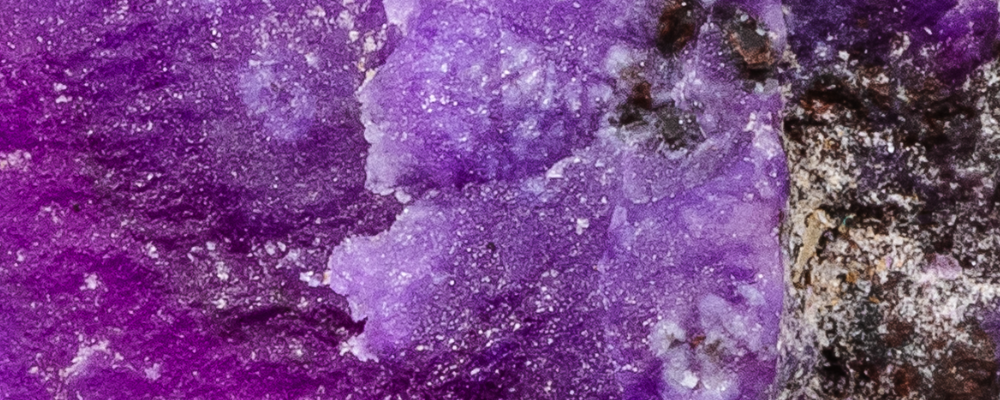
In the late 1970s, the Wessels manganese mine in South Africa yielded aggregates ranging from intense violet to magenta. Manganese produces this color, which has become emblematic. Polished pieces may combine Sugilite, dark matrix, and other manganese-bearing minerals.
The Gemological Institute of America describes this material as a polycrystalline aggregate and links its violet color to its manganese content. The contrast between the Japanese discovery and the South African revelation gives the stone its first magical domain: recognizing a value that remained without public recognition for a long time.
The Circle Inscribed in Matter
Sugilite belongs to the cyclosilicates. Within its structure, silicon and oxygen tetrahedra are arranged in rings. This architecture gives the circle a fitting place in ritual work: enclosure, continuity, and authority exercised around a center.
The circle is not used to isolate oneself from the world. It defines the boundary from which a person can act, welcome, or refuse. Associated with violet, it becomes a sign of inner governance: choosing what enters one’s domain and taking responsibility for what leaves it.
Jupiter and the Power of Violet
In Western correspondences, purple belongs to Jupiter and Thursday. George Frederick Kunz recalls this in The Curious Lore of Precious Stones, published in 1913: purple there expresses measured judgment, gravity, and elevation of thought.
Jupiter brings expansion, dignity, justice, and the ability to guide without crushing. Air carries counsel and broad vision; Earth responds to mineral mass, endurance, and lasting construction. The number four, linked to stability and the Jovian sphere in Hermetic Qabalah, forms its ritual framework.
Authority, protection, and expansion
Sugilite suits projects that must leave a confidential phase and take a recognized place. It supports requests for authorization, legal proceedings, new responsibilities, the defense of a reputation, and decisions in which generosity must remain bounded.
Its protection rests on sovereignty: defining your domain, choosing your rules, and ceasing to negotiate what should no longer be negotiated. It also supports the growth of an already solid undertaking, especially when that expansion calls for broader language, an alliance, or institutional support.
Jupiter’s purple square
On a Thursday, draw a square and write one sentence on each of its sides: what you govern, what you protect, what you develop, and what you share. Place the Sugilite at the center.
Read the four sentences clockwise. Correct the one that promises more than your current means, then say: “I expand my domain without losing its law.” Within four days, take an action that gives the intention a public form: a request, appointment, filing, announcement, or written agreement.
Correspondences and markers
| Marker | Correspondence |
|---|---|
| Nature | Complex cyclosilicate; purple aggregates rich in manganese |
| Historical markers | Discovered in 1944; name published in 1976; purple material circulated thereafter |
| Planet | Jupiter |
| Elements | Air and Earth |
| Day | Thursday |
| Number | Four |
| Domains | Authority, justice, protection, recognition, expansion, and reputation |
| Symbols | Circle, square, seal, and purple mantle |
| Ritual gesture | Define the domain to govern, protect, develop, and share |