


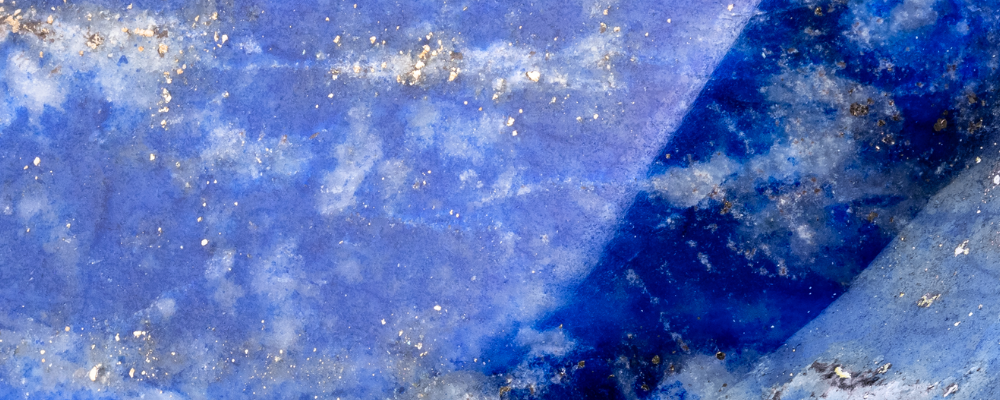
Lapis lazuli bears a midnight blue crossed by white calcite and pyrite flecks. Long before modern correspondences, this rock crossed mountains and kingdoms: it was carved into beads, seals, and inlays, then ground to produce the ultramarine used by painters.
In Mesopotamia, its resemblance to a starry sky may have brought it closer to the divine. This memory provides a solid historical basis for its symbolic language. Jupiter gives it sovereignty and the power of speech that brings people together, Saturn commitment, Air thought, and Earth the enduring substance of the work.
To place this stone among related minerals, compare it with Sapphire, Sodalite, and Purpurite.
The rock of royal blue
Lapis lazuli is not an isolated mineral species, but a rock composed of several minerals. Its color ranges from azure blue to violet-blue. White areas and metallic flecks may appear throughout its mass.
The name combines the Latin lapis, “stone,” with a family of words that passed through Persian and Arabic to designate blue. The material and the color thus traveled together into the French word “azur.”
Lazurite, calcite, and pyrite
The Gemological Institute of America description presents lapis lazuli as an aggregate dominated by lazurite, with calcite and pyrite. Lazurite provides the blue, calcite the light areas, and pyrite the golden flecks.
These variations are not absolute flaws: they tell the story of the rock. A uniform blue creates a solemn impression; a veined material more closely resembles a sky crossed by clouds and stars.
From the mines to the palaces
As early as the 4th millennium BCE, Badakhshan lapis lazuli, in present-day Afghanistan, circulated toward Mesopotamia. The Metropolitan Museum of Art attests to this long-distance trade.
At Ur, blue was worn with gold and carnelian. The British Museum notes its association with the divine, reinforced by its resemblance to a starry night sky. Here, the celestial idea is grounded in an identified cultural context.
Later, ground lapis lazuli produced natural ultramarine. A GIA study on pigments derived from gemstones traces the value of this blue in painting, particularly from the 15th century onward.
Blue becomes authority when it commits words. Seal, pigment, and adornment have given Lapis lazuli a history of representation. Its magic does not consist in domination, but in making rank, word, and action answer to one another.
Jupiter, Saturn, Air, and Earth
Jupiter corresponds to royalty, breadth of vision, and public speech. Saturn safeguards the oath, law, and duration. Air governs language; Earth gives discourse a material trace.
Thursday suits transmission and Saturday commitment. Midnight blue, gold, and white make up its palette. A seal, tablet, quill, or seven golden dots may accompany its rites.
Words, authority, and vision
Lapis lazuli accompanies speeches, study, group leadership, and decisions that must be explained. It invites you to use authority as a responsibility: whoever speaks on behalf of a project is also accountable for its consequences.
It is suitable for divination when the question concerns the general meaning of a situation. Its Pyrite nevertheless brings the vision back to matter: what fact, date, or commitment will make the interpretation verifiable?
The seal of the blue sky
On a Thursday, write in seven words the commitment that should guide your words. Draw a blue rectangle around it, then mark a golden dot at each corner and at the center of the three remaining sides.
Place the Lapis lazuli in the center and say: “May my words see far, may they remain tied to action.” Sign only if the commitment truly depends on you. Keep the sheet until its fulfillment or explicit revision.
Correspondences and references
| Reference | Correspondence |
|---|---|
| Nature | Rock dominated by Lazurite |
| Components | Lazurite, Calcite, Pyrite, and associated minerals |
| Celestial bodies | Jupiter and Saturn |
| Elements | Air and Earth |
| Days | Thursday and Saturday |
| Domains | Words, authority, vision, study, oath |
| Associated objects | Seal, tablet, quill, golden dots |
| Gesture | Link words to a verifiable commitment |