





















































































































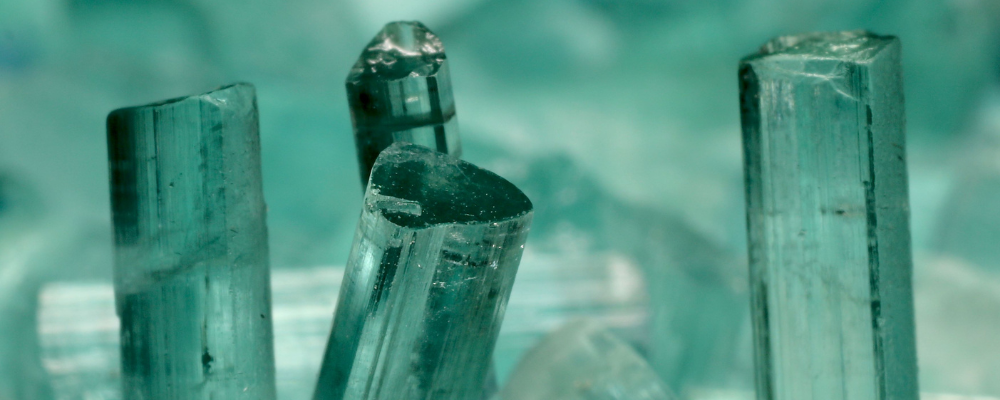
Electric blue, lagoon green, or luminous turquoise, Paraíba seems to hold light beneath its surface. This copper-bearing tourmaline belongs to the recent history of gemstones, but its copper, color, and brilliance offer a coherent ritual language for visibility, communication, attraction, and new opportunities.
The name appeared after the Brazilian discoveries of the late 1980s, then extended to copper-bearing tourmalines from Nigeria and Mozambique. Its correspondences therefore do not come from an ancient lapidary tradition. They associate a precise material fact—copper—with the grammar of Venus, then connect the blue color and lively brilliance to Water, Air, and Mercury.
To place this stone among related minerals, compare it with Tourmaline, Black Tourmaline, and Rose Tourmaline.
Tourmaline Illuminated by Copper
Paraíba belongs to the Tourmaline group. Most of the stones analyzed are Elbaite, although the GIA has also identified a copper-bearing Liddicoatite. Copper plays a major role in the saturated blues and greens that have made this category renowned.
This vivid color gives the stone an immediate presence. In ritual work, it suits requests that need to be seen, heard, or recognized: presenting a creation, finding its audience, opening a conversation, or bringing a previously discreet possibility to light.
A history born at the end of the 20th century
The first copper-bearing tourmalines to become famous on the market were discovered in the Brazilian state of Paraíba in the late 1980s. Comparable material was later found in Africa. The word “Paraíba” now designates a gemological and commercial category, not a distinct mineral species.
A study by the Gemological Institute of America compares the chemical signatures of Brazil, Nigeria, and Mozambique. Exact origin requires laboratory analysis; a bright hue alone is not enough to identify a mine.
Copper under the sign of Venus
In Western planetary magic, copper belongs to Venus. The British Museum preserves a talisman bearing the magic square of Venus, described as a copper kamea. This ancient correspondence concerns the metal; its application to Paraíba is a contemporary extension based on the element that produces its color.
Venus brings attraction, harmony, beauty, and value. Paraíba can therefore accompany a work being presented, a relationship one wishes to make more fluid, or a project whose radiance must meet the right gaze.
A modern stone, an ancient grammar. Paraiba has no separate historical cult. Its Venusian correspondence comes from copper; its other uses derive from the blue and green light that shaped its contemporary identity.
Mercury, Water, and luminous speech
Mercury is suited to speed, exchange, and messages that need to circulate. Air carries speech; Water gives blue-green its capacity for receptiveness and adaptability. This alliance makes Paraiba a lively communication stone, less oriented toward silence than toward clear and attractive expression.
Friday emphasizes harmony, beauty, and value. Wednesday is suitable for démarches, presentations, and announcements. A blue-green cloth, a piece of copper held away from the stone, and a white candle make up a simple altar.
Visibility, attraction, and a new opportunity
For visibility, place the Paraiba near a text, photograph, or creation ready to be shown. Name the audience you seek to reach and the right impression you wish to leave. The request gains strength when it corresponds to a real act of dissemination.
For a conversation, write the sentence that must be understood, then remove everything that seeks to dazzle at the expense of meaning. For attraction, consecrate the stone to a reciprocal encounter, a suitable clientele, or a favorable proposal, never to coercion.
The blue-green signal
On a Wednesday or Friday, place the Paraiba on a white sheet of paper. Draw a blue-green circle around it, then write outside the circle the name of the project that should gain visibility. Inside, write in one sentence what the project genuinely offers.
Light a white candle at a distance and say: “May the radiance reveal value without distorting it.” Send, publish, or present the project before extinguishing the flame. Then keep the stone near the medium used until the first response.
Correspondences and references
| Reference | Correspondence |
|---|---|
| Nature | Copper-bearing Tourmaline, mainly Elbaite |
| History | Category that emerged in the late 1980s |
| Suggested planets | Venus through copper; Mercury through exchange |
| Suggested elements | Water and Air |
| Days | Friday and Wednesday |
| Areas | Visibility, attraction, value, communication, and opportunities |
| Colors | Electric blue, turquoise, and luminous green |
| Ritual gesture | Reveal value, then present it to the right audience |