


A stone of protection and grounding in contemporary magic, black Tourmaline is worn to keep hostile influences at a distance, strengthen boundaries, and remain calm in a charged place. Yet this reputation does not tell its whole story: occult authors of the early 20th century also connected it with Mercury, eloquence, knowledge, and strength of mind.
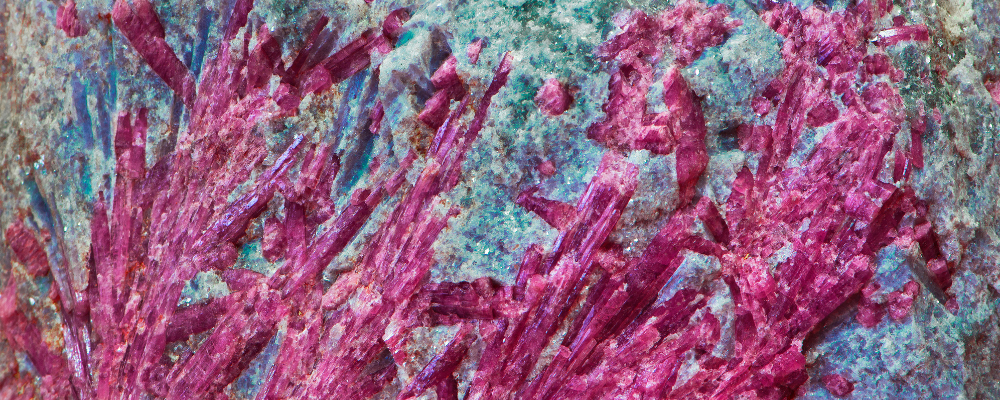
The name Tourmaline refers to an entire family of stones. Black Schorl, pink Rubellite, blue Indicolite, and green or multicolored Tourmalines therefore do not receive exactly the same uses. Their most evocative common feature remains their polarity: when exposed to a change in temperature, the crystal attracts and then repels small particles. This real property provided a powerful image for stone magic, between attraction, defense, and bringing things into order.

To place this stone among related minerals, compare it with Black Tourmaline, Rose Tourmaline, and Green Tourmaline.
A Family of Polar Stones
Tourmaline forms a large group of borosilicates. Schorl, rich in Iron, produces the black Tourmaline sold for protection; Elbaite comes in a wide range of pinks, greens, and blues. All have a hardness of around 7 to 7.5 and striated crystals that are easy to recognize.
Its most distinctive property is pyroelectricity. A change in temperature causes opposite charges to appear at the two ends of the crystal. Tourmaline can then attract dust, ash, or small fragments of paper, and later repel them. This physical phenomenon does not establish a supernatural power, but it explains why this stone lent itself so well to the magical language of attraction and defense.
The Stone That Attracts Ash
At the beginning of the 18th century, Tourmalines from Ceylon arrived in Dutch workshops. Lapidaries noticed that heated crystals attracted light ashes and named them Aschentrekker, “ash puller.” Linné would later call it an “electric stone.”
In The Magic of Jewels and Charms, published in 1915, George Frederick Kunz recounts this discovery, the experiments conducted in the 18th century, and Benjamin Franklin’s Tourmaline ring. He sees in the stone’s color, poles, and capacity for attraction the qualities of a true talismanic gem.
A magical story in two stages. Early 20th-century texts associate Tourmaline with knowledge, eloquence, forces of attraction, and the idea of a talisman. The specific use of black Schorl for grounding, protection, and sending back unwanted influences belongs chiefly to contemporary stone magic. This distinction makes it possible to preserve its true uses without inventing an ancient origin for them.
Mercury, Eloquence, and Knowledge
In 1922, Isidore Kozminsky devoted a chapter of The Magic and Science of Jewels and Stones to tourmaline. He compares its two poles to the serpents of Hermes’s caduceus, one receiving knowledge and the other transmitting it. He presents it as a stone of wisdom, mental strength, eloquence, study, and success gained through knowledge.
Kozminsky places the tourmaline family under Mercury and the sign of Gemini. He assigns it to authors, poets, editors, and teachers. These correspondences suit workings involving speech, writing, learning, negotiation, and transmission. They give tourmaline an identity far richer than the simple idea of absorbing a negative atmosphere.
Black Tourmaline in Protection
In manuals of stone magic circulated from the late 20th century onward, black schorl became a reference for protection. Scott Cunningham’s work, Cunningham’s Encyclopedia of Crystal, Gem & Metal Magic, published in 1988, is among the texts that established this modern reception. The black color associates the stone with Earth, boundaries, banishing, and stability; its attraction and repulsion suggest matter that captures what disturbs and then keeps it at a distance.
Black tourmaline may be worn, placed near the front door, or arranged at the boundaries of a ritual space. It supports defensive work, breaking with a burdensome influence, and returning to calm after a difficult encounter. Its role is that of a consecrated support: intention, prayer, and ritual give it a specific function.
For household protection, place a piece of schorl inside the entrance, facing the door. After physically cleansing the stone, pass it through the smoke of frankincense or benzoin and name what must not cross the threshold. Repeat the consecration when the function of the place changes or after an event perceived as hostile.
Colors and Their Domains
Contemporary magic distinguishes tourmalines by their color. Black tourmaline is used for protection, banishing, and reinforcing boundaries. Pink tourmaline, or rubellite, supports love, reconciliation, and the soothing of relationships. Green tourmaline supports growth, prosperity, and ventures that require development. Blue tourmaline, or indicolite, is associated with speech, expression, and study, in keeping with the Mercurial attribution given by Kozminsky.
Multicolored crystals, including “watermelon” Tourmaline, combine several colors in a single stone. Kunz had already proposed red, white, and green Tourmaline as a “stone of peace,” with each zone remaining distinct while forming a single crystal. It is therefore suited to work involving agreement, conciliation, and unity without erasing differences.
How to work with Tourmaline
For defense, keep a black Tourmaline with a protective sachet, a pentacle, or a written prayer. Place it between you and the source of pressure when it can be identified. In a circle, four pieces arranged at the cardinal points mark a clear boundary.
For eloquence and study, choose a blue, green, or black Tourmaline and place it on your desk. Consecrate it on a Wednesday, Mercury’s day, to support clarity of expression, working memory, and the transmission of knowledge. Before speaking publicly, hold it for a few moments and recite your text or intention aloud.
For reconciliation work, a bicolor Tourmaline can be placed between two separately written names. Draw a circle around them without overlapping them, then state the desired peace, the boundaries that should remain in place, and the common ground to preserve.
Correspondences and references
| Reference | Correspondence |
|---|---|
| Nature | Borosilicate family; Schorl for Black Tourmaline |
| Planet | Mercury according to Isidore Kozminsky; Saturn appears in modern correspondences for black Schorl |
| Sign | Gemini according to Isidore Kozminsky |
| Element | Earth for Black Tourmaline in contemporary magic |
| Day | Wednesday for eloquence, study, and transmission; Saturday for boundaries and defense |
| Areas | Protection, grounding, banishing, eloquence, knowledge, study, peace, and conciliation |
| Colors | Black for protection; pink for connection; green for growth; blue for speech |
| Ritual action | Wear it, keep it at the threshold, place it at the boundaries of the circle, or pair it with a written request |