






















































































































Black Tourmaline is one of the great protective stones of contemporary magic. Its color absorbs the gaze, its upright prisms create a boundary, and its measurable polarity offers a remarkable image: attracting on one side, repelling on the other, then returning each force to its proper place.
Known by its mineralogical name, Schorl, in most cases, it is assigned to Saturn and Earth. It is placed at doorways, in the four directions, or near oneself to maintain a boundary, bring attention back to reality, and hold a space.

To place this stone among related minerals, compare it with Tourmaline, Rose Tourmaline, and Green Tourmaline.
Schorl, Iron-Rich Tourmaline
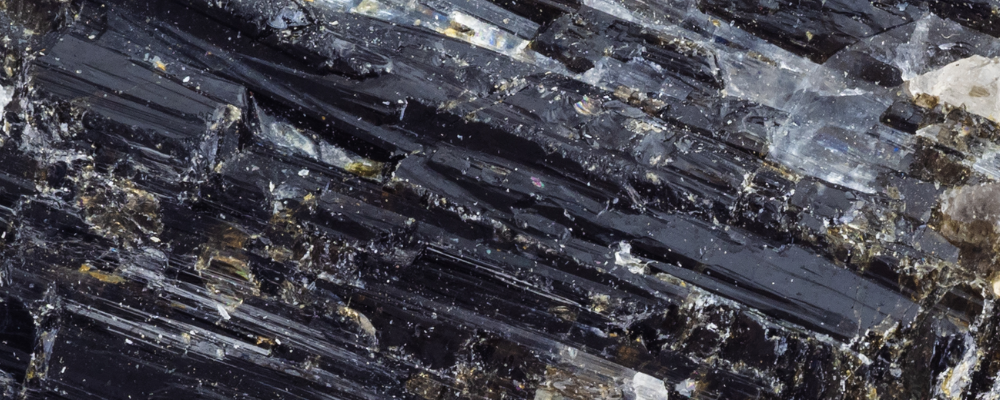
Black Tourmaline primarily refers to Schorl, an iron-rich species of the Tourmaline supergroup. Its black crystals form prisms marked by long striations. Their rounded triangular cross-section and asymmetrical terminations reveal a polar structure.
The Handbook of Mineralogy gives it a hardness of 7 to 7.5. It occurs in granite, pegmatites, and certain metamorphic rocks. A prism can remain brittle despite this good resistance to scratching.
The Electric Stone That Attracts Ash
In the 17th and 18th centuries, Tourmalines from Ceylon reached Europe through Dutch trade. Cutters observed that stones heated by the Sun attracted ashes, straw, and light dust. They called them aschentrekker, “ash puller.”
Isidore Kozminsky tells this story in The Magic and Science of Jewels and Stones, published in 1922. Heat creates opposite charges at the ends of the crystal: this is pyroelectricity. The GIA also notes its electrical polarity.
From Polarity to Protection
Kozminsky sees an alchemical image in Tourmaline’s attraction and repulsion. He places the family under Gemini, the dual sign. For him, the stone has not yet acquired the grand protective language that late-20th-century magic would give it.
In 1988, Scott Cunningham assigns Schorl to Saturn and Earth. He dedicates it to grounding, representing the Earth element, and ritually absorbing hostile influences.
A boundary has two sides. Tourmaline attracts light particles and has two electrical poles. In ritual, it is not used only to repel: it helps choose what we welcome and what we keep outside the circle.
Saturn, Earth, and Gemini
Saturn governs boundaries, duration, discipline, and closure. Earth brings us back to the body, the place, and verifiable actions. Gemini, according to Kozminsky, preserves the memory of the two poles and opposing movements.
Saturday is suitable for lasting protection, boundaries, and banishing. A lighter working of balance or speech can be done on Wednesday under Mercury, ruler of Gemini.
Protection, Grounding, and Boundaries
Place a Black Tourmaline near the door to mark the passage between public space and guarded space. It reminds us that every entry implies a rule: respect, consent, and tranquility of the place.
Worn on the body, it accompanies charged environments, conflicts, and periods of scattered attention. Its grounding consists of returning to the facts, the breath, and possible action, without indefinitely absorbing other people’s problems.
In banishing work, pair it with a written boundary and the measure that makes it real: blocking a contact, closing access, revoking authorization, or leaving a space.
The Four Guardians of the Threshold
On a Saturday, arrange four Black Tourmalines around a white candle, each facing one direction. Place the name of the place to be protected beneath the candle. At each point, name one quality being safeguarded: peace, integrity, rest, and respect.
Say: “What comes in peace finds passage; what comes to harm remains outside the threshold.” Leave the stones at the four corners of the room or gather them near the entrance. Renew the words whenever the rules of the place change.
Correspondences and references
| Reference | Correspondence |
|---|---|
| Nature | Schorl in most cases, iron-rich tourmaline |
| Hardness | 7 to 7.5 on the Mohs scale |
| Planet | Saturn according to Scott Cunningham |
| Sign | Gemini for the family according to Isidore Kozminsky |
| Element | Earth |
| Day | Saturday |
| Areas | Protection, grounding, banishing, boundaries, and stability |
| Ritual action | Place at thresholds or in the four directions |