















































































































































































































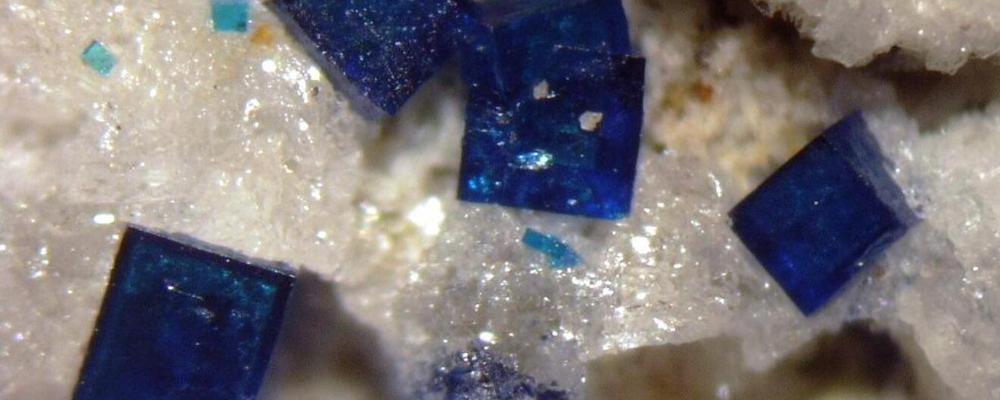
Boleite encloses an intense blue within a remarkably precise cubic form. Its structure brings together copper, silver, lead, chlorine, and potassium in a tightly ordered arrangement, like a chamber built around a force that must remain contained.
Described at the end of the 19th century in the El Boleo mining district, it is not associated with an ancient magical tradition under this name. Its geometry and metals nevertheless allow for a coherent contemporary interpretation: Saturn establishes the enclosure, Venus receives the copper and blue, the Moon the silver, Earth provides support, and Water concentrates.
To place this stone among related minerals, compare it with Copper, Bronze, and Malachite.
A blue cube rich in metals
Boleite is a complex potassium, lead, silver, and copper hydroxychloride. The Handbook of Mineralogy describes it as belonging to the cubic system, with a Prussian blue to indigo color, a vitreous to pearly luster, and a hardness of 3 to 3.5.
Its well-formed crystals attract collectors with their color and geometry. Their small size does not diminish their presence: each face makes the boundary immediately legible.
A complex crystalline enclosure
The Mindat entry gives the formula KPb26Ag9Cu24(OH)48Cl62. Boleite is closely related to Pseudoboleite and Cumengéite, which may grow alongside it.
This relationship calls for careful identification. An apparent cube may conceal a more complex architecture than its silhouette reveals, a fruitful idea for its symbolic use.
The El Boleo district
Boleite owes its name to the El Boleo district, near Santa Rosalía in Baja California Sur, Mexico. It was studied in 1891 in the context of the region’s rich copper mineralization.
The type locality entry places it alongside Pseudoboleite, Gypsum, Cumengéite, Anglesite, and Atacamite. Its formation is linked to a mining, saline, and metallic environment.
A good boundary does not suffocate what it protects. It defines a chamber, regulates passage, and gives each authority a recognizable place.
Saturn, Venus, Moon, and Earth
Saturn governs the cube, the enclosure, and prohibition. Venus receives copper and deep blue; the Moon, silver and preserved content. Earth provides stability, while Water corresponds to the concentration of blue.
Saturday is suitable for closing access, Friday for protecting a connection, and Monday for guarding private content. A cube drawn in blue and black is sufficient as a support.
Boundary, guardianship, and access
Boleite accompanies the definition of a private space, a role, restricted information, or a shared resource. It invites you to decide what enters, what leaves, and who holds the key.
It is also suitable for relationships in which protection risks becoming confinement. Three distinct enclosures make it possible to separate the private, shared, and public spheres.
The Rite of the Three Enclosures
Use a photograph. Draw three nested squares. Write in the center what must remain private, in the second what may be shared conditionally, and in the third what may become public. Write an access rule along each edge.
Say: “I close what must be closed, I open what may be opened, and I maintain the proper balance between the two.” Apply a rule as soon as the rite ends.
Correspondences and markers
| Marker | Correspondence |
|---|---|
| Nature | Lead hydroxychloride, copper, silver, and potassium |
| Celestial bodies | Saturn, Venus, and Moon |
| Elements | Earth and Water |
| Days | Saturday, Friday, and Monday |
| Ritual colors | Prussian blue, indigo, black |
| Domains | Boundary, guardianship, access, privacy |
| Support | Photograph and nested squares |
| Gesture | Define three levels of access |










