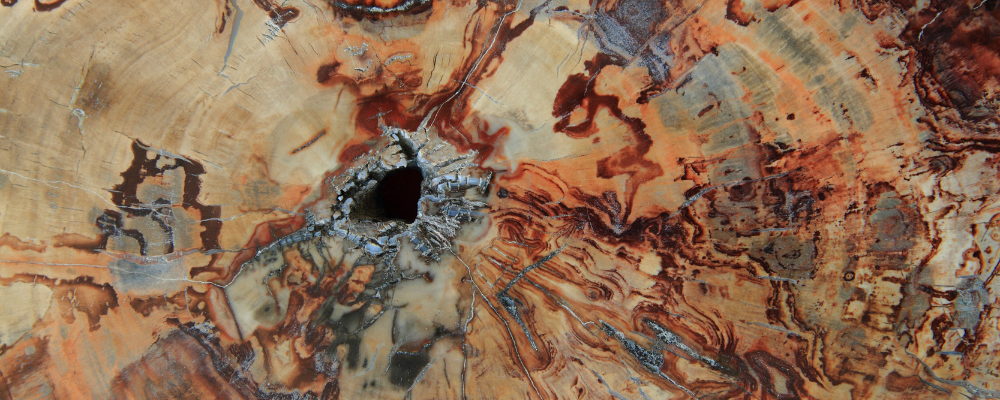
Petrified Wood retains the shape of a tree even though its material has become stone. Growth rings, fibers, and bark remain visible, but silica has taken the place of the plant tissue. It shows that memory does not always preserve substance: it can preserve architecture.
This transformation naturally invites reflection on deep time, lineages, and rootedness. It also has a concrete human history: Petrified Wood served as a tool, a building material, and a shaped object.
To place this stone among related minerals, compare it with Amber, Jet Black, and Ammolite.
When Wood Becomes Silica
Petrified Wood forms when wood is rapidly buried in a low-oxygen environment. Mineral-rich water circulates through its cells; silica is deposited, replaces the organic matter, and reproduces the details of the tissue.
The National Park Service defines a fossil as the trace or remains of ancient life. Its page devoted to Petrified Wood from Petrified Forest explains the action of silica and the origin of the colors caused by iron, manganese, and other elements.
The Form Preserved by Time
Petrification does not instantly transform a fresh branch into stone. It results from a combination of geological conditions and immense spans of time. The visible growth rings are not an added design: they belonged to the tree and were reproduced in silica.
This continuity grounds its magical language. The body changes, form conveys a history, and the seasons remain legible. Stone becomes a medium suited to the legacies we want to understand without repeating them identically.
Stone-Wood Tools and Houses
The ancient populations of the Petrified Forest region shaped this material into points, knives, and scrapers. The National Park Service presents these tools. At Agate House, ancestral Pueblo communities also used fragments of Petrified Wood as a building material.
These uses attest to a genuine human relationship, but they do not provide a complete magical system. Current work on the house, tool, and lineage draws on observed functions without attributing rites that were not transmitted to the peoples concerned.
Saturn, the Sun, and Earth
Saturn governs time, generations, preservation, and stone. The Sun corresponds to the living tree, growth rings, and annual growth. Earth connects the two states. Saturday suits ancestors and foundations; Sunday suits what should be passed on alive.
A piece of wood, a family photograph, a key, or a house plan may accompany the stone. It requires neither burial nor contact with a living plant.
Ancestors, home, and transmission
Petrified Wood accompanies lasting installations, inheritances, family memory, and projects built to endure. It helps you ask what should be preserved, transformed, or ended within a lineage.
Near an entrance, it marks the continuity of the home. On an ancestors’ altar, it represents time without claiming to speak for the dead. On a desk, it supports long-term work whose result may outlast its original author.
The Rite of Passed-Down Growth Rings
On a Saturday, draw three concentric circles. In the first, write what you have received; in the second, what you are transforming; in the third, what you will pass on. Place the Petrified Wood in the center.
Say: “The form remains, the matter changes; I choose what passes through me.” Enclose a concrete action: preserving a story, repairing an object, changing a habit, or preparing a document. Give it a date before putting the stone away.
Correspondences and references
| Reference | Correspondence |
|---|---|
| Nature | Petrified wood whose structure has been replaced by minerals |
| Documented uses | Shaped tools and building material |
| Image | A form preserved through a transformation of matter |
| Planets | Saturn and the Sun |
| Element | Earth |
| Days | Saturday and Sunday |
| Areas | Lineage, home, transmission, duration, and long-term work |
| Ritual act | Naming what is received, transformed, and passed on |