





















































































































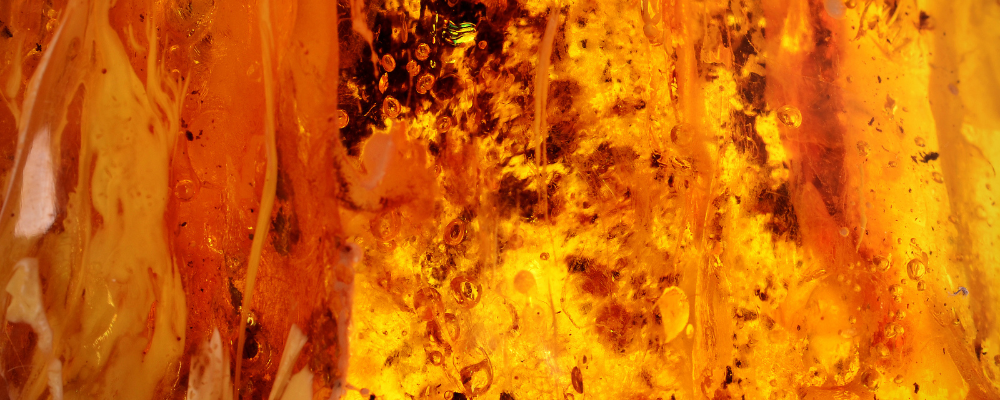
Amber is not a stone, but ancient plant resin that became fossilized material. Warm in the hand, light, golden, and capable of attracting small fragments after being rubbed, it acquired a very ancient magical language: preserved life, sunlight, protection, and attraction.
Its inclusions seem to hold on to a vanished moment. Its electrical properties gave the Greek elektron an unexpected legacy. Between memory, the Sun, and the power to attract, Amber brings together a material and talismanic history of rare coherence.

To place this stone among related minerals, compare it with Jet Black, Ammolite, and Fossilized Wood.
A Resin Turned Fossil
Amber comes from resin produced by ancient trees, then buried and transformed over time. It therefore has neither a crystalline structure nor a fixed mineral composition. Its hardness of 2 to 2.5 explains its softness to the touch and the ease with which it takes a polished shape.
The Gemological Institute of America presents it as a fossilized organic material capable of preserving insects, leaves, flowers, and other traces of vanished ecosystems. Not all inclusions are ancient: laboratory examination distinguishes natural Amber from recent resins, pressed pieces, and imitations.
Elektron, the Material That Attracts
The Greeks called Amber elektron. After being rubbed with wool or cloth, it becomes statically charged and attracts strands of straw, fibers, or small pieces of paper. The modern vocabulary of electricity comes from this observation.
In the 1st century, Pliny the Elder describes its plant origin and attractive power in book 37 of his Natural History. This real phenomenon provided a direct model for sympathetic magic: what attracts materially can represent the ability to attract a person, a favor, or an opportunity.
The Heliades’ Solar Tears
The Greek story connects Amber with Phaethon, son of the Sun, who loses control of his father’s chariot. Zeus strikes him with lightning to save the Earth. His sisters, the Heliades, mourn his death and become poplar trees; their tears harden into Amber on the banks of the Eridanus.
Ovid elaborates on this metamorphosis, later taken up by Pliny. The myth unites the Sun, trees, a river, and a substance born of tears. It thus transforms Amber into luminous memory: grief preserved without remaining sterile.
Attract and preserve. Amber brings together two actions. Its electrical charge attracts lightweight materials; its resin preserves ancient forms. In ritual, it therefore serves to call in what one wishes to welcome and to preserve the memory of what deserves to endure.
Sun, Fire, and living memory
In The Magic and Science of Jewels and Stones, published in 1922, Isidore Kozminsky compiles its uses for protection against the evil eye and hostile workings. In 1988, Scott Cunningham assigns it the Sun, Fire, and Akasha, the principle that connects matter with life.
The Sun suits radiance, confidence, and visible success. Fire carries vitality and defense. Amber’s plant origin adds memory, cycles, and continuity between life and fossilized matter. Sunday is its most natural day.
Protection, beauty, and attraction
Worn around the neck or placed near the entrance, Amber takes on a protective role. Ancient texts attributed medical virtues to it that should not be repeated as treatments. In current practice, it remains a consecrated symbol of safety and strength.
For attraction, gently rub an intact piece with a wool cloth, then name the desired quality: loyal friendship, respectful clientele, trust, or freely given affection. The physical gesture anchors the request without seeking to dominate a person.
Amber also accompanies mourning and family memory. Place it near a name, photograph, or passed-down account. Its purpose is not to hold on to the dead, but to preserve a living trace and pay tribute.
The Solar Amber Circle
On a Sunday morning, place a piece of Amber in front of a yellow candle. Draw a circle around it with a golden cord. Write in the center the name of what you wish to protect or attract, then rub the stone for a few moments with wool.
Say: “What comes through accord finds its way; what seeks to harm encounters the light.” Tie the cord around the paper and keep the stone on it for a seven-day solar cycle. Do not burn Amber or place it against a flame.
Correspondences and references
| Reference | Correspondence |
|---|---|
| Nature | Fossilized plant resin, organic material |
| Hardness | 2 to 2.5 on the Mohs scale |
| Planet | Sun in modern magic |
| Elements | Fire and Akasha according to Scott Cunningham |
| Day | Sunday |
| Areas | Protection, attraction, beauty, memory, success, and vitality |
| Ritual image | The light that attracts and the resin that preserves |
| Ritual act | Rub with wool, then name what should come or endure |