























































































































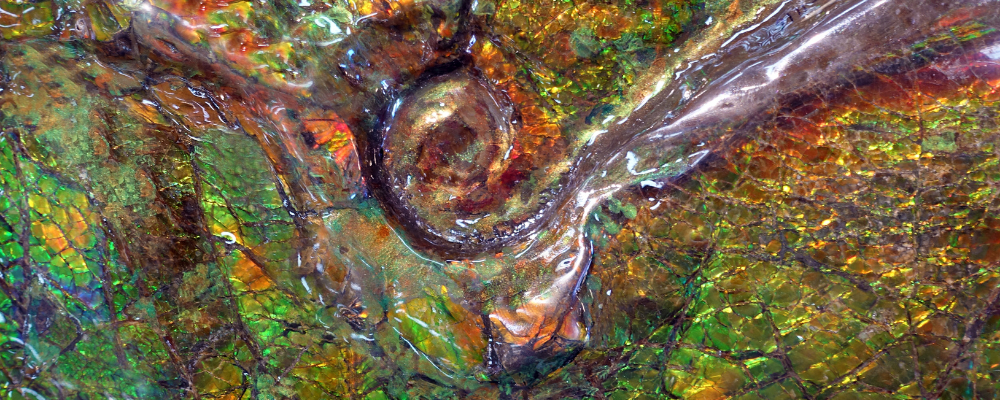
Ammolite is the light of a vanished sea. It comes from the fossilized shell of Cretaceous ammonites, whose layers of Aragonite reflect red, green, blue, and gold. Its spiral brings together memory, transformation, and the return of resources.
In southern Alberta, Blackfoot peoples know ammonite fossils as Iniskim, the bison stone. These stones served as talismans associated with the return of the herds and subsistence. Commercial Ammolite is recent, but the territory from which it comes therefore has a ritual relationship that predates the gemstone market by a long time.
To place this stone among related minerals, compare it with Amber, Jet Black, and Fossilized Wood.
A Fossil Shell Turned Gemstone
Ammolite is a gemstone material derived from fossilized ammonite shells. A GIA study devoted to optical effects describes a structure composed mainly of Aragonite, with small amounts of Calcite, Pyrite, Siderite, and Apatite.
Its colors do not come from pigments. Light interferes with thin plates inherited from nacre. Red and green appear more easily; blue requires a better-preserved structure. The material thus bears the form of the ancient shell and a light born of its organization.
The Inland Sea and Alberta
Ammonites lived in the inland sea that covered part of North America during the Cretaceous. Their shells were buried in the sediments of the Bearpaw Formation. The University of Alberta traces this formation and the long process that preserved the iridescent Aragonite.
Gemstone mining developed in the 20th century. Alberta chose Ammolite as its official gemstone in 2022. This modern status recognizes a material linked to the province’s geology and cultural history.
Iniskim, the bison stone
The Galt Museum in Lethbridge reports that the Blackfoot have long known ammonites called Iniskim, “bison stone.” Their shape evokes a resting or coiled bison, and they were kept as talismans to call the herds and support subsistence.
This relationship concerns bison stones within their own cultural context. Contemporary Ammolite magic may draw on themes of returning resources, gratitude, and continuity, without turning a living tradition into interchangeable decoration.
The spiral returns without repeating the same circle. Ammolite preserves the memory of a vanished living being, but its color did not exist in this form in the ancient sea. Transmission preserves an origin while producing a new expression.
Saturn, Moon, Earth, and Water
Saturn governs long time, the fossil, heritage, and responsibility toward what will be passed on. The Moon corresponds to the shell, mother-of-pearl, cycles, and sustenance. Water recalls the ancient sea; Earth bears burial and preservation.
Saturday suits ancestors, lasting commitments, and heritage. Monday supports the home, family memory, and resources that return in cycles. A spiral, a bowl of water placed at a distance, and a lineage photograph extend these connections.
Memory, resources, and transmission
For ancestral work, place the Ammolite near a name, photograph, or received object. Ask less for a sign than for a quality to continue through a present act.
For resources, write down what returns in cycles: income, harvests, orders, or support. Then note what must be protected before the next passage. The spiral reminds us that a resource circulates and requires a reserve.
For a transformation, distinguish what deserves to be preserved from the form that has become too narrow. The shell remains recognizable, but its material has changed function.
The spiral received and passed on
On a Saturday, draw a spiral from the outside toward the center. Along the way, write three things received from your lineage, your profession, or your land. Place the Ammolite at the center.
Start again from the center toward the outside and write what you will pass on in turn. Say: “I keep the source, I transform the form, I keep the resource alive.” Within the month, carry out an act related to the last word.
Correspondences and reference points
| Reference point | Correspondence |
|---|---|
| Nature | Fossil ammonite shell, composed mainly of Aragonite |
| Major origin | Bearpaw Formation, southern Alberta |
| Local tradition | Iniskim, bison stone of the Blackfoot |
| Modern planets | Saturn and Moon |
| Elements | Earth and Water |
| Days | Saturday and Monday |
| Areas | Memory, resources, cycles, heritage, and transmission |
| Ritual gesture | Naming what was received and what will be passed on |